
Oct. 7, 2023, forever changed Israel. The Jewish state is more somber, more defiant, and more determined to persevere in its decadeslong fight to secure its existence. But as Israel looks ahead, it confronts a question that has plagued the tiny country since its rebirth nearly eight decades ago.
Israel is a nation unlike any other. It is a country of contradictions, where thousands of tech startups solving the problems of tomorrow exist mere miles from holy sites that inspired visionaries and prophets millennia ago.
Israel is unique in another respect: The Jewish state has existed in a state of permanent siege even before it was recreated in 1948. From the beginning, Israel’s borders were disputed and perennially redrawn by war. In part, this stems from the unusual circumstances of its birth.
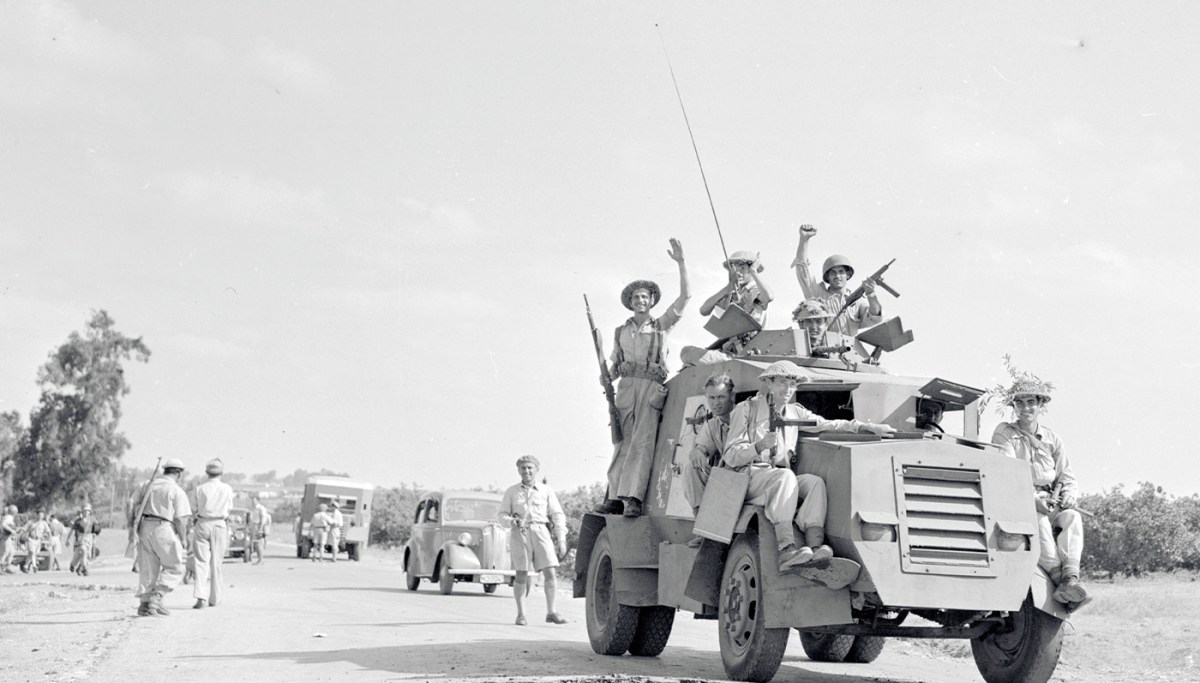
 Israeli troops enter the Arab city of Ramleh during Israel’s War of Independence, July 25, 1948. (Bettmann/Getty Images)
World War I shattered empires throughout the world, including the Ottoman Empire, which had ruled, if haphazardly, over much of the Middle East for centuries. In the last year of the war, the British issued the Balfour Declaration, which called for a “national home for the Jewish people” in the Ottoman region often referred to as “Palestine” or “Southern Syria.” The 1920 San Remo Agreement and the 1924 Anglo-American Convention also enshrined Jewish claims into territorial law.
British promises were vague. “Nothing shall be done,” Foreign Secretary Arthur Balfour pledged, “which may prejudice the civil and religious rights of existing non-Jewish communities in Palestine.” This may have sounded good in theory, but it proved to be impossible in practice.
But one thing was soon clear: Many Arab leaders living in the British-ruled Mandate Palestine were unwilling to accept Jewish political and social equality in any form.
Jews had a continuous presence in the land, which predated the Arab and Islamic conquests of the seventh and eighth centuries. But in recent centuries, they had been treated as second-class citizens and subjected to the whims of the Muslim majority. Their sudden change in political fortunes and power was bound to stir outrage from the majority, and it did.
On April 4, 1920, a violent riot erupted during the Nebi Musa festival in Jerusalem. Five Jews were murdered, and hundreds more were injured by Arab demonstrators who shouted, “The Jews are our dogs.”
Before the riot, anonymous Arabic-language flyers were circulated promising “the government is with us, kill the Jews; there is no punishment for killing Jews.” This wasn’t a coincidence.
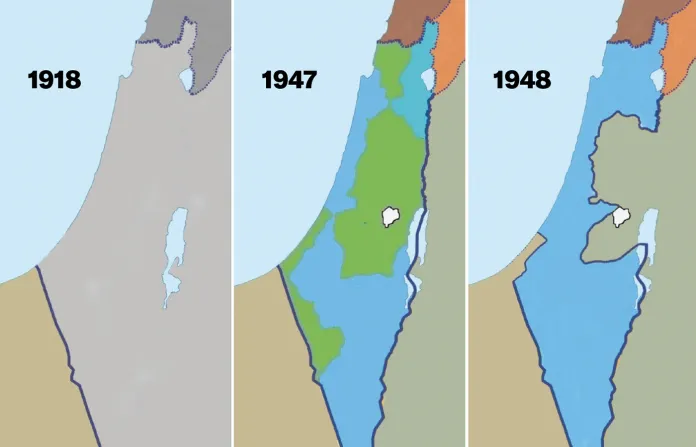 Left to right, 1918: After World War I, the British Mandate (in light gray) followed 400 years of Ottoman rule; Egypt is at lower left; 1947: The United Nations partition plan, with a Jewish state represented in blue, Palestine in bright green, Jordan at right in olive green, Lebanon at top in maroon, and Syria in orange. The plan was accepted by Jews but rejected by Palestinians; 1948: The armistice agreement at the end of Israel’s War for Independence allowed for Egyptian rule over Gaza and Jordanian rule over most areas around Jerusalem.
Some British military officials, opposed to a Jewish national home, encouraged the violence, hoping to demonstrate to politicians in London the unworkability of the Zionist project.
Colonial rule in the Middle East was under threat. Two months after Nebi Musa, a revolt unfolded in British-ruled Iraq. France, which administered the mandates for the newly created entities of Lebanon and Syria, also faced upheaval.
In 1921, the British, their coffers depleted by World War I, came up with what they were sure was a solution. They removed 77% of the original territory of the Mandate for Palestine and created a new country called Transjordan, and placed Abdullah bin Hussein on its throne. This, it was thought, would appease the Arabs of Mandate Palestine and give a crown to Abdullah, who was threatening to invade French-controlled Syria.
Britain’s colonial secretary, a young Winston Churchill, never lacking in ego or wit, remarked: “The Emir Abdullah is in Transjordan where I put him on Sunday afternoon at Jerusalem.”
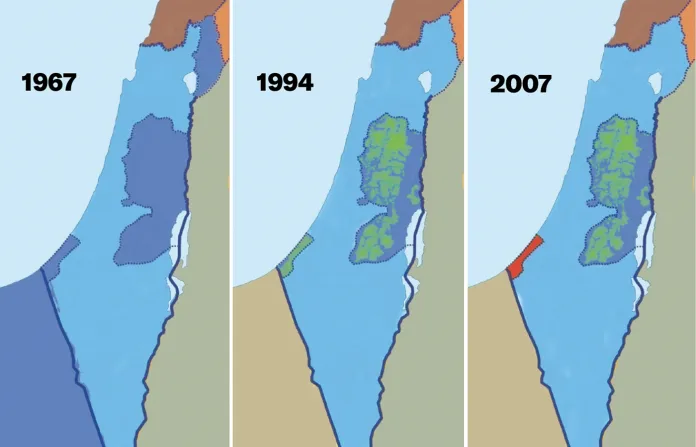 Left to right, 1967: After it was attacked in the Six-Day War, Israel occupied Egyptian territory at lower left, Jordan’s earlier territory west of the Jordan River, center, and the Golan Heights at top (all in dark blue); 1994: The Oslo Accords recognized the Palestinian Authority (shown in bright green), though Israel maintained control of some parts of the so-called West Bank and the Golan Heights; 2007: Following an election in Gaza (in red), Hamas took control of the coastal strip.
Yet again, the Brits had wholesale created a polity in the Middle East and installed its rulers.
To this day, legend has it that the 90-mile zig-zag border between Transjordan and Saudi Arabia, nicknamed “Winston’s hiccup,” was the byproduct of a “particularly liquid lunch” on Churchill’s part. In fact, it was to give Britain an uninterrupted air corridor between the Mediterranean and Iraq, air power being a feature that the British had learned to value during the previous year’s revolt.
The British hoped that creating another Arab state out of the ashes of the Ottoman Empire would placate Arab anti-Zionism. But they were soon disappointed.
On a 1921 train journey from Egypt to Gaza, Arab crowds gathered and held a reception for Churchill. The future prime minister didn’t speak Arabic and mistook their chants as gratitude, only to be told by his adviser, the legendary T.E. Lawrence, or “Lawrence of Arabia,” that they were yelling, “Down with the Jews” and “Cut their throats.”
This was not the last time that Western rulers in the Middle East failed to appreciate the full extent of Arab antisemitism, nor was it the last time that they tried to appease it.
OCT. 7, TWO YEARS ON: A WATERSHED MOMENT, BUT ISRAEL IS NO STRANGER TO WAR
Meanwhile, the borders of the “Jewish national home” continued to shrink. By the end of the 1930s, they had almost disappeared.
Violent antisemitic attacks erupted again in 1929, with no fewer than 133 Jews murdered and hundreds more wounded. The ancient Jewish community of Hebron was forced to leave, and bit by bit, the British distanced themselves from their pledge of 1917.
The 1937 Peel Commission recommended that the mandate be divided once more and another Arab polity be carved from its remnants. However, Arab leaders under Amin al Husseini, the grand mufti of Jerusalem, refused to make any compromises and recognize any Jewish state, irrespective of its borders.
Husseini and others launched a wave of terrorist attacks that targeted Jews, British authorities, and Arab rivals. In 1939, the British government issued the infamous White Paper and reneged on the Balfour Declaration while closing the gates to Jews seeking to flee Adolf Hitler’s Europe.
British appeasement failed. Husseini and many Arab leaders sided with the Nazis during World War II anyway, bonded together by their shared hatreds of Jews and the West.
In 1948, U.N. Resolution 181 proposed to divide the mandate into two states, one Arab and one Jewish. Yet again, Arab leaders rejected the compromise while Zionist leaders accepted it, although the territory now offered to the Jews was a fraction of what had initially been promised three decades before.
Arab leaders chose war instead of peace and a Palestinian state. Israel survived being attacked by five Arab nations and Palestinian militias, but lost 1% of its population in the process. And the borders it was left with all but made more conflict inevitable.
Israel was now a nation reborn, but it was surrounded by enemies who sought to strangle it in the cradle.
Israel’s neighbors refused to recognize its existence. No peace treaties were signed as they de facto granted recognition, and with it, legitimacy. Instead, armistice agreements were reached, ceasefires in all but name, and a formal state of war continued between Israel and the many Arab opponents that it had defeated.
Nation-states are a fairly modern Western concept, imported only recently to the tribal lands of the Middle East. Other nations were created out of the Ottoman Empire, but Israel alone was born surrounded on all sides by countries that not only failed to recognize its right to exist but that openly called for its destruction.
During the 1948 Arab-Israeli War, Transjordan seized nearly a quarter of the original mandate. The Hashemite Kingdom, led and trained by British military officers, had gained much of the high ground in the hills surrounding Jerusalem.
The Jewish community of the Old City of Jerusalem was expelled, and houses and synagogues in the historic Jewish quarter were destroyed. Jewish holy sites were intentionally used as horse stables and chicken coops. And, perhaps most significantly, the city was itself divided, and the holiest sites in Judaism fell under Jordanian control.
Abdullah illegally annexed the land west of the Jordan River and renamed Judea and Samaria, the Jewish people’s ancestral lands, the “West Bank,” a name that hadn’t appeared on maps before but is commonly used today.
Palestinian Arabs fleeing the war, many encouraged by Arab rulers themselves, were weaponized and turned into a permanent class of refugees. Only Jordan gave them citizenship. The rest, and their descendants not yet born, were held in reserve, their “resettlement” prevented until a promised “return” that would culminate in the end of Israel as a Jewish state.
THE HAMAS UNIT THAT HUNTS PALESTINIANS
For nearly two decades, Israel lacked what military analysts call “strategic depth.” Simply put, there was little land to fall back on in the event of an attack, and much of the high ground was held by its surrounding, and numerically superior, opponents.
Diplomatically, Israel responded by strengthening ties with the French, the historic counterweight to British ambitions, and by reaching out to the newly decolonized nations of Africa. Israel hoped that by providing aid and support to African nations, it could alleviate its economic and diplomatic isolation, particularly in international forums such as the United Nations. Such hopes were forlorn in the long term.
Close ties with America didn’t come until later, and only after Israel demonstrated its prowess on the battlefield.
Indeed, the United States refused to sell arms to the fledgling state. President Dwight Eisenhower, like the British before him, was concerned about isolating the oil-rich Arabs and kept Israel at a distance. Eisenhower’s CIA and State Department plotted against the Jewish nation, with the former even launching anti-Zionist propaganda efforts backed by money from Big Oil.
Militarily, Israel recognized that its thin and difficult-to-defend borders meant that a defensive strategy was doomed to fail. Israel had to go on the offensive. Israel’s famed expertise in intelligence and special operations was the result, born from necessity more than anything else. Israel excels in these fields because it doesn’t have a choice.
From the beginning, terrorists launched raids into Israel. They came from all corners and were armed, supplied, and supported by the neighboring states, Egypt, then the leading power in the Muslim world, foremost among them.
Israel formed special commando teams to attack them, and its spies sent mail bombs to the Egyptian military operatives overseeing them. In 1956, determined to oust Egyptian leader Gamal Abdel Nasser and put an end to his fedayeen, “those who sacrifice themselves,” Israel teamed up with France and Great Britain in what became known as the Suez War.
Egypt lost on the battlefield. But Eisenhower, outraged at the surprise invasion during an election year, declared economic war against the British pound and handed Nasser, soon to be a beneficiary of significant Soviet largesse, a victory.
Israel was forced to return key land that it had seized. In exchange, Israel was offered protection from the U.N. Such assurances proved worthless.
In 1967, Nasser, facing his own headwinds from both a failed war in Yemen and a failed union with Syria, massed the Arab world in yet another bid to destroy Israel. Israel, anticipating mass casualties, began digging graves for mass burials in public parks. The U.N. peacekeepers fled at Nasser’s request.
Israel, President Lyndon Johnson said, wouldn’t be alone unless it acted alone. The U.S., bogged down in its own unpopular war in Vietnam, wouldn’t help despite its own previous assurances to do so.
The message to Israel was clear: Don’t act preemptively. But the Israelis didn’t listen to their American friends.
Instead, Israel launched a preemptive strike, decimating Egypt’s Soviet-supplied air power while it sat on the ground and its pilots ate breakfast.
The young King Hussein of Jordan, pressured by a Nasser that he both feared and admired, foolishly joined the war. Jordan lost the high ground, its hold of Jerusalem, and the so-called West Bank. For the first time in thousands of years, Jerusalem was reunited and under Jewish control.
Israel seized the Golan Heights from Syria to the north and key lands from Egypt in the south. Damascus itself was within reach, and Cairo trembled.
In a mere six days, Israel had remade itself and the Middle East with it. Israel now had some measure of strategic depth. It now held high ground near Jordan and Syria. And having once again defeated numerous opponents, it was the preeminent military superpower of the Middle East, its fearsome capabilities unquestioned.
Closer ties with America, which had only begun limited arms sales in 1962, soon followed. In 1973, Nasser’s successor, Anwar Sadat, launched a surprise war against Israel during Yom Kippur to recover lost lands and Egyptian honor.
Israel was caught unaware and lost ground and men in the war’s early days before surging and eventually encircling Egypt’s Third Army. Jordan’s King Hussein wisely stayed out this time.
THE FUTURE OF THE PALESTINIAN MOVEMENT
American intervention once again saved Egyptian forces. But the Arab nationalism embodied by Nasser was no longer the chief force in the Arab world. It gave way to the terrorism of Palestinian groups, Yasser Arafat’s Palestine Liberation Organization foremost among them.
Sadat made peace with Israel, and the Jewish state surrendered the lands it had seized in the Sinai in return. The peace was a lasting, if cold one. It was born not from paper and promises, but from repeated battlefield defeats and a far-sighted leader in the form of Sadat.
The PLO used Lebanon as a base for terrorist attacks, just as it had Jordan and Egypt before it. During the late 1970s and 1980s, Israel was forced to contend with Palestinian terrorist groups, many operating in Lebanon and Hafez Assad’s Syria.
Once again, Israel intervened militarily, and the PLO was expelled to faraway Tunis. Israel’s strategic depth, such as it was, held. Israel’s future wounds were self-inflicted and encouraged by a naive West.
The lands and borders that Israel had fought so hard to hold and keep were given away to create what Israeli politician Shimon Peres famously hailed as a “new Middle East.” But there is no “new Middle East,” there is only the Middle East, and as the last three decades have shown, it is a harsh teacher.
Israel and Jordan reached a peace agreement in 1994. Jordan renounced any claims to the West Bank.
The PLO, bereft of its Soviet sponsor, was willing to cut temporary deals to restore its finances and end its exile in Tunisia. As part of the Oslo Accords, the PLO and Arafat were given lands in the West Bank and Gaza and allowed the opportunity for limited self-rule and perhaps a state, provided Arafat kept his promises to renounce terrorism. He didn’t.
Israel surrendered much of its lands in both Gaza and the West Bank, losing important on-the-ground intelligence with it. The PLO and its rival, Hamas, a Muslim Brotherhood offshoot backed by Iran, began carrying out a deadly, decadeslong campaign of suicide bombing that only ended with Arafat’s death in 2004.
Israel retook some of the territory it had given up and constructed a wall to prevent the entry of more suicide bombers. But the West and the Arab world continued to push it to surrender more land, irrespective of the increase in terrorism it had created. After all, their people weren’t the ones dying in suicide bombings. Not yet anyway.
In 2005, Israel unilaterally withdrew from Gaza. Gazans held elections and voted in Hamas, an Islamist movement whose charter quotes Hitler and calls for Israel’s destruction.
To the north, Israel had withdrawn from southern Lebanon, once again trusting in the promises of the U.N. and the international community to keep the peace. The results were predictable. Hezbollah, another Iranian-backed proxy, was empowered and made Lebanon a vassal state.
The stage was now set for a quarter-century of war, as emboldened Iranian proxies tried to surround Israel on all its borders. The mullahs in Tehran had replaced Nasser’s Cairo and Arafat’s PLO as Israel’s chief foe.
Syria’s Bashar Assad became their appendage, his country serving as a land bridge for weapons transfers. In Gaza, Hamas could boast of having ousted the Zionist entity and of the generous foreign funds that it used to build tunnels and an army of bloodthirsty terrorists.
A half-dozen wars and military campaigns, many of brief duration, followed. And then came Oct. 7.
On that day, Hamas and other Iranian-backed proxies perpetrated both the largest massacre of Jewish civilians since the Holocaust and the bloodiest terrorist attack in the Jewish state’s history.
Three years of war followed. Just like 1973, Israel recovered from its initial shock and defeat. Iran’s top rulers are dead, killed in the largest military decapitation strike in modern history. Assad has been ousted, and Hezbollah and Hamas have been severely degraded.
But the need for defensible borders remains.
Syria is now ruled by Ahmed al Sharaa, a onetime al Qaeda terrorist whose patron, Recep Tayyip Erdogan of Turkey, dreams of rebuilding the Ottoman Empire. Al Sharaa seized power after a decadelong civil war in Syria, in which jihadist groups were mere yards away from the Golan Heights that the West has constantly pressured Israel to surrender.
Who al Sharaa truly is, and what he wants, is a question foremost on the minds of the Israeli security establishment.
To the south, not far from Kibbutz Kfar Aza, an Israeli community that was nearly destroyed by Hamas, the borderland topography is flat. It is easy to see how hundreds, even thousands, of terrorists could swarm in and overwhelm Israeli defenders, as they did on that fateful day three years ago.
Who rules Gaza and from where will continue to be of paramount concern to Israelis. Ditto for Lebanon, whose rulers are once again feigning interest in ousting Hezbollah in order to get more Western money.
PEACE IN LEBANON? NOT IN OUR TIME
“Fences offer the illusion of security,” Jonathan Conricus, a former Israeli military spokesperson and fellow at the Foundation for Defense of Democracies, told me. What matters most is who is on the other side, and for much of Israel’s history, it has been those who seek its destruction.
The lessons of that history are simple, if repetitive and bleak.
Hold the high ground and surrender nothing. Appeasement doesn’t satiate — it encourages and emboldens.
Discard advice from those in the West who live in an entirely different neighborhood, with different rules and different mores. They’re often wrong anyway and show little interest in learning the hard-fought lessons of history.
Their solution, surrendering land preemptively in the hopes of obtaining peace, has been tried. It failed and has only led to more war.
Their failure to recognize as much is revealing. Israel’s opponents and critics existed long before the nation held the so-called West Bank or the Golan Heights — some are irrevocably opposed to any Jewish state, irrespective of its borders or boundaries.
The U.N. and the so-called international community are useless on a good day, and often they’re a great deal worse than that. Their words aren’t worth the paper that they’re printed on, and their condemnations count for little when weighed against the horrors of another Oct. 7.
Perhaps most of all: Dispense with illusions of peace partners who will “remake the Middle East.” Israel, a nation the size of New Jersey and which is 9 miles wide at its narrowest point, can ill-afford to indulge them.
The Middle East is not a fairy tale. It is the precise opposite: a place filled with the self-defeat born from ancient hatreds and dreams of conquest.
Real peace flows from economic power and military dominance. Those who pretend otherwise do so at their own peril. Israel has long had to fight for what it has. It will, no doubt, have to do so again.
Sean Durns (@SeanDurns) is the deputy commentary editor of the Washington Examiner.