
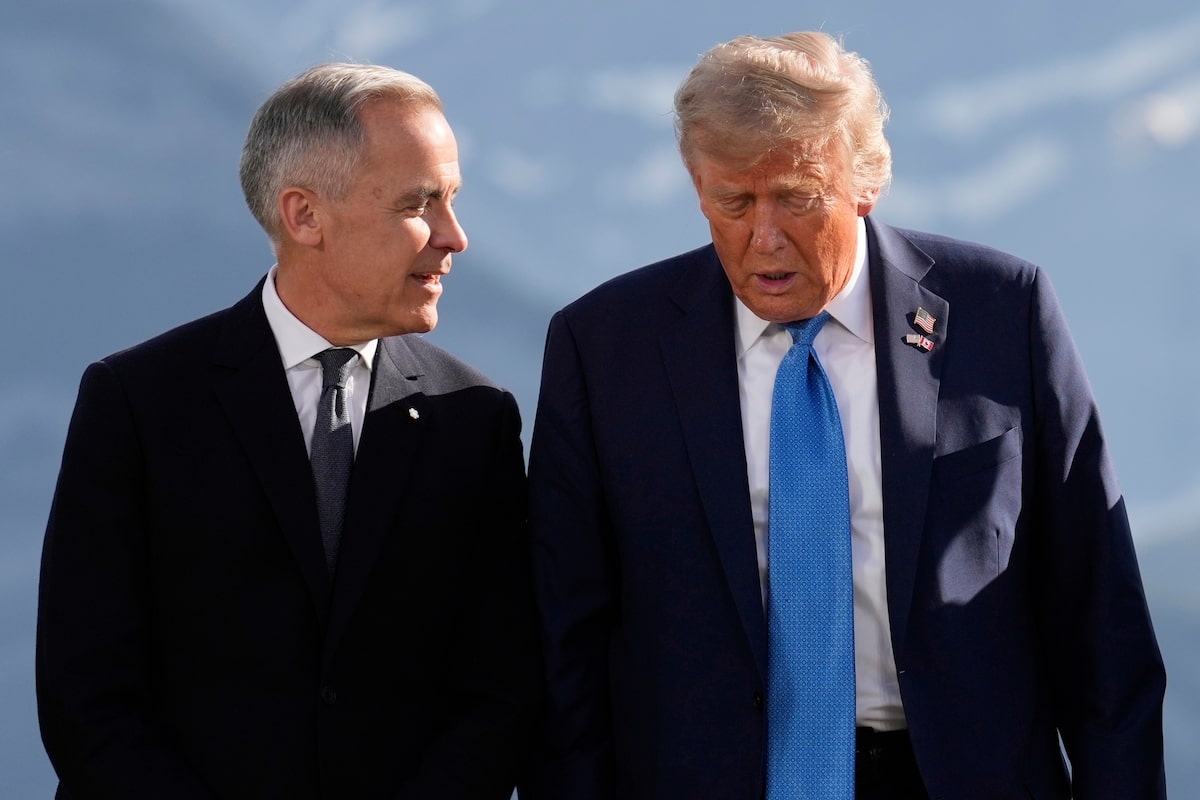
Prime Minister Mark Carney talks with President Donald Trump before a group photo at the G7 Summit in Kananaskis, Alta., in June, 2025.Mark Schiefelbein/The Associated Press
The Trump administration is finding novel ways to embitter relations with Canada as it wages a wanton trade war.
White House trade adviser Peter Navarro made a series of comments this week that were contemptuous of Canadian officials and suffused with American anxiety about China.
He referred to Prime Minister Mark Carney and Ontario Premier Doug Ford as “the Sino twins” just days after his boss, U.S. President Donald Trump, rolled out the red carpet for China’s President Xi Jinping in Washington. Mr. Navarro also warned Ottawa not to interfere in the U.S. midterm elections and told Canadian lobbyists to “get the hell out” of the U.S.
International Trade Minister meets with Greer, highlights trade war’s impact
That ramped-up rhetoric follows published reports that Mr. Trump’s escalating economic enmity has also tainted – at least temporarily – other areas of cross-border co-operation, such as antitrust cases and law-enforcement investigations.
In September, The Wall Street Journal reported the U.S. Department of Justice’s antitrust division was ordered to “pause” all work with the Canadian government. A department official later chalked it up as a misunderstanding, according to the U.S. newspaper’s story.
That was followed by a New York Times report that FBI director Kash Patel “temporarily halted” some co-operation with the RCMP, apparently over an unrelated annoyance with the CBC that played out against the backdrop of a worsening trade war.
Mr. Trump and his minions seem determined to deepen the damage done to two countries that were once the best of bilateral buddies. But Canadians should not despair because many Americans are also nostalgic for the way we were.
Among them is William Kovacic, a former chairman of the Federal Trade Commission, who was at the helm of the U.S. antitrust watchdog from March, 2008, until March, 2009, after being appointed by then-president George W. Bush.
An American legal scholar who also served as a non-executive director of Britain’s Competition and Markets Authority from 2013 to 2022, Mr. Kovacic is offering Canadians a dose of badly needed optimism about the future.
“I’m really tempted to wallow and to lament the state of the world, but that’s not gonna make it better,” Mr. Kovacic said at an event organized by The Dais, a public policy and leadership think tank at Toronto Metropolitan University, on Tuesday night.
“I think we’re aware of the difficulties that we face. What’s the happy side of the story?”
Trump expects Canada to cave in trade war as Stelco cites tariffs for layoffs
Indeed, he argues there are plenty of reasons for Canadians to be hopeful about the prospects for innovation, competition law and, yes, even moving from rupture to repair with the U.S.
Mr. Kovacic made his remarks on the same day that Mr. Navarro told Canadian lobbyists to scram. The juxtaposition is striking.
As Mr. Kovacic points out, Canada has other international partners, including Britain, Australia and the European Commission. That means that Ottawa doesn’t have to overcome challenges alone.
“There you have a cluster of well-developed, extremely smart, and progressively minded institutions,” he said.
“If they can co-operate in thinking about what the appropriate strategy is, picking targets, deciding where to fight, where to wait for another day, they’re in a position to do very good work that the large enterprises will not be able to ignore.”
Opinion: The trade war is no excuse for flights of economic nationalist fancy
His advice? Canada should continue building those relationships regardless of what is happening in Washington.
Mr. Kovacic also notes that Canada has “first-rate talent” to fill key positions at institutions like the Competition Bureau.
(Jeanne Pratt has been serving as the bureau’s interim commissioner of competition since Matthew Boswell left the role on Dec. 17.)
Mr. Kovacic also believes that relationships between U.S. and Canadian institutions will endure because the cross-border affinity was forged over decades.
“When you go deep into the infrastructure of the Department of Justice and the FTC, you still have people who spent years building relationships with their counterparts in Ottawa. And they haven’t forgotten that,” he said.
“I expect that those relationships will continue to be nurtured, even in a quiet way, that they continue. So that when you have a regime change, they’ll be ready to make a difference.”
Universities and professional societies are also playing a pivotal role in sustaining those cross-border ties, he added.
“There’s been a form of terrible institutional vandalism that has run through Washington over the last, not quite two years yet, and it’s shocking to see how quickly you can destroy things that took decades to build,” Mr. Kovacic said.
“But despite that activity, there is a rugged, and I think, durable infrastructure that will carry on.”
Thank you for this timely reminder. Even an ink-stained wretch like me harbours hope that you’re right.