
Facebook
Twitter/X
LinkedIn
Pinterest
Reddit
Email
Print
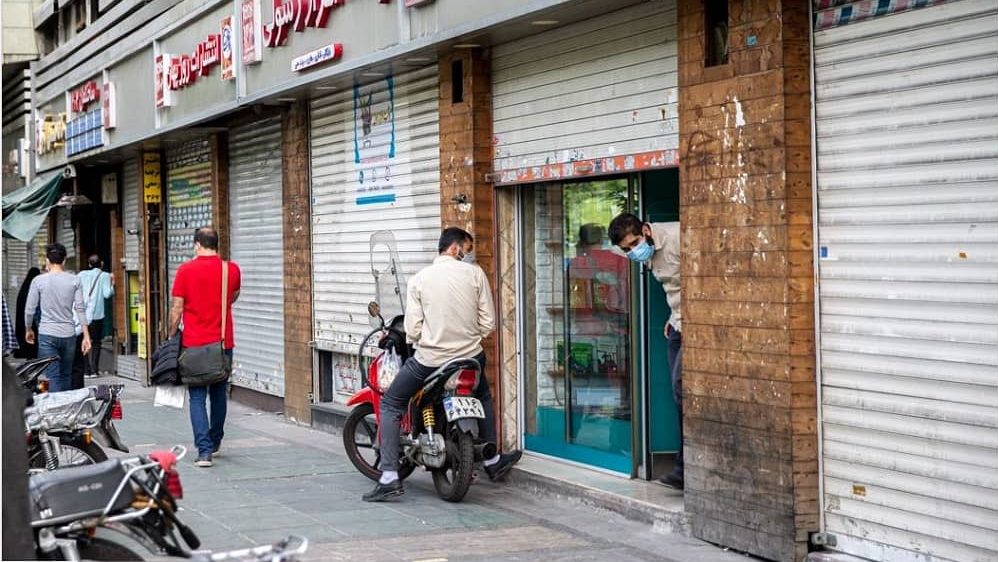
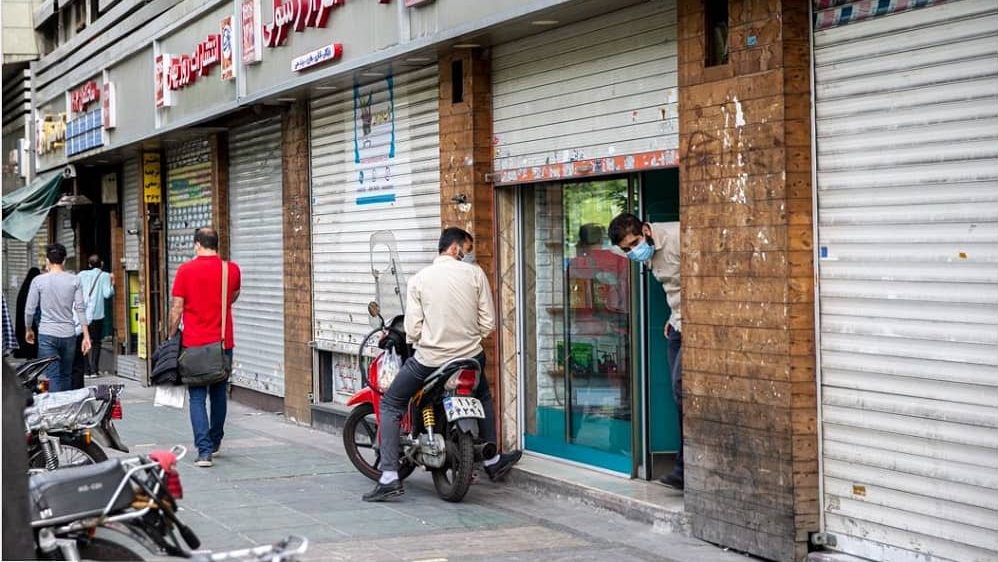 An Iranian man peers inside a partially closed shop
Nine-minute read
For millions of Iranian families, the economic crisis is no longer measured primarily in inflation rates, budget deficits or monetary aggregates. It is measured at the bakery, the butcher’s counter, the pharmacy and the landlord’s door.
In parts of the country, according to accounts published in the Iranian press, customers who once bought a full loaf of bread are asking for half. Fruit, increasingly beyond the reach of ordinary salaries, is being purchased by the piece rather than by the kilogram. Meat, dairy products and other staples have gradually disappeared from the diets of many lower-income households.
Behind these daily adjustments lies a much larger economic breakdown: exceptionally high inflation, rapid monetary expansion, a depreciating currency, chronic government deficits, weak investment, a distressed banking system and a labor market in which millions of working-age Iranians are no longer economically active.
The scale of the deterioration can be seen in the rial itself. The free-market price of the US dollar rose from roughly 60,000 tomans in September 2024 to around 258,000 tomans by October 2, 2026. Beyond all expert opinion, the direction is unmistakable: the purchasing power of the national currency has been severely eroded.
International institutions are similarly pessimistic about the broader economy. The International Monetary Fund currently projects average consumer-price inflation in Iran at 68.9 percent in 2026. Its July 2026 country data also projects a contraction in real GDP.
The World Bank’s June 2026 Global Economic Prospects report, meanwhile, estimated a 2.8 percent contraction for Iran in the 2025/26 fiscal period.
The Iranian regime’s own media are connecting the dots:
• Inflation: 83.8%
• January unrest began with an “#economic spark”
• Security chiefs warn every “spark” could become a “flame”
• Universities, hijab and even pessimism are increasingly treated as security issues.…
— NCRI-FAC (@iran_policy) September 26, 2026
The inflation shock
Iran has lived with high inflation for decades, but the latest acceleration is qualitatively different.
According to figures attributed to the Statistical Centre of Iran and reported by Fararu, annual inflation reached 57.7 percent in May 2026, while point-to-point inflation — comparing prices with the same month a year earlier — was reported at 83.9 percent. Two months later, the reported annual rate had climbed to 62.5 percent.
The IMF’s 68.9 percent projection for average consumer-price inflation in 2026 underscores how severe the pressure has become.
But aggregate inflation figures only partially convey what is happening to household budgets.
Figures published by Donyaye Eqtesad and cited in the source material show enormous year-on-year increases in key food items. Vegetable oil was reported to have risen by 431 percent, liquid oil by 353 percent, eggs by 342 percent, chicken by 287 percent, imported rice by 222 percent, Iranian rice by 161 percent, and beef or veal by 157 percent. Bread prices were reported to have increased by approximately 140 percent over the year to late June 2026. Separately, Arman-e Melli reported increases of as much as 500 percent for some medicines.
The significance is not merely that prices are rising. It is that the cost of essentials has been increasing much faster than household incomes.
The result is a form of economic compression: families progressively eliminate non-essential spending, then reduce the quality and quantity of food, postpone healthcare, abandon savings and finally accumulate debt simply to maintain basic consumption.
“The clerical regime in Iran is facing a compounding crisis as #economic mismanagement, hyperinflation, and public outrage converge, forcing senior officials into unprecedented admissions of failure,” @MansoreGolestan writes.https://t.co/iakYpfvgi0
— NCRI-FAC (@iran_policy) August 17, 2026
A wage rise that inflation swallowed almost immediately
Iranian workers received what appeared on paper to be a substantial pay increase for 2026.
The Supreme Labor Council raised the minimum wage by about 60 percent. According to figures reported by Estekhdam, a single worker without children could receive approximately 22 million tomans a month, while the total monthly income for the breadwinner of a four-person household was calculated at roughly 25.6 million tomans.
Yet the state estimates the cost of basic food alone for such a household at around 21 million tomans — meaning approximately 83 percent of minimum pay could be consumed by essential food purchases before rent, utilities, transport, clothing, healthcare or education were considered.
That illustrates one of the defining features of Iran’s present crisis: nominal wages can rise sharply while workers become poorer in real terms.
ILNA, Iran’s state-affiliated labor news agency, reported in June that even after salary increases, workers’ purchasing power had continued to decline and that the cost of a simple family meal had moved beyond what many workers could afford from a day’s wages.
The dollar value of workers’ pay fell substantially within a single year as the rial depreciated. The precise dollar comparison varies depending on the exchange rate and the definition of minimum compensation, but the underlying problem is clear: wage adjustments are repeatedly overtaken by inflation and currency depreciation.
The monetary machine behind the price spiral
One reason inflation has proved so persistent is the extraordinary growth of money and credit.
According to Iranian Central Bank figures cited in the source material, liquidity increased from approximately 353 trillion tomans in 2011 to more than 15,581 trillion tomans by March 2026 — an increase of more than fortyfold in fifteen years.
Tabnak reported that liquidity had recently been expanding at around 40.4 percent, while the monetary base was growing at 47.5 percent. The publication warned that hundreds of trillions of tomans in additional high-powered money had entered the banking system, increasing the risk of further inflation.
Iranian economist Jamshid Pajouyan and other analysts have long drawn attention to the connection between monetary financing and inflation. More recently, economist Mohammad-Hossein Jamshidi, quoted in the Iranian newspaper Setareh Sobh, warned that the financing requirement associated with the budget deficit implied enormous daily liquidity creation and could intensify inflationary pressure.
The mechanism is relatively straightforward.
When government expenditure persistently exceeds sustainable revenue, the deficit must be financed. If the state borrows directly or indirectly from the central bank, or if commercial banks lend to the government and subsequently turn to the central bank themselves, new base money enters the system.
If money expands far faster than productive capacity, increasingly large quantities of currency chase a limited supply of goods and services.
In Iran, that process is reinforced by expectations. Donyaye Eqtesad reported an unusually strong statistical correlation between monetary growth and food inflation since 2022, suggesting that changes in inflation expectations are being transmitted particularly quickly into household food prices.
“Iran is engulfed in a severe socio-#economic crisis, driven by geopolitical adventurism, systemic mismanagement, and hyperinflation,” @MansoreGolestan writes.https://t.co/kNJLoCPPdC
— NCRI-FAC (@iran_policy) July 21, 2026
The deficit at the center of the crisis
At the heart of the monetary problem lies a structural fiscal one.
Iran has been running large deficits for years. According to figures cited by Donyaye Eqtesad, the 2025/26 budget carried a deficit of more than 950 trillion tomans, equivalent to roughly 6 percent of GDP. More recent estimates quoted in Ettelaat put the emerging funding gap above 1,550 trillion tomans, as the government faces additional demands including subsidies and post-war reconstruction expenditure.
An economist quoted by Donyaye Eqtesad described the transmission mechanism succinctly: when the fiscal deficit grows, pressure is ultimately transferred to the banking system and the central bank, leading to liquidity growth and inflation.
That cycle creates a formidable policy trap.
The government needs money to meet existing obligations. Raising taxes aggressively in a contracting economy can deepen the downturn. Borrowing from domestic banks adds pressure to an already fragile financial system. Cutting subsidies or public spending can impose immediate hardship. Monetary financing, meanwhile, risks another round of inflation.
The result is that policies intended to close one financial gap can reopen it elsewhere.
The banking system’s hidden burden
Iran’s banks constitute another weak point in the economic structure.
Former Central Bank governor Valiollah Seif has described the banking system as suffering from deep and persistent balance-sheet imbalances rooted not merely in capital ratios but in the quality of bank assets and the sustainability of their funding structures.
Official figures cited by Tabnak put non-performing obligations across 26 banks and credit institutions at more than 779 trillion tomans by March 2025.
Economist Saeed Laylaz went further, telling Khabar Online that, in his assessment, roughly 40 percent of the banking system’s assets were effectively fictitious or impaired. That is his characterization rather than an independently established figure, but it captures the depth of concern even among economists quoted in the regime’s own media.
The problem matters far beyond bank shareholders.
A bank burdened by loans that will not be repaid or assets that cannot generate sufficient income still has obligations to depositors. If it cannot meet them from its own resources, it may require central-bank liquidity or government support.
That can effectively socialize banking losses: bad lending decisions eventually reappear as monetary expansion and inflation, which is paid for through the declining purchasing power of the population.
Government debt to the Central Bank was reported by Jahan-e Sanat at approximately 863.6 trillion tomans, while commercial bank debt to the central bank was reported at around 1,170 trillion tomans.
It is therefore increasingly difficult to separate Iran’s banking problem from its inflation problem or its fiscal problem. They are different manifestations of the same interconnected balance-sheet crisis.
“The Iranian regime is confronting its most severe economic crisis in years, with basic food prices doubling in months, the national #currency in freefall and the government forced to let citizens buy essentials on credit backed by future subsidies,” writes @MansoreGolestan.…
— NCRI-FAC (@iran_policy) April 29, 2026
A labor market with millions missing from it
Official unemployment statistics tell another incomplete story.
Iran’s Statistical Centre reported unemployment at around 7.6 percent in the winter of 2025/26. On its own, that figure might suggest a labor market performing reasonably well.
But participation tells a very different story.
According to Donyaye Eqtesad, the economic participation rate was only 39.7 percent in winter 2026. By comparison, the newspaper cited an International Labor Organization global average of around 61.1 percent. This means a very large proportion of working-age Iranians were neither employed nor actively looking for work.
Economist Massoud Nili has described the consequences in stark terms. According to remarks published by Donyaye Eqtesad, Iran has approximately 12 million young people who are neither studying nor employed. He also noted that the number of employed people barely changed between 2019 and 2025 despite a substantial increase in the working-age population.
Women are particularly under-represented. The material cites an economic participation rate for women of only 12.2 percent, far below global averages.
There is also a problem of job quality.
Khorasan, drawing on two decades of labor data, reported that more than 58 percent of Iranian workers are employed informally, often without adequate contracts, insurance or employment protection. In rural areas, it said, the proportion can reach 90 percent.
Thus the employment crisis has two dimensions: millions are outside the labor market altogether, while millions more are technically employed but remain economically insecure.
“Iran is grappling with a multi-layered socio-economic crisis that has intensified in recent weeks, combining runaway food #inflation, severe water shortages, a prolonged internet blackout, and growing shortages in essential medicines,” @MansoreGolestan writes.…
— NCRI-FAC (@iran_policy) May 11, 2026
Poverty has moved into the middle class
Perhaps the most consequential effect of prolonged inflation is the erosion of the social groups that once considered themselves economically secure.
The evidence appears in consumption.
Shargh reported cases of middle-class consumers purchasing fruit individually and asking bakeries to sell pieces or half-loaves because a full purchase had become unaffordable. The same body of reporting describes meat, dairy products, fruit and vegetables disappearing from the diets of many poorer households.
Housing compounds the pressure.
Iranian media estimates cited in the source suggest that rent now absorbs roughly 50 to 70 percent of household income for many tenants. Tose’e-ye Irani reported cases in which the rent burden for two-income couples approached 70 percent of combined earnings.
This is the point at which inflation stops being merely an economic indicator and begins altering society itself.
A family that spends most of its income on food and housing cannot accumulate savings. Without savings it cannot absorb illness, unemployment or an unexpected bill. Young adults delay marriage or independence. Families move to cheaper areas. Children receive less varied nutrition. Preventive healthcare is postponed.
The cumulative result is not simply lower living standards, but an increasingly fragile household economy.
One particularly disturbing indicator concerns nutrition. The material cites Iran’s Ministry of Health as reporting a large number of annual deaths associated with inadequate dietary intake. A ministry nutrition official, quoted by the news website Entekhab, linked thousands of deaths to insufficient intake of fruit, vegetables, omega-3 fatty acids, dairy products and whole grains, while noting that dairy consumption had fallen to less than half the recommended level partly because of price.
The historic #Tehran Bazaar, long considered the economic barometer of Iran, erupted in strikes and protests on Sunday, December 28, 2025, signaling a deepening crisis for the clerical regime.https://t.co/GGnopWMsFf
— NCRI-FAC (@iran_policy) December 28, 2025
Capital is leaving while investment stalls
An economy cannot rebuild productive capacity without investment. Yet Iran has simultaneously struggled to attract productive capital and to keep domestic wealth inside the country.
A study at Tarbiat Modares University, cited by the newspaper Etemad, estimated annual capital outflows at between $30 billion and $80 billion, depending partly on oil revenues.
Iranian MP Hossein Samsami subsequently said that of approximately $270 billion in non-oil exports since 2018, some $95 billion had not returned to the country through the official repatriation system. Other reports have raised similar concerns about export earnings from petrochemicals, metals and oil.
Not all unrepatriated export revenue can automatically be classified as capital flight: sanctions, payment restrictions, offshore settlement mechanisms and commercial practices complicate the picture. But the scale of funds reported outside the official system illustrates a deeper lack of confidence in domestic financial arrangements.
That confidence problem becomes self-reinforcing. When businesses and households expect the currency to fall, they have stronger incentives to hold dollars, gold, property or foreign assets rather than rials or long-term productive investments.
Iran’s national currency rapidly plunges, now reaching an all-time low rate of 410,000 rials versus a US dollar. The Rial’s freefall indicates a catastrophic economic crisis in Iran and a deep sense of insecurity among investors. #IranRevolution2022 https://t.co/Pb4NEPotHk
— NCRI-FAC (@iran_policy) December 27, 2022
Oil wealth — but fragmented control
Iran remains one of the world’s major hydrocarbon producers, making the weakness of its economy particularly striking.
Reuters reported in December 2024 that the Islamic Revolutionary Guard Corps had expanded its role in the country’s sanctioned oil trade and, according to sources interviewed by the news agency, controlled as much as half of Iranian oil exports at that time.
That finding matters economically because sanctions have forced Iran to rely heavily on opaque intermediaries, discounts, informal payment systems and complex logistics to export crude.
Iranian commentators cited in the source material have also complained that parallel organizations and brokers competing to sell Iranian oil can weaken the National Iranian Oil Company’s bargaining power and reduce the efficiency with which export revenue returns to the formal economy.
The wider question is therefore not simply how much oil Iran sells, but how much value ultimately reaches the national economy, through which channels, at what discount and with what degree of transparency.
“With food inflation hitting 112 percent and millions of digital livelihoods erased, the Iranian state’s narrative of “resilience” has collapsed. This systemic desperation is no longer merely an #economic crisis; it is a volatile catalyst,” writes @MansoreGolestan.…
— NCRI-FAC (@iran_policy) April 26, 2026
The infrastructure that never gets finished
The consequences of weak productive investment are visible across Iran in an enormous inventory of unfinished infrastructure.
The regime’s president Masoud Pezeshkian has publicly acknowledged the problem. According to state media, he said the country had roughly 6,000 trillion tomans worth of projects left incomplete, many of them launched without adequate financing. In another statement, he referred to unfinished commitments whose total cost exceeded the annual public budget.
A government official, Matin Ramazankhah, was later quoted by ISNA as saying the country had approximately 67,000 unfinished projects, some of which had been delayed so long that their original economic justification had disappeared.
The Majlis Research Centre has produced perhaps the most dramatic illustration of the backlog: at current rates of implementation, completing existing projects could theoretically take around 101 years if no new projects were launched.
Behind those extraordinary numbers are roads that remain incomplete, power infrastructure that fails to keep pace with demand, delayed hospitals and schools, ageing energy systems and capital trapped for years in projects that generate no return.
The effect is another feedback loop: weak infrastructure reduces productivity, weaker productivity constrains growth, low growth reduces government revenue and scarce revenue makes infrastructure even harder to complete.
The #Iranian Regime’s Economic Warfare Creates a Multi-Front Crisis for the Peoplehttps://t.co/KoEgu32dxd
— NCRI-FAC (@iran_policy) July 9, 2025
An economy running out of shock absorbers
Iran has survived severe economic stress before: sanctions, oil-price shocks, war, banking difficulties, currency crises and periods of high inflation.
What distinguishes the current situation is the number of stresses occurring simultaneously.
Inflation is eroding wages. Currency depreciation increases import costs and undermines savings. Fiscal deficits generate pressure for monetary financing. Banks carry impaired assets and large debts. Investment remains weak. Capital moves abroad. Labor-force participation is extraordinarily low. Food and housing absorb increasingly large shares of family income.
Meanwhile, the capacity of households to absorb another shock is diminishing.
The IMF’s current projections put 2026 Iranian inflation at 68.9 percent while projecting a substantial economic contraction. The World Bank estimated a 2.8 percent contraction for Iran in FY2025/26 and excluded forecasts beyond that fiscal year because of high uncertainty.
Neither figure alone determines Iran’s economic future. Forecasts can change, particularly in a country whose economy is heavily affected by geopolitics, sanctions, oil exports and exchange-rate movements.
But they reinforce what is already visible in Iranian statistics and Iranian newspapers themselves: this is no longer simply a conventional inflationary episode.
It is a crisis of household purchasing power, public finance, money, banking, employment and investment occurring at the same time.
And its most important statistic may ultimately be the simplest one.
When wages rise by tens of percentage points and families still remove food from their tables; when an employed household cannot cover both rent and basic nutrition; and when a growing proportion of the population has little realistic capacity to save, invest or plan for the future, economic deterioration has moved beyond the balance sheet.
It has entered everyday life.