
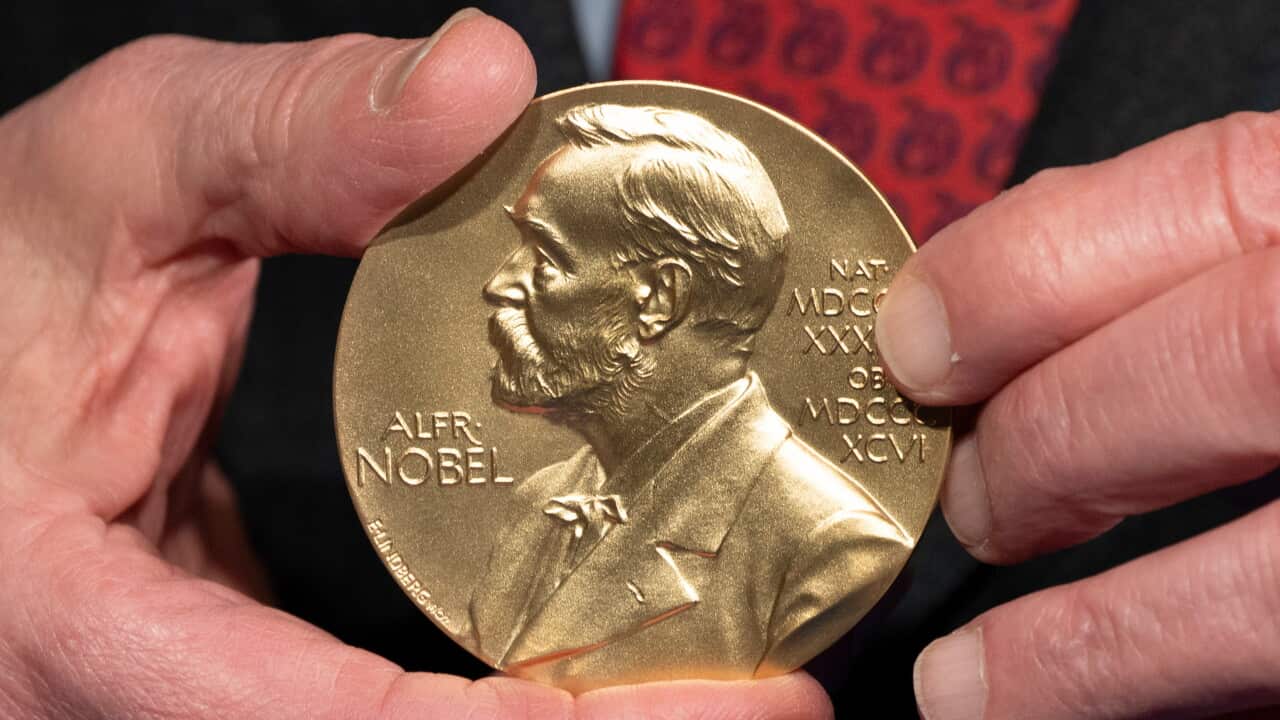
In brief The Nobel prizes are set to be announced from next week.The awards come with a recently increased prize amount of 12 million Swedish kronor ($1.74 million).
Not so outlandish, prognosticators say: The Nobel Peace Prize this year could go galactic, with an award to the International Space Station.
But terrestrial contenders loom too, including US President Donald Trump, Prime Minister Mark Carney of Canada, emergency teams in Sudan, children’s advocates in Ukraine and two top international courts.
The annual guessing game about who will win the prize, often called the most prestigious award on the planet, is revving up ahead of the Norwegian Nobel Committee’s 9 October announcement in Oslo.
Predicting the outcome is inherently speculative. Some surprising and controversial choices have appeared over the years.
The committee received 287 candidates for this year’s prize, and just over a quarter of them are organisations.
Your trusted source for staying up-to-date with the world around you. Get free daily news updates and analysis, straight to your inbox.
Experts say the committee, in awarding the prize, typically focuses on the durability of peace, the promotion of international fraternity, and the quiet work of institutions that strengthen those goals.
International Space Station a symbol of global cooperation
Haakon Gjerløw, director of the Peace Research Institute Oslo, is considered a top forecaster.
He says the ISS — well, the organisation behind it — is a rare symbol of global cooperation in a quest toward the heavens at a time when multilateralism is crumbling, and many countries have retreated into narrower national interests on Earth.
The institute’s annual watch list is one of the sources that most informs pundits and punters about the top contenders.
Trump has made no secret of his desire to win the prize, and has been nominated again, but could be viewed as a controversial choice after the US, along with Israel, launched an ongoing war on Iran in February.
Trump and Canada’s Carney are both candidates
Canada’s Carney has made a mark internationally this year, in large part by standing up to Trump on issues like US tariffs.
Gjerløw’s list this year also features Ukrainian children’s advocate Mykola Kuleba and Save the Children; Sudan’s Emergency Response Rooms, a grassroots relief network; and the Committee to Protect Journalists after the deadliest two years for reporters since record-keeping began nearly 45 years ago.
READ MORE
The International Court of Justice and International Criminal Court, jointly, also got a nod. The ICC has faced criticism among some, and respect from others, over its arrest warrants against leaders like Russian President Vladimir Putin and Israeli Prime Minister Benjamin Netanyahu.
Trump has long criticised the ICC, and US secretary of state Marco Rubio in July announced a campaign to “dismantle the threat … posed by the International Criminal Court to US sovereignty.” Later that month, the ICC’s chief prosecutor was controversially removed from office over sexual misconduct allegations.
READ MORE
Gjerløw said the committee’s choice is complicated by recent turmoil after 2025 laureate María Corina Machado of Venezuela, in a symbolic gesture, presented her prize to Trump days after US forces abducted Venezuelan President Nicolás Maduro.
Conflicts and wars mark this year’s prize
This year’s peace prize comes in an era marked by the most war and conflict in decades, including in Sudan, Ukraine, Yemen, Iran and the Middle East.
Shawn Davies, a senior analyst at the Uppsala Conflict Data Program, which monitors conflicts, cited “increased international tensions and changes in the global security order” that he linked to an erosion of US willingness to enforce international rules. Washington has gone from guarantor of the postwar order to a violator of it in some cases, he said.
“I don’t even think his own base would believe” Trump could win the prize now, “given how he’s stuck in what looks like a forever war in Iran,” Davies said.
READ MORE
Jody Williams, who won the 1997 Peace Prize jointly with the International Campaign to Ban Landmines, says she hopes for a continued trend toward awarding the prize to women. Only 20 of the prize’s 112 individual laureates have been women in its 125-year history.
In the past 15 years, eight women have won the prize individually, compared to six men.
Among names of the women circulating in prediction markets this year are Gaza surgeon Sara al-Saqqa and Yulia Navalnaya, the Russian opposition figure and widow of Alexei Navalny.
Nobels start with prize for medicine
Nobel week kicks off Monday with the announcement of the medicine prize, followed by the physics prize on Tuesday, chemistry on Wednesday and literature on Thursday. After Friday’s peace prize is awarded, the Nobel Memorial Prize in Economic Sciences will be announced on 12 October.
The prize money this year is 12 million Swedish kronor (about $1.74 million), whether for an individual, small group of laureates or organisation.
READ MORE
When it comes to the peace prize selection, expect political fallout no matter who wins.
“Trump will be unhappy whoever gets the Nobel,” said Nelson Wiseman, a University of Toronto professor emeritus.
“If Carney got it, it would make relations with Canada rockier than they are.”
Who awards the Nobel prizes?
The Nobel Prize was created by wealthy Swedish chemist and entrepreneur Alfred Nobel, who in his will dictated that the bulk of his estate should be used to fund “prizes to those who, during the preceding year, have conferred the greatest benefit to humankind”.
Nobel selected the Royal Swedish Academy of Sciences to award the prizes for chemistry and physics, the Swedish Academy for literature, Sweden’s Karolinska Institute medical university for physiology or medicine, and the Norwegian parliament for peace.
READ MORE
It is not known exactly why Nobel chose Norway to hand out the peace prize, though it may reflect that Norway and Sweden were linked in a political union when he penned his will.
In 1968, when Sweden’s central bank was celebrating its 300th anniversary, it established the Prize in Economic Sciences in Memory of Alfred Nobel with a donation to the Nobel Foundation. The Royal Swedish Academy of Sciences awards the prize under the same principles as the other prizes.
Famous and infamous laureates
Notable Nobel laureates include physicists Albert Einstein and Niels Bohr, authors Ernest Hemingway and Albert Camus, and leaders such as Nelson Mandela and Mother Teresa.
The Curies were the most successful “Nobel Prize family”, with Marie Curie winning twice and her husband, daughter and son-in-law also among Nobel laureates.
Only five people have won multiple Nobel prizes, with American chemist and peace activist Linus Pauling the only person to have received two unshared Nobel Prizes.
Some awards have aged poorly, such as Egas Moniz’s 1949 medicine prize for the since-discredited practice of lobotomy.
Many peace prizes have also been criticised, including those for Henry Kissinger, Yitzhak Rabin and Shimon Peres. Many also see the failure to award the prize to Mahatma Gandhi before his death in 1948 as a major oversight.
For the latest from SBS News, download our app and subscribe to our newsletter.