
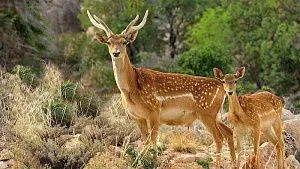
Iran’s Department of the Environment (DOE) has stepped up its efforts to restore the population of the Persian yellow deer. This was announced by the department’s spokesperson, Mohammad Nosrati, according to Tehran Times, a partner of TV BRICS, citing IRNA.
Work is proceeding along two lines: conserving the species in its natural habitat and under controlled conditions. A feasibility study for the reintroduction of the Persian fallow deer is planned in the provinces of Fars and Yazd. The DOE has also allocated funding for monitoring and assessing the species’ population in the provinces of Ilam, Khuzestan, Fars and Yazd. The aim is to study population dynamics, identify potential threats and assess habitat suitability.
Outside the species’ natural habitat, the department is organising fallow deer breeding centres. There, staff manage the population, release deer into the wild and assess the species’ genetic purity.
According to the International Union for Conservation of Nature (IUCN) Red List, the Iranian yellow deer is classified as an endangered species. Almost half a century ago, it was believed to have become extinct worldwide. Around 50 years ago, four individuals were discovered in the forests of Dez and Karkheh. They were released into various regions of Iran for breeding purposes. Thanks to the conservation programme, the population has grown from five individuals in 2019–2020 to 19 in 2026.
At the same time, the DOE is developing a genetic map of endangered wildlife species. As Leila Ezzeddinlou, director of Iran’s National Museum of Natural History and Genetic Resources, stated, this is necessary to improve the species’ chances of survival, draw up a breeding plan and manage the population. The objectives include preserving genetic diversity, preventing inbreeding (mating between closely related individuals) and halting the loss of biodiversity.
In collaboration with the Universities of Tehran and the Gorgan University, a project is underway to study the genomic diversity of the Levant viper and the Latifi viper. Work has begun on developing genetic profiles for the Asian cheetah, the black bear and the Persian fallow deer. Genetic variability and kinship within the Persian zebra population are being assessed separately, in collaboration with the DOE department in Yazd.
According to the IUCN, around 154 vertebrate species and approximately 25 per cent of plant species in the country are threatened with extinction. On the national list, 117 species are classified as critically endangered. These include the Persian zebra, the Asian cheetah, the black bear, the bustard and the Persian fallow deer. The Hyrcanian tiger and the Persian lion have disappeared forever.
DOE spokesperson Hamid Zohrabi noted that the Persian zebra and the Persian fallow deer are examples of successful recovery thanks to scientific measures and the involvement of local communities. In the current Iranian year, the first Persian fallow deer was born in Karkheh National Park. A Persian zebra foal was born in Yazd Province, and the population is now estimated at more than 50 individuals.
According to the DOE, 27 Asian cheetahs inhabit the country’s protected areas, with a further five in breeding centres and six in captivity. In September 2025, the department resumed its national project to protect Asian cheetahs after a six-year hiatus.
A separate action plan has been drawn up for each endangered species. The DOE oversees more than 337 protected areas, 13 biosphere reserves and 226 wetlands. Conservation plans have been drawn up for 25 endangered species, with a further 13 currently being developed.