

Listen to this article
Estimated 4 minutes
The audio version of this article is generated by AI-based technology. Mispronunciations can occur. We are working with our partners to continually review and improve the results.
The City of Moncton is looking to test lowering the speed limit on some streets next year.
“We’re looking at a pilot project for a reduced speed zone,” René Lagacé, the city’s director of engineering, told councillors during a committee meeting Monday.
“A lot of municipalities are going to 40 km/h neighbourhood zone, or a 30 km/h zone. So we want to implement that in Moncton; we want to look at a pilot project next year.”
No specifics were given, such as what areas are being considered. The city didn’t make anyone available Thursday for an interview, saying it was too early to provide more details.
Reducing speed limits on residential streets, along with enforcement and other measures, is something the Active Transportation Coalition of Moncton has been seeking. The citizen group advocates for ways to improve street safety and alternate modes of transportation.
“I think we would all feel a little better, or most of us would feel a lot better, just even driving around to basically give ourselves more reaction time when things inevitably happen,” Calvin Martini, the coalition’s president, said in an interview Thursday.
“That includes a child maybe stepping out in front of your truck. You need a long lead time in order to be able to react to that. So slower speeds help put that buffer in place.”
 Calvin Martini, president of the Active Transportation Coalition of Moncton, says the group has advocated for lower speed limits in residential areas. (Submitted by Calvin Martini)
New Brunswick’s Motor Vehicle Act allows municipalities to set a lower speed limit with a bylaw if it isn’t a provincial highway.
Cities such as Calgary and Edmonton have already moved to lower speed limits on residential streets after years-long debates.
Ahsan Habib, a transportation professor and director of the school of planning at Dalhousie University in Halifax, told CBC News in 2023 that research has shown slower speed reduces the severity of crashes.
A report from the Organisation for Economic Co-operation and Development studied the relationship between different speed limits and fatalities in pedestrian crashes.
The report says on-scene investigations of cars hitting pedestrians has shown 90 per cent survived when hit at 30 km/h, while only 20 per cent survived at 50 km/h.
Lagacé mentioned the pilot as he presented an update on traffic-calming measures implemented since 2024. Lagacé said the city’s focus has been physical traffic-calming measures before changing speed limits.
“If you don’t force cars to slow their speeds, most of them will not just based on a sign,” he said.
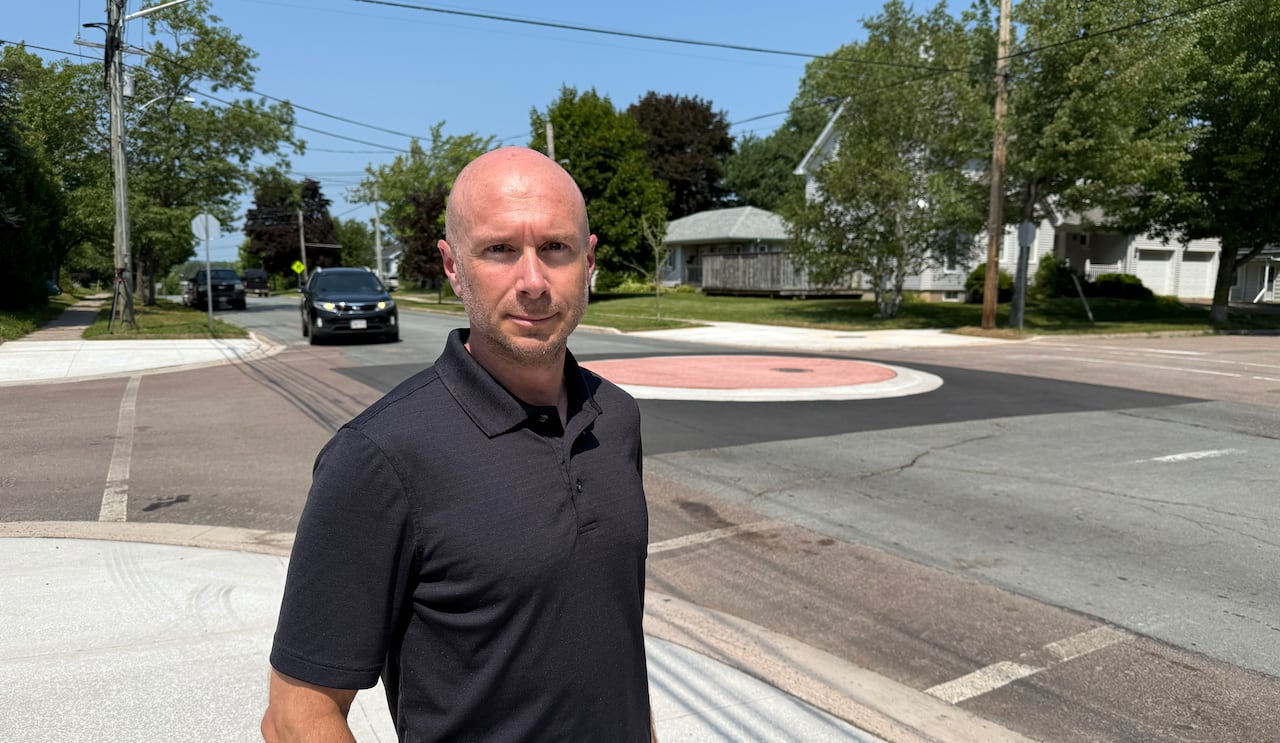 René Lagacé, Moncton’s director of engineering, says the city’s focus has been physical traffic-calming measures. (Shane Magee/CBC)
Ward 3 Coun. Julianna Mutch, speaking during Monday’s committee meeting, said she regularly travels to Ottawa for work where the city has implemented lower speeds on some residential streets.
“I’m happy to hear that we will be considering that,” Mutch said.
Moncton introduced a traffic-calming policy in late 2023 which calls for assessing streets to determine if they qualify for traffic-calming measures.
Those measures can include speed “humps,” signs showing a driver’s speed, raised intersections, and narrowing driving lanes on various streets. The streets selected are based on ratings accounting for data on vehicle speed, crashes, injuries and fatalities.
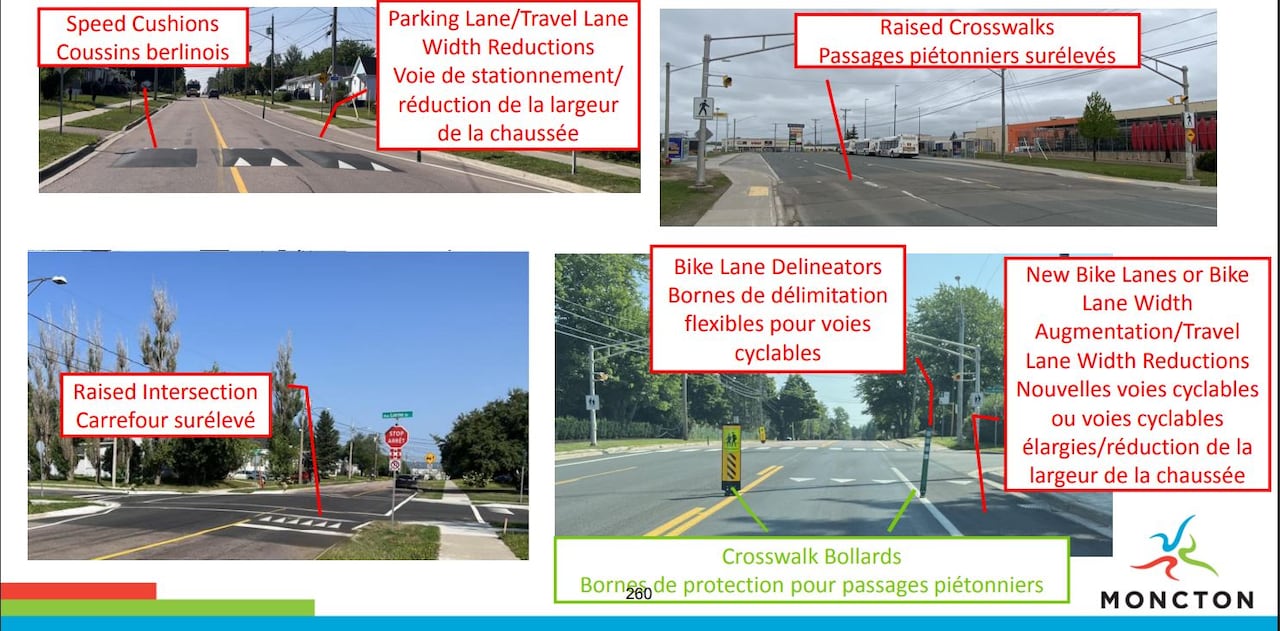 Examples of traffic-calming measures installed in Moncton. (City of Moncton)
Lagacé said Monday that data collected before and after traffic-calming measures were installed shows a reduction of speed of around 10 km/h.
“So they do work, these measures.”
His presentation said traffic-calming measures are being proposed next year on streets like Frampton Lane, Gorge Road, McAuley Drive, Milner Road, Millennium Boulevard, Morton Avenue, Royal Oaks Boulevard and Ryan Street.
Lagacé told council the city has also received $162,000 from the Federation of Canadian Municipalities that the municipality would need to match to install measures near Birchmount, Evergreen Park and L’Odysee schools.