
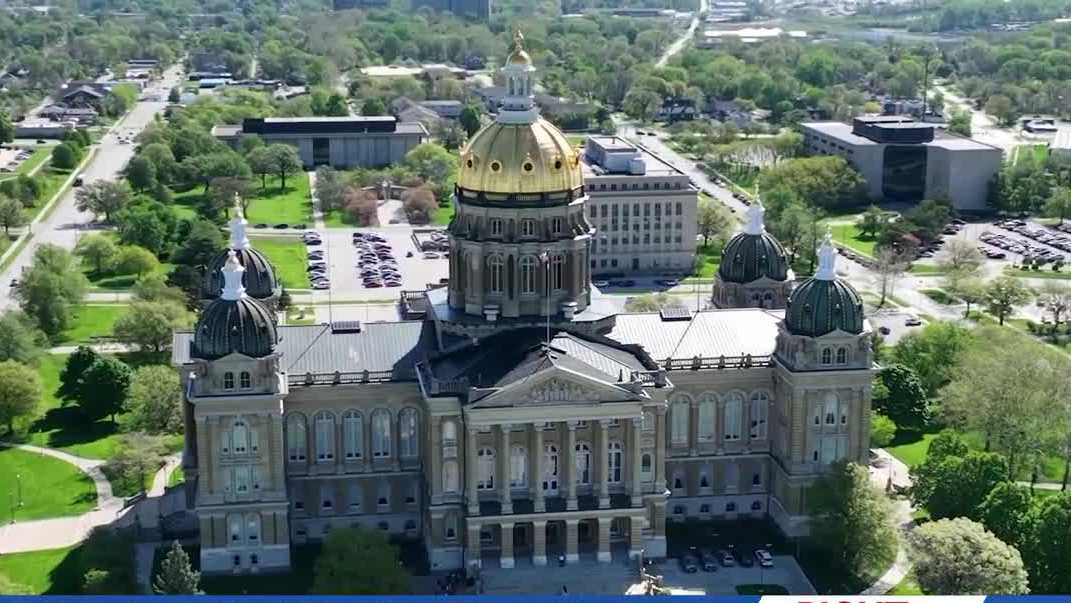
Gov. Kim Reynolds signs tax incentives bill into law, paving way for $15 billion steel mill
 DES MOINES, Iowa —
Iowa Gov. Kim Reynolds signed legislation that would allow the state to offer a larger package of tax incentives for a proposed $15 billion steel mill in southeast Iowa.
The Senate passed the bill 28-19 Friday evening, just hours after it cleared the Iowa House. The measure would expand Iowa’s MEGA economic development program to allow the state to offer additional incentives for a project of this size. The steel mill’s incentive package could be worth roughly $1.36 billion, though the state would still need to approve the project’s full application and negotiate a final agreement with Mesabi Metallics.
Reynolds signed the bill into law just before 9 p.m. Friday.
WATCH: Gov. Kim Reynolds signs Mesabi Metallics tax incentives bill into law
Reynolds called lawmakers back to the Statehouse for a special legislative session Friday to consider “reasonable and limited updates” to the state’s economic development program, which she said are needed to advance the project proposed by Mesabi Metallics, a Minnesota company owned by the India-based conglomerate Essar Group.
The terms of an agreement between the state and Mesabi Metallics have been outlined in a memorandum of understanding; neither provided a copy when asked for one.
The legislation would expand Iowa’s Major Economic Growth Attraction program, which offers tax incentives to businesses making more than $1 billion in qualifying investments in the state.
The biggest change would allow the Iowa Economic Development Authority to offer one qualifying project in a rural county an investment tax credit worth up to 10% of its qualifying investment. Current law allows credits of up to 5%.
While the specific location remains undisclosed, elected officials have indicated the project is set for Lee County, which has a population of about 32,000. The bill defines a rural county as one with 50,000 or fewer people. The new credit would be paid out over 10 years.
The legislation does not automatically award the steel project a credit equal to 10% of its entire $15 billion price tag. The credit would be based on the project’s qualifying investment, which can include land, site preparation, infrastructure, construction and certain business assets. The Iowa Economic Development Authority would determine how much of the credit to authorize, up to the 10% limit.
The company would also have to meet certain requirements before receiving the credit. The project, or a designated portion of it, would have to be operating, and at least half of the jobs associated with that portion of the project would have to be added to the company’s payroll. Those jobs would have to pay at least 140% of the state’s qualifying wage threshold.
The credit would be refundable and, with state approval, could be transferred to another person or business. The ability to transfer the credit would apply only to agreements entered into by the end of 2027.
WATCH: What we know about the company behind proposed $15 billion Iowa steel plant
The bill also includes provisions allowing the state to recover incentives if a company violates its agreement or program requirements, including through fraud, misrepresentation or claiming credits for expenses that do not qualify. For projects receiving the new 10-year credit, the state could also recover a portion of the tax savings if the company sells or makes the qualifying property unusable within 10 years.
Businesses participating in the MEGA program can also qualify for other incentives, including sales and use tax refunds, withholding tax credits, and locally granted property tax exemptions.
If approved by lawmakers and signed by the governor, the changes would take effect immediately.
Senate minority leader questions special session
Sen. Minority Leader Janice Weiner spoke on the Senate floor early Friday and questioned the special session and its timing.
Weiner released this statement:
“We all want to see good-paying jobs and investment come to our state. But, in less than one week, we’ve hurtled from rumors and speculation to a special session. We all saw the presentation in the Oval Office that claimed this was a done deal, but clearly this resolution proves those claims false.
“Why are we leaving regular Iowans out of this conversation? Why are we tripping over ourselves to approve a corporate tax giveaway for a foreign corporation?” Sen. Weiner said. “This does nothing to help Iowans who are hurting now. It doesn’t lower prescription drug prices, it doesn’t re-open local clinics, it doesn’t clean up our water, it doesn’t address our cancer epidemic, and it doesn’t help with record high diesel prices.
“Statehouse Republicans have run back-to-back billion-dollar budget deficits and now this piece of corporate welfare is moving forward before it’s been appropriately vetted or Iowans have had a chance to weigh in.”
The pivot to Iowa seems to have moved quickly
Iowa state Rep. Matthew Rinker said he joined conversations on a potential project in his district several months ago, according to the Associated Press.
Still, as recently as July, job listings on Mesabi’s website for the steel plant were based in Paducah, Kentucky, according to a version saved in the web archive. Jobs are now listed for Iowa, though the job responsibilities for a government relations manager still include interfacing with Kentucky’s economic development team.
While the company had been in discussion with Kentucky officials, the scale of the project “more than doubled over the negotiation period,” spokesperson Brandon Mattingly said in an email.
Iowa “did get kind of into the mix late,” said Rinker, a Republican. “I think once they got here, they realized this is where they needed to be.”
First, though, changes in state law are necessary for Iowa to compete against other states for the project, Reynolds said in her proclamation. She is asking lawmakers to modify the economic development program so that tax credits on eligible projects can be worth up to 10% of investments, an increase from the current 5%, and paid out over 10 years instead of five.
For a $15 billion project, that could mean up to $1.5 billion in kickbacks payable over 10 years once the plant is running and contingent on jobs.
A major investment opportunity could carry risks for local communities
Lee County does not have any zoning or permitting ordinances that would be required for the project itself. The company would need a permit for hauling on the county’s secondary roads.
The scale of an investment such as this one is asymmetrical with the legal and administrative capacity of a small, rural community, said Anthony Pipa, a senior fellow at the Brookings Institution who studies development and policy in rural areas.
While there’s a lot of potential upside to a project of this scale, that asymmetry also leaves those communities vulnerable and without significant leverage, he said. Pipa also pointed to examples of massive proposed investments that didn’t come to fruition.
In neighboring Wisconsin, for example, Trump announced a Foxconn Technology Group display screen manufacturing facility and its promise of 13,000 jobs, saying it would be the “eighth wonder of the world.” The state Legislature, at the urging of then-Republican Gov. Scott Walker, approved up to $3 billion in state tax breaks for the Taiwanese manufacturing company if it hit employment and investment benchmarks, though those were significantly scaled back by Walker’s successor, Democratic Gov. Tony Evers.
Foxconn has since dramatically reduced the scope of the project and now says it will employ about 2,600 people by the end of 2029.
Wisconsin Democrat Gordon Hintz, a leading opponent of the Foxconn project when he was a state lawmaker, said he sees parallels with what’s promised in Iowa.
“The idea of having domestic production in an Upper Midwest, post-industrial economy has a lot of appeal,” said Hintz, who is now a county executive. “The devil’s in the details.”
The Lee County Economic Development Board, which Rinker said was pivotal in bringing the Mesabi project to Iowa, said the plant brings “extraordinary opportunity,” while acknowledging the ongoing questions that need to be addressed “about workforce, infrastructure, housing, and community services.”
“We take both seriously,” board CEO and President Emily Benjamin said in a statement. “Our job is to help make sure growth like this benefits the people who live and work here.”
Information from the Associated Press was used in this article.