

Photo: Warner Bros./Everett Collection
This is the latest edition of The Critics, our weekly roundup of critical reviews, essays, and conversations. Want to have it arrive in your inbox every Friday? Sign up here.
This roundtable contains spoilers for Digger.
Thanks to a press tour involving a baffling GQ cover story and a protracted boogie through Jennifer Hudson’s spirit tunnel, the normally elusive and laconic Tom Cruise has been brought once again to the fore of the collective consciousness. The occasion? Digger, the latest film by the Oscar-winning director Alejandro González Iñárritu, in which the actor plays an unrepentant oilman named Digger Rockwell alongside the likes of Riz Ahmed, John Goodman, Sandra Hüller, and Jesse Plemons. The star power in and around Digger may be off the charts, and yet, as critic Bilge Ebiri writes in his review, the movie — about climate change and the powerful few who are running our planet into the ground — is “played at such full-tilt pomposity that it’s hard not to wince.”
If you are hypersensitive to spoilers, you should probably stop reading right here — though it’s not long into the movie that it’s revealed that the spectacle of remorseless oligarchs we’ve been watching is actually a play, and that Cruise (nearly unrecognizable underneath his prosthetics) is playing an actor playing Rockwell. Digger, which reportedly cost $160 million to $180 million and hit theaters today, has been largely panned by critics and is projected to be a box-office bomb. What went wrong? I asked movie critics Bilge Ebiri and Alison Willmore and our resident awards pundit Nate Jones. —Jasmine Vojdani, senior newsletter editor
We’ve been waiting for this Cruise-Iñarritú film for so long and, indeed, it’s been in the works for nearly a decade, also because of delays. What were you anticipating from this film before seeing it?
Alison Willmore: This movie has been set up to signal the next phase in Tom Cruise’s career, in part because he has been doing these action movies in which he insisted on physically putting himself at risk and doing stunts himself. This was supposed to indicate what Tom Cruise, Serious Actor, is going to be now.
Bilge Ebiri: I consider myself a great admirer of Tom Cruise as an actor, not necessarily as a person.Years ago, when I did a Rolling Stone “Every Tom Cruise Film Ranked” list and made a point to rewatch everything, I came away from that impressed by both the level of control he has exerted over his films, starting with Top Gun, but also by how genuinely he wants them to be good. Iñarritú is a director who I have a love-hate relationship with. I will always remember seeing Amores Perros for the first time and being completely blown away — and then seeing 21 Grams and Babel and thinking they were really bad. I love Birdman. There is a really good 100-minute movie in The Revenant somewhere, but the director wouldn’t edit it down. Bardo was a disaster on all fronts. I went into Digger thinking it could be a really exciting movie. I didn’t like the movie, but I wasn’t entirely disappointed, because it takes risks. It is wildly out there. It’s about climate collapse. And Cruise is absolutely taking a huge swing.
I’m a little disappointed that Cruise, for a variety of reasons, can never play a normal person again, a person who an audience can conceive of existing in the real world. The person he turns out to be playing in this movie is kind of farcical. Will he ever be able to play another Jerry McGuire? I think he could. The question is, will he ever do that?
I’m surprised to hear you say that it didn’t disappoint, because you describe the movie as “tortuous” and “like being trapped inside a tuba for two hours.”
B.E.: Disappointment and dislike are two very different things.
One of your critiques is that it’s hard to know how seriously to take a satire that doesn’t seem to take itself seriously. Your description of Digger actually made me think of the movie’s original title, Blah, Blah, Blah. Allison and Nate, do you both agree that it fails as satire?
A.W.: I feel like it’s actually a movie questioning the purpose of satire. We learn pretty early on that all of these people are putting on a play that is trying to skewer oligarchs who are destroying the world. These venal politicians and military generals are already existing in a bubble away from the rest of the world, and they don’t seem to feel responsibility to everyday people. The movie is making fun of them, and yet Cruise’s character — the actor he is playing — argues that, in making them caricatures, you lose any sense of them as people.
The movie suggests that satire is an empty bit of catharsis we can get without taking responsibility ourselves, that it is easier to be angry at individuals than to look at why we let those individuals succeed.Does it succeed on that entirely? I think it flips back and forth a little bit too much. I think that it is trying to ask, What are we looking for from these bits of satire? Having just come off of this run in the movie industry of so many eat-the-rich dark comedies, I think Digger is asking whether the measly catharsis we get from mean depictions of the rich and powerful is actually doing anything for us.
Nate Jones: To me, the ending was more Sullivan’s Travels–y, arguing for broad-minded satire. It was like, These people are so powerful, but we cannot stop them. The only thing we can do is laugh at them. It was more about the palliative effects of a satire.
B.E.: I think you’re both right, in a sense. The most frustrating thing about having to review this movie is that my favorite part of it is the last five to ten minutes. That’s the part that works beautifully.
A.W.: Yeah, you want to talk about it as a whole. Before you get the reveal that it’s a play, the film is a ghoulishly broad satire about a bunch of awful people — we as a society are finally at a point where that kind of satire is neither very sharp edged nor funny, just an incredibly grating exercise.
Could this finally be the end of that genre?
A.W.: It feels like we were reaching the end of it anyway. I think the movie makes you wonder what the genre is accomplishing. It’s not stinging the people who are being depicted as far as I can tell. A lot of those people literally own the companies putting out these movies and shows. Real levels of power are not controlled by a satirical comedy at the box office.
N.J.: It is a way that the movie is having its cake and eating it too. It’s like, I know I’m a broad satire; if any of this is clunky and obvious and not working, that’s because it’s meant to be. The movie is much more fun to talk about than to watch.
B.E. At first it was annoying, then it acknowledged that it was annoying, but then it continued to be even more annoying. At that point, I didn’t even know what to think. Iñárritu clearly doesn’t care if it’s annoying. That was when I was like, Nobody’s taking this seriously. And then the final scene makes it more interesting, but it doesn’t retroactively get better. On a granular directing level, the film fails in many ways. What is Sandra Hüller doing in this movie? It’s such a poor use of her.
N.J.: And she’s doing, I think, an American accent, which is kind of fun.
B.E.: When I hear about how the budget for this project ballooned and how long it took, I am just like what? Did they at some point reshoot or reconfigure it? Was the play originally in the script?
Bilge argues that the top-line silver lining of the movie is that Cruise, typically an apolitical actor, has starred in one of the biggest climate-change movies we’ve seen in a while. What else is redeemable that might make you recommend this film to other people? Are there laughs? Is it pleasurable as a hate watch?
B.E.: I would never describe anything in this movie as pleasurable. On some level, I think the set design is impressive. All the laughs in the movie are in the trailer. The score is horrible. It’s shot by Emmanuel Lubezki, the greatest cinematographer on earth, and it doesn’t even look very good. I enjoyed that scene where Digger gives his big speech. There’s so much to talk about in it that I keep saying “people should totally see this movie.” But at the same time, they should be aware that it could aggravate the living shit out of them.
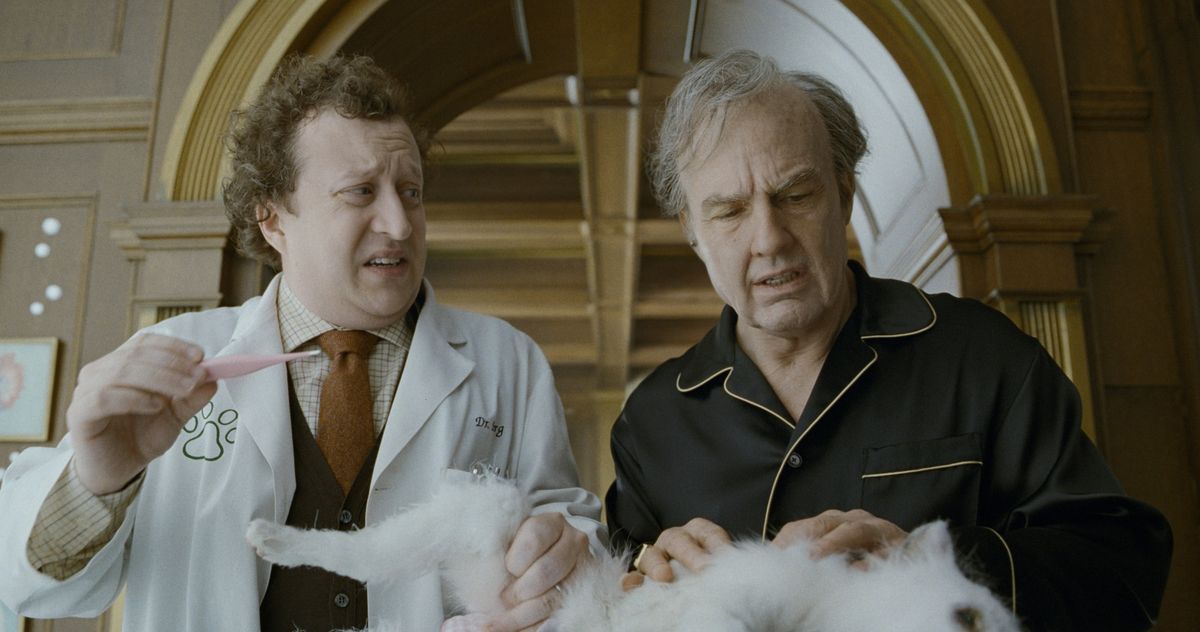
A.W.: I enjoy the look of the film. It borrows from Roy Andersson, a Swedish filmmaker beloved by cinephiles and known to almost no one else. You have these intricately composed shots, the camera is often static. Digger the character has this 30-year-old cat who wants to die …
Thank you for bringing up the cat.
… It’s an animatronic cat for the play, so it looks hilariously grotesque, and the idea is that he has been keeping it alive just by pouring money into it. It shits and pisses in his bed every night. It’s the only thing he seems to love. There’s something funny about him doting on this cat that is almost a revenant as an ongoing bit.
There are new Digger ads out this week incorporating the mixed reception of the movie into them. Is it as mixed as they’re making it sound, or is it vastly negative? We’ve also seen Cruise do press in a way that he hasn’t in a long time. Do you think this has a real shot at award nominations?
N.J.: This feels like a case where people are using mixed and polarizing as euphemisms. Every single Iñarritú movie has gotten an Oscar nomination. They invented a special technical award to give to a VR exhibition that he made.
I do think that given the star power and the bigness, Cruise can still make it into the five Best Actor nominees. It’s clear that they wanted to run a coronation campaign: Everything had led up to this. It’s very much narrative focused. The idea was to blow everybody away, become unstoppable, and then just coast from there so that Tom doesn’t have to do the whole six-month pole dance. And the Best Actor category has also gotten much more competitive. Suddenly people are talking about John Malkovich in Wild Horse Nine or Andrew Scott in Elsinore as potential winners. It will be fascinating to see if Tom keeps on the road and keeps trying to make the campaign happen, or if they quietly wash their hands of it.
B.E.: That’s another area where the Paramount-Warner merger could possibly have an effect. There have been examples of studio heads pulling the awards-season budget from a movie for whatever reason. I mean, if Tom Cruise really wanted it, he could finance his own awards campaign himself, but they tend not to do that. The industry has a way of closing ranks around Iñarritú. We’ll see.
I will say that, after I saw Digger, I had a strange guilt dream inspired by the movie, the kind of guilt that Digger the character is almost not allowed to feel in the film but that transferred itself to me. So I retroactively have a little more respect for the movie.
Sign up for The Critics
A weekly dispatch on the cultural discourse, for subscribers only.
Vox Media, LLC Terms and Privacy Notice