
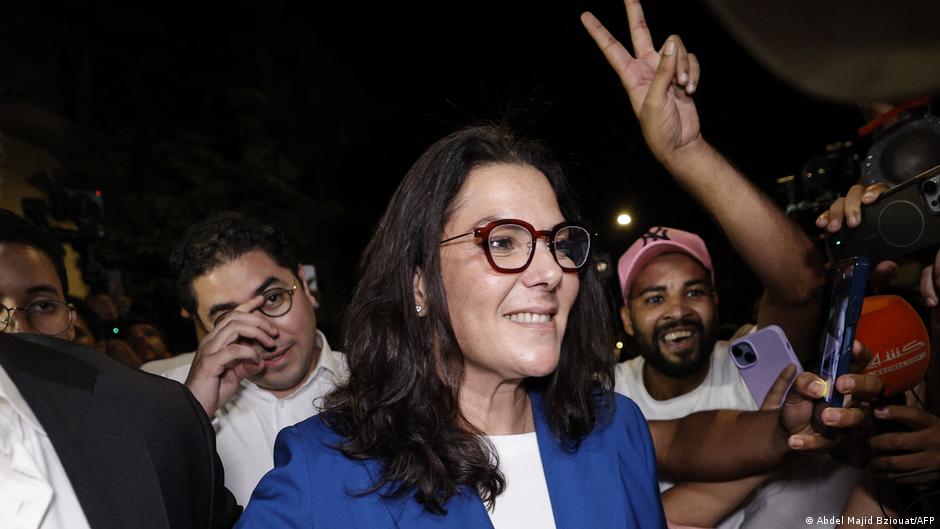
After the announcement that Morocco would appoint its first female head of government – Marrakech mayor Fatima Zahra Mansouri – citizens interviewed by local television reporters were mostly enthusiastic.
“It would be great if we had a female prime minister for a change. She’d lift our spirits a bit,” one woman said.
“Why don’t we give women a chance? We’ve never had one [a female head of government] before,” said another. “May God bless her and help her stay on a straight path.”
“Regardless of who takes on the role, it should be a change for the better in Morocco,” a man added.
Morocco’s King Mohammed VI chose Fatima Zahra Mansouri to be the country’s first female prime minister following September’s parliamentary electionsImage: Mosa’ab Elshamy/AP Photo/picture alliance
But there were also naysayers. Some locals questioned how she would take part in official events where tradition and protocol dictate that only men attend.
“People are saying that a nation cannot succeed if a woman is in charge, even if she’s only half in charge,” one man told a television reporter, referring to the fact that Morocco’s King Mohammed VI has the final say in national politics.
Morocco is a constitutional monarchy, so elections are held but the king has ultimate executive power. The head of the country’s government, or prime minister, leads the cabinet and administration and executes public policy.
The king chose Fatima Zahra Mansouri, minister of planning and mayor of Marrakesh, over Fouzi Lekjaa, head of Morocco’s football federation and budget minister. The pair are senior members of the Authenticity and Modernity Party, or PAM, which won the most seats in the country’s parliamentary elections in September.
“If you talk to Moroccans, there are some who are really proud of having a woman at the top and they see a chance for her to have impact on women’s representation in society,” confirms Anja Freudenreich, who heads the Morocco office of Germany’s Friedrich Ebert Foundation (FES) in Rabat. “But others see her appointment as bare symbolism.”
Mansouri will lead what is colloquially being called the “World Cup government” as Morocco prepares to invest billions before it hosts the 2030 football World Cup along with Spain and Portugal. Mansouri is seen to have shown leadership after the devastating 2023 Morocco earthquake.
Her appointment makes her the third woman to lead a government in the Arab world.
Morrocan women have become more visible in local politics in recent years. Casablanca and Rabat both have female mayors, and there are a number of female cabinet ministers Image: Abu Adem Muhammed/Anadolu/picture alliance
Will Mansouri improve the lot of Moroccan women?
There is no doubt that Mansouri’s appointment has important symbolic value, observers say.
Two Tunisian women, Najla Bouden and current prime minister Sara Zaafarani, became heads of an Arab government before Mansouri’s appointment. A 2022 surveyby polling organization Arab Barometer found Tunisian attitudes towards women in power had changed as a result.
Researchers from Arab Barometer believed the change — with only 40% agreeing that “in general, men are better at political leadership than women” in 2022 compared to 56% four years earlier — was the result of a “role-model effect.” Before the appointment of Bouden and Zaafarani, there had been no major changes, they pointed out.
According to a 2025 survey by the organization, attitudes toward women’s roles have also been changing in Morocco. Mansouri could accelerate that.
“We’ve already noticed how impactful this [appointment] is in terms of social and cultural norms,” said Stephanie Willman Bordat, co-founder of Rabat-based advocacy organization, Mobilizing for Rights Associates (MRA).
“People in public spaces, in cafes, on trains on their commute and just regular folks are having conversations about women’s leadership and the taboo that says women can’t be heads of government or women can’t be bosses of men. There’s good public debate and dialogue on this.”
“And on a global level, in terms of women’s participation, this is really something to encouraging,” Bordat, who has lived in Morocco for two decades, told DW. “Especially when you look at the global climate of backlash and regression in women’s rights.”
Mansouri’s prime ministership “is certainly notable as female leadership in the region is rare,” Freudenreich of FES agreed. “It does have a highly symbolic character and I’m sure she does, or she will have, a role model function for women and girls in Morocco as well as in the region.”
No major changes from past
However, Mansouri is unlikely to initiate a major change from past politics, Freudenreich suggested.
She’s more of a pragmatist than a rebel — a quality that’s likely to see her navigate the much-discussed issues of protocol — and her party’s electoral manifesto doesn’t go into any major detail on women’s issues, she pointed out.
Before the September elections, MRA looked at which parties had women’s issues in their electoral manifestos. Mansouri’s party, PAM, appeared to offer only three such policies.
PAM said it wanted to increase female economic activity, increase vulnerable widows’ pensions and ensure better obstetric care.Image: Jalal Morchidi/Anadolu/picture alliance
Other parties were more vocal on women’s issues than PAM, with some saying they would push for updates to the Moroccan family code, or “moudawana.” This sets rules on all-important aspects of Moroccan women’s lives like custody of children, divorce, property rights, marriage, polygamy and domestic violence. It has not been updated since 2004.
Did the king pick a symbol or is he genuine?
In 2023, King Mohammed VI asked the then-prime minister to look into further updates to the family code. Discussions around that are ongoing and reforms are still pending, MRA’s Bordat said.
“But what’s really interesting is that now we can say, well, women can be heads of government so women can also be heads or co-heads of family,” she argued.
The Moroccan king, who took the throne in 1999, has been broadly supportive of women’s rights, Ahmed Benchemsi, advocacy and communications director for Human Rights Watch’s Middle East and North Africa division, confirmed. Still, his organization would like to see things improve further.
“With regard to women’s rights, a symbol won’t serve women’s rights as much as legal reform,” Benchemsi told DW.
Morocco is generally considered comparatively progressive in women’s rights and the 2011 Constitution guarantees equality between men and womenImage: Moe Zoyari/Sipa USA/picture alliance
“Activism around women’s rights remains relatively permitted — an exception to the heightened governmental scrutiny and judicial proceedings against other areas of activism in Morocco,” the Carnegie Endowment for International Peace wrote in a July 2025 commentary. “The king’s leadership on gender reforms creates space for this activity, as advocates are often working in conjunction with parts of the government rather than against it.”
Given popular discontent with the economy and high youth unemployment and protests, “improving women’s status is a promise the government can deliver on in a challenging period,” the organization noted.
But right now, Bordat argued that Mansouri’s appointment shouldn’t be seen as “something to be either celebrated or criticized.”
The country is still waiting to see how Mansouri will form a governing coalition, she argued. How many female ministers the new government appoints, and what powers they are granted, will also be closely observed.
After that, “the real question is what civil society organizations, NGOs and citizens will do with this opportunity?” Bordat concluded. “That is, how do we hold all of the political parties and all of the newly elected representatives accountable and engaged … so we can continue to advance women’s rights in Morocco?”
Edited by: R. Casey