
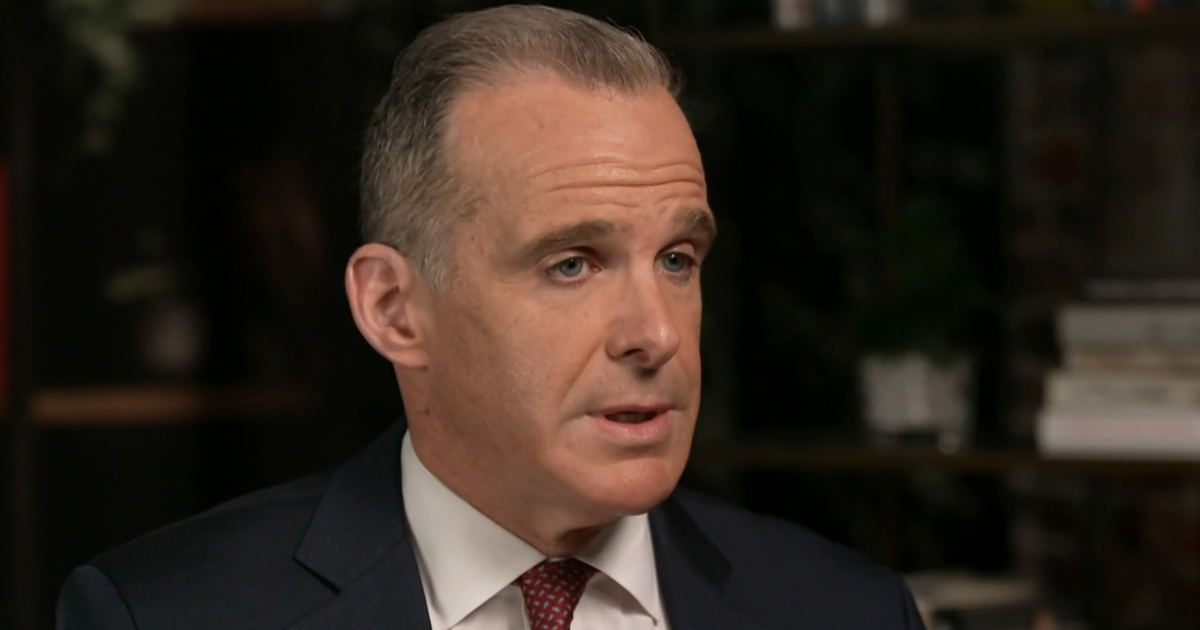
President Joe Biden was on the verge of taking “draconian measures” after an Israeli military drone strike killed seven World Central Kitchen aid workers in the Gaza Strip in April 2024, but U.S. intelligence that Iran was about to launch an “unprecedented” aerial attack on Israel prevented Biden from moving forward, according to Brett McGurk, a top Middle East adviser to four presidents.
In an interview with “Face the Nation with Margaret Brennan” taped Thursday, McGurk described Biden as “fed up” with Israeli Prime Minister Benjamin Netanyahu’s handling of the war in Gaza.
“At that moment, if not for that impending missile attack, which we then had to deploy military forces … I think we would have taken some pretty draconian measures against Israel,” he said, adding that cutting off U.S. weapons to Israel “was very much on the table.”
The U.S. and its Arab and European partners helped protect Israel from the Iranian attack, which McGurk said included 120 ballistic missiles, 170 drones and 30 cruise missiles that were “all launched to land at the same time.”
In his new memoir titled “Brink,” which is set to be published Tuesday, McGurk recalled a tense conversation between Biden and Netanyahu around that time in which the U.S. leader warned the prime minister he could end the weapons supply. At the time, the Israeli government said it believed there were more than 130 hostages in Gaza and around 34,000 Gazan deaths, according to the Hamas-run Gaza Ministry of Health.
“You think I’m Santa Claus? No Santa in Israel, pal,” McGurk quotes Biden as saying.
In McGurk’s interview with CBS News, the longtime foreign policy aide recounted the Biden administration’s initial reaction to Hamas’ Oct. 7 terror attack on Israel, its handling of Israel’s war against Hamas in Gaza, the efforts to secure an Israel-Hamas ceasefire and hostage release deal, the role of Iran and — starting years earlier — a long-sought push to normalize relations between Israel and Saudi Arabia.
McGurk is no longer working with the Bidens and is currently a CNN contributor.
McGurk: “If you just stop American support for Israel, that is not going to end the crisis”
Biden’s handling of the Israel-Hamas war has drawn years of scrutiny — including from within his own party. During the 2024 presidential campaign, the administration faced intense pressure to stop military aid to Israel amid the humanitarian crisis in Gaza.
The U.S. is the largest weapons supplier to Israel, and provides billions in aid. A 2023 State Department review of Israel’s conduct found that it was “reasonable to assess” that Israeli security forces have used U.S.-made weapons in ways “inconsistent with” international humanitarian law obligations. Casualties in Gaza, “including high levels of civilian casualties,” raised “substantial questions as to whether the IDF is using” U.S.-made weapons “effectively in all cases,” the report said.
Democratic Sen. Chris Van Hollen told “Face the Nation” in November 2024 that Biden didn’t use U.S. leverage effectively, arguing he sent Israel “more bombs and more money” after Netaynahu disregarded his requests, and pointed to U.S. laws blocking arms shipments to military units that violated human rights.
Since then, debates over the future of U.S.-Israel relations have continued to rage. Some of the criticism that the Biden administration was not strong enough in its response to Israeli actions in Gaza has been directed at McGurk, who was the White House National Security Council’s coordinator for the Middle East and North Africa and one of his most influential advisers.
McGurk noted that the Biden administration did pause some weapons transfers to Israel, including 2,000-pound bombs but never instituted a weapons halt. He believes some of the calls to go further may not have been effective.
“Israel also has one of the largest arms industries in the world, so the idea that had Biden gone further on a step on that course, it would have stopped the war, I just think the record does not support that,” McGurk said.
McGurk also argued that exerting too much public pressure on Israel could have hardened Hamas’ stance, ultimately setting back the negotiations to end the war in Gaza and release the hostages.
“I come back to the question: How do you end this crisis?” he said. “And I think the record shows: If you just stop American support for Israel, that is not going to end the crisis, it’s going to make it worse.”
At the same time as the Israel-Hamas war, attacks on U.S. forces by Iranian-backed proxy groups surged. McGurk pushed Biden to punish Iran in an effort to deter the attacks, and expressed some frustration with Biden administration colleagues who were wary of striking Iranian officials in response.
What would’ve happened if Iran “made a dash” toward weapons-grade uranium
McGurk said part of Biden’s goal was to prevent the outbreak of a broader regional war. Meanwhile, periodic aerial attacks between Iran and Israel continued.
In December 2024, McGurk traveled to Israel with national security adviser Jake Sullivan as they worked toward a deal with Hamas to release the remaining Israeli hostages.
During the visit, according to McGurk, Netanyahu talked about taking out nuclear sites in Iran, including at Fordow, a facility built inside a mountain that processed and stored highly enriched uranium. Fordow was one of the three Iranian nuclear sites that President Trump ordered to be bombed in June 2025, eight months before the Trump administration and Israeli forces launched a wider war against Iran.
McGurk said the Biden administration was concerned in late 2024 that Iran “might make a dash” toward making weapons-grade uranium, and officials were open to carrying out strikes if there were evidence obtained that showed Iran was making a bomb. Netanyahu urged the US not to wait for that step. Iran had been building up a stockpile of 60%-enriched uranium, which is a short step from the material required to build a bomb.
“We actually had a principals committee meeting — that’s everybody around the table — what would we do if we see that?” McGurk said. “And as I recall, unanimity on: We would do the strike in Fordow. We didn’t see that. We sent a message to Iran, don’t even think about it. But yet Netanyahu was clearly contemplating that.”
Hamas and Israel struck a ceasefire deal that led to the release of some hostages a month after that, just days before President Trump was inaugurated and the Biden national security team left the White House. McGurk said he and Mr. Trump’s Middle East envoy Steve Witkoff “agreed we’re going to work in lockstep.” He described how the Biden and Trump teams put pressure on both Hamas and Israel.
Hamas released the last living hostages in October 2025, as part of another ceasefire agreement.
U.S. saw no “warning or indicator” of Oct. 7 attack
The circumstances leading up to the Oct. 7 attack have drawn renewed attention in recent weeks, as The New York Times, The Atlantic and the Israeli newspaper Haaretz report on warnings that officials in Egypt and the United Arab Emirates allegedly delivered to Israel that Hamas was planning a major attack. Netanyahu has strongly denied that there were any warnings, but his opponents in Israel’s election later this month have expressed outrage.
CBS has confirmed via a former US official and a diplomatic source that Emirati Sheikh Mohammed bin Zayed al Nahyan, President of the UAE, did share a warning with Israeli Prime Minister Netanyahu in the weeks leading up to the attack. The UAE had learned that Hamas leader Yahya Sinwar was preparing a major attack but did not have specific intelligence such as a date, time or location.
McGurk told CBS News the U.S. had no intelligence that could have warned about Hamas’ Oct. 7 attack.
“We did not have anything in our system that would have been a warning and indicator,” he said. “No U.S. intelligence of a warning or indicator.”
But he said Israel should launch an official inquiry that probes its own security establishment and political leadership, much like the U.S. did after the 9/11 attacks.
“I think they had an assumption that was deeply ingrained that Hamas was deterred, assuaged, and was not about to do something massive on any scale like this,” McGurk said. “I think that was a false assumption in their system, a failure of imagination, and it was tragic.”
McGurk on the Biden-MBS fist bump: “I encouraged the president to just shake his hand”
Hours before the Oct. 7 2023 attack, McGurk said he met with the Saudi Arabian Ambassador to the U.S., Princess Reema Bandar, to discuss a different issue — a potential pathway for Israel and Saudi Arabia to normalize relations.
MB SUGGESTIONED INSERT: Just weeks prior, Prime Minister Netanyahu had stood at the UN General Assembly in New York and predicted a new Middle East to include normalization between the Jewish State and the Kingdom of Saudi Arabia, birthplace of Islam.
“I believe that we are at the cusp of an even more dramatic breakthrough: an historic peace with Saudi Arabia,” Netanyahu said.
The idea of Saudi Arabia establishing formal diplomatic ties with Israel had been floated to McGurk by Saudi Crown Prince Mohammed bin Salman nearly two years earlier, in January 2021, shortly after Biden took office, McGurk said, a deal that would have included a pathway to a Palestinian peace agreement. McGurk said he reported that extraordinary offer back to the President, but the U.S. did not act on it.
Biden was skeptical of Saudi Arabia, vowing in the 2020 Democratic primaries to treat the kingdom as a “pariah” due to U.S. intelligence indicating that Crown Prince Mohammed bin Salman was linked to the murder of Washington Post columnist Jamal Khashoggi.
McGurk also explained that Biden did not want to focus on the Middle East, and only reached out to the Gulf States after the chaotic August 2021 U.S. exit from Afghanistan caused the emergency need for the U.S. to ask those governments to take in Afghan allies fleeing the Taliban. The U.S. needed another favor in 2022 when Russia invaded Ukraine, and turned again to the Gulf states, specifically Saudi Arabia, asking them to pump more oil to alleviate a spike in prices.
Rebuilding frayed relations because a necessity for U.S. national security. McGurk said it was a “mistake” that administration officials did not engage with Saudi Arabia more frequently early in Biden’s term. He convinced him to visit in 2022.
McGurk offered rare criticism of Biden over his 2022 visit to Saudi Arabia, which came during a global spike in energy prices. He recounts that for 18 minutes Air Force One sat on the tarmac in the Kingdom as Biden argued with aides over how he would greet the Crown Price at his palace.
Rather than shaking bin Salman’s hand, Biden famously gave him a fist bump.
“He was concerned about the optics and the imagery,” McGurk told CBS News, and “I encouraged the president to just shake his hand.” He later said: “We were asking some very hard things to the Saudis that we needed for our core interests, and so I think the fist bump set us back.”
By 2023, the U.S., Israel and Saudi Arabia were working toward a normalization agreement, a complicated deal that likely would have involved the U.S. offering Saudi Arabia a civil nuclear program and Israel agreeing to concessions around the Palestinian territories. The Oct. 7 attack derailed those talks — and President Biden often openly theorized that Hamas may have sought to prevent normalization.
McGurk said he “never saw anything to tie a direct connection,” but didn’t rule out that idea.
“Hamas, of course, does not recognize Israel, wants to destroy Israel, and I would not be surprised if one of the motivations on October 7th was to knock this agenda off the table,” McGurk said, calling the prospect of Saudi-Israeli normalization “one of the biggest deals since the Cold War.”
President Trump has revived the terms of that U.S.-Saudi arrangement, including the pledge to develop a civil nuclear program. However, the current Israel government has refused to discuss a Palestinian state in the wake of Oct 7 attacks, and the civilian death toll in Gaza from the war makes normalization more politically difficult for Saudi leaders.