
A while back, I met an Israeli woman from a mixed family: one parent Jewish, the other Arab.
Her background struck me less than her way of thinking and how she saw Israeli society and the region. She does not fit neatly into the boxes we tend to use from far away.
How should we describe her: by her father’s side, her mother’s, or just as Israeli?
The question probably tells us more about our own habits than about who she is. We are trying to squeeze someone shaped by a different social reality into molds built by a decades-long conflict.
That meeting prompted me to look at Israeli society in a new way. It is deeply diverse, and its communities hold on to their religious, national, and cultural identities.
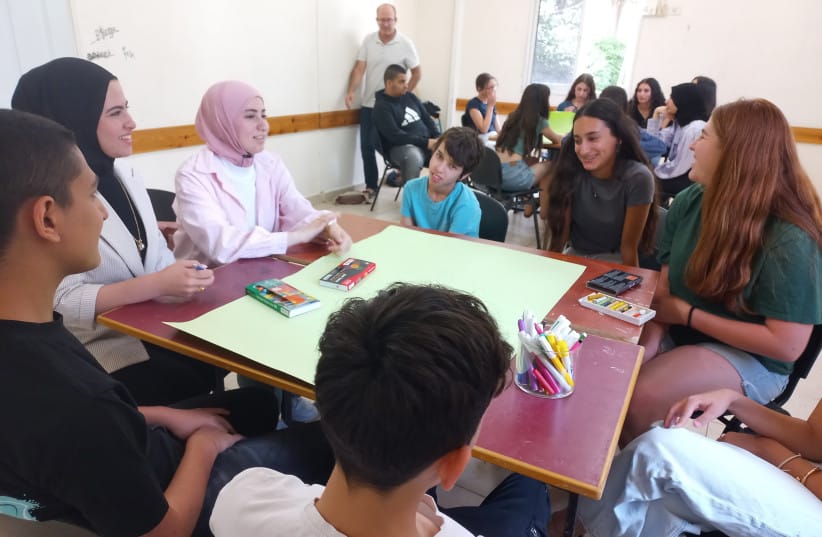 ISRAELI ARAB and Jewish youth often meet for the first time at Givat Haviva. The demand for shared society encounters is growing, the writer asserts. (credit: COURTESY GIVAT HAVIVA)
But decades of living in the same state have loosened the boundaries between them in daily life, much more than politics and the conflict would have you believe.
We, in the Arab world, usually see Israel through the lens of war, the Palestinian-Israeli conflict, the army, and the government. Those are real and fundamental. But they are only part of the picture.
Behind them is everyday life, built over generations among Jews, Arabs, Druze, Christians, and Muslims, and even within each of those categories, among groups that differ in origin and how they define themselves.
Israel holds a strange tension. Religion runs deep in the structure of society and the state, while liberal norms shape social, cultural, and economic life.
Plenty of problems, gaps, and disputes remain, and there is no reason to deny them or romanticize what exists.
Even so, spaces of citizenship and shared life have opened up. They have allowed Arab citizens to become doctors, judges, university professors, and members of the Knesset, and, in some communities, officers and soldiers.
Diversity of Arabs in Israel
The phrase “Arabs in Israel” also conceals more diversity than it suggests. There are Israeli Palestinians for whom Palestinian identity sits at the core of who they are. There are Bedouins, Druze, Christians, and Muslims.
Some families have roots in Lebanon, Syria, Egypt, and beyond. Some see themselves as Arab and Israeli, some as Palestinian and Israeli, and some put their Israeli identity first.
This does not match the story that parts of the traditional Arab media have settled on: the Arab in Israel as a citizen with no real belonging to the state.
The reality is more complicated. Recent polls show that a large majority of Arabs in Israel would rather stay in the State of Israel even if they had the chance to live in a Western country.
Interviews and public statements also reveal Arab Israelis who see staying in Israel as preferable to moving to an Arab country. These positions fall short of satisfaction, but they point to something real: Arab origin and Israeli identity can coexist.
What interests me most is not this overlap in its political or civic form, but the moment it enters the family itself. Marriage between Jews and Arabs in Israel is still limited, and the religious and social barriers around it are strong on both sides.
It would be wrong to present it as a broad demographic trend, or to talk about a large generation about to transform society. Its value lies less in the numbers than in what it says: that shared life can produce identities the old divisions fit poorly.
A person born to a Jewish father and an Arab mother, or the other way around, carries inside one home what the conflict has always presented as two separate worlds.
Such a person may hear Arabic and Hebrew, know Jewish and Arab relatives, and grow up moving between two cultures and two memories, maybe more than one religion or social tradition.
The Arab side might be Palestinian Israeli, Druze, Bedouin, or from a family with other Arab roots. For this person, the line between “us” and “them” can run inside the home rather than outside it. Sometimes it runs right through the family tree.
MY VIEW shifted after I met that woman. Her significance lies not in representing a large demographic segment, for she represents no such thing, but in her being a model of a human being produced by Israeli society itself.
The old definitions no longer describe such a person easily. I see no point in deciding whether she is an Arab Jew or a Jewish Arab.
What matters is that she is an Israeli with a composite identity, and the way she was formed says something about the society that raised her.
The October 7 massacre put this idea to a much harsher test. The attack did not spare Arab citizens who were in the areas that were hit. Arabs were killed, among them Israeli Palestinians and Bedouins, and others were taken hostage.
At the same time, Arab citizens joined rescue and defense efforts, and soldiers and officers from the Druze and Bedouin communities helped protect towns and fight.
When danger comes, identity stops being abstract. A person can keep their Arab origin or Palestinian identity and still see Israel as the state where they live. Defending its citizens means defending their family, their home, their future.
For people from mixed marriages, this becomes even more layered, because, for them, a Jew and an Arab were never two completely separate worlds. Both were always there – in the family and in their own formation.
So, I would say it is inaccurate to describe these people as a generation of peace. One of them might be right-wing or left-wing, nationalist or liberal, for the government or against it. Mixed marriage does not produce uniform politics nor immunity from the conflicts the society is going through.
This generation complicates the traditional map of the conflict. Political discourse usually needs fixed boundaries: this one is Jewish, that one is Arab. This one is Israeli, that one is Palestinian. These are here, those are there.
Inside mixed families, those boundaries can pass through the same house, sometimes through a single person’s identity.
That is why, I think, Jewish-Arab marriage matters less for its current size than for what it means. It shows that decades of living in one society can, even amid conflict and tension, produce people that a single word cannot adequately describe.
The paradox is that politics and the media can go on describing Jews and Arabs as two separate worlds, while life itself, even in small numbers, keeps producing people who belong, in varying degrees, to both.
The conflict and disagreements are not going anywhere. But that reality makes complete separation between identities harder to sustain as conditions slowly shift within society.
Perhaps what will matter in the future is not the number of these marriages, but what they produce: people who see no need to make a forced choice among the parts of their identity.
And what happens to a conflict when the boundaries it rests on no longer run cleanly between people, but start running through their identities, their families, their everyday lives?
The writer is a UAE political analyst and former Federal National Council candidate.