
Facebook
Twitter/X
LinkedIn
Pinterest
Reddit
Email
Print
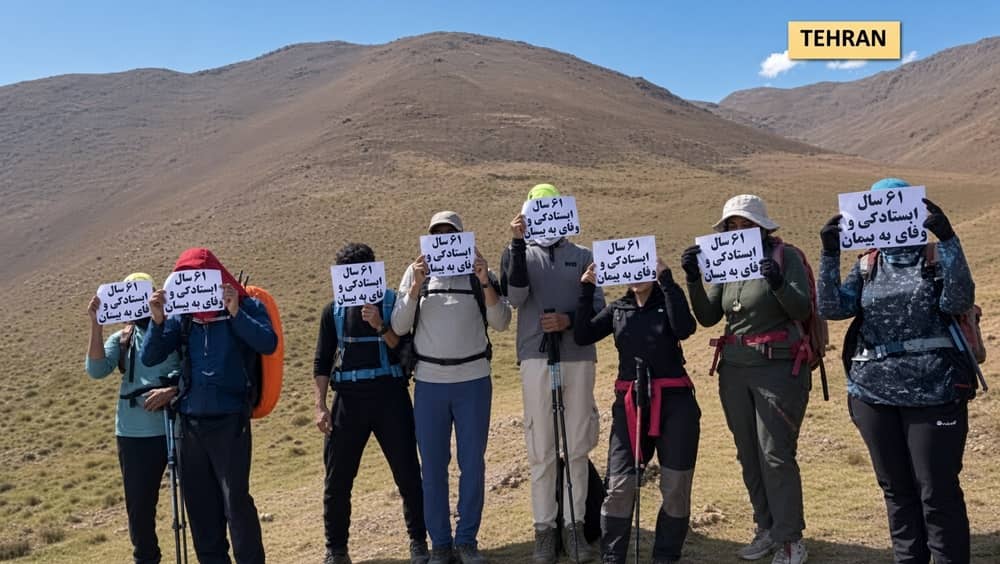 MEK Resistance Units on a mountain hike near Tehran, September 6, 2026, marking the organization’s 61st anniversary. Their signs read “61 years of steadfastness and loyalty to the pledge”
A major surge of coordinated direct actions, arson attacks on state security centers, anti-execution campaigns, and public messaging campaigns unfolded across Iran between September 27 and October 3, 2026. MEK Resistance Units executed over dozens documented operations targeting Islamic Revolutionary Guard Corps (IRGC) Basij bases, Ministry of Intelligence (MOIS) facilities, and state propaganda infrastructure. The week’s operations commemorated the martyrs of the 2022 Zahedan “Bloody Friday” massacre, honored recently executed dissidents, and reinforced the political movement rejecting both clerical rule and monarchical restoration.
October 3, 2026
Resistance Units conducted 20 fiery direct actions across 10 municipalities—Hamidieh, Tehran, Mashhad, Karaj, Shahriar, Yazd, Gorgan, Birjand, Aligudarz, and Bushehr—in response to the execution of rebels Ali Hemmati and Majid Nikandish in Mashhad. In Hamidieh, an armed team launched a Kalashnikov gunfire attack targeting the command headquarters of the repressive police forces. In Tehran, units executed a Molotov cocktail attack on an IRGC Basij base and burned banners depicting Supreme Leader Ali Khamenei and deceased military commanders. In Karaj, an IRGC Basij base was set on fire, while field units in Aligudarz torched an MOIS intelligence command signboard alongside state propaganda banners. Additional torching operations targeting billboards of Ali Khamenei, Ruhollah Khomeini, Mojtaba Khamenei, and Qasem Soleimani were carried out in Mashhad (across multiple locations), Shahriar, Yazd, Gorgan, Birjand, and Bushehr.
🚨 EXCLUSIVE | 8 Resistance Unit Operations in Sistan and Baluchestan
Exclusive footage received by Simay Azadi shows highlights of eight PMOI Resistance Unit operations on October 2 across Sistan and Baluchestan Province.
According to the PMOI, the actions targeted large… pic.twitter.com/YyTJYMI4e0
— SIMAY AZADI TV (@en_simayazadi) October 3, 2026
October 2, 2026
In Sistan and Baluchestan province, units carried out 8 specialized operations across Zahedan, Rask, Iranshahr, and Khash. In Rask, Resistance Units targeted an IRGC Basij base and the tactical base of the 1st Battalion of the Rask IRGC Region with Molotov cocktails. In Iranshahr, an MOIS espionage headquarters guidance signboard was set on fire, while units in Zahedan and Khash torched billboards and bridge banners displaying images of Ali Khamenei and Mojtaba Khamenei.
Concurrently in Zahedan, Resistance Units launched an extensive placard display campaign featuring statements from opposition leaders Masoud Rajavi and Maryam Rajavi. The placards affirmed the core stance of “Neither Shah nor mullah” as a rejection of all forms of authoritarian rule, advocating instead for an armed National Liberation Army and a democratic republic. Public messaging displayed throughout the city included slogans such as “From Zahedan to Tehran, death to the oppressor, be it Shah or Leader,” “Dictatorship is dictatorship, whether with a turban or a crown,” and “No mullah, No Shah; Freedom and a Democratic Republic”.
🚨 EXCLUSIVE | 40 PMOI Resistance Unit Operations Mark Zahedan’s “Bloody Friday” Anniversary
Exclusive footage received by Simay Azadi shows 40 operations by PMOI Resistance Units across Tehran and 22 other cities on September 29, targeting IRGC and Basij centers.
The PMOI… https://t.co/Ysf8FUB0v1 pic.twitter.com/QHgwDoX6xs
— SIMAY AZADI TV (@en_simayazadi) October 1, 2026
September 29, 2026
Resistance Units conducted 40 synchronized operations across 23 cities to mark the anniversary of the September 30, 2022 (“Bloody Friday”) massacre in Zahedan. Operations took place in Tehran, Mashhad, Zahedan, Iranshahr, Karaj, Isfahan, Ahvaz, Qom, Ilam, Bushehr, Qazvin, Kermanshah, Bandar Abbas, Birjand, Shahriar, Dezful, Chabahar, Javanrud, Saveh, Azadshahr, Marivan, Khash, and Dehdasht. Highlights of the offensive included:
Dehdasht: Three arson attacks executed at the IRGC Nomadic Basij center.
Mashhad: Fire was set at two separate IRGC Basij bases.
Zahedan, Iranshahr, Ahvaz, Javanrud, Chabahar, and Marivan: Incineration of multiple IRGC Basij bases, the Khatam al-Anbiya Basij facility, an anti-student Basij unit, and an IRGC infantry battalion using Molotov cocktails.
Bandar Abbas and Ilam: Torching of MOIS intelligence guidance signboards.
Nationwide Propaganda Destruction: Torching of state banners and billboards featuring Khomeini, Ali Khamenei, Mojtaba Khamenei, and Qasem Soleimani in Tehran (3 sites), Mashhad (4 sites), Kermanshah, Birjand, Dezful, Khash, Karaj, Isfahan, Qazvin, Saveh, Azadshahr, Ilam, Bushehr, and Qom.
Simultaneously, in alignment with the “No to Execution Tuesdays” movement, Resistance Units conducted solidarity campaigns across 16 cities: Karaj, Tehran, Hamedan, Mashhad, Urmia, Arak, Yazd, Ahvaz, Bandar Abbas, Malayer, Langarud, Meshkin Dasht, Kermanshah, Fardis, Kazerun, and Jahrom. The units posted flyers, placards, and floral tributes demanding the immediate revocation of death sentences for political prisoners, specifically highlighting cases including Issa Chari, Zahra Tabari, Manouchehr Fallah, Masoud Jamei, Farshad Etemadifar, Mansour Jamali, Reza Abdali, Amir Hassan Akbari Monfared, Yaghoub Derakhshan, Alireza Merdasi, Ehsan Faridi, Arghavan Fallahi, and boxing champion Mohammad Javad Vafaei Sani.
🚨 EXCLUSIVE | Resistance Units Mark Anniversary of the September 27, 1981 Uprising
On September 24, PMOI Resistance Units across Iran held banners featuring Massoud Rajavi and Mrs. Maryam Rajavi, along with messages commemorating the September 27, 1981 uprising — 5 Mehr 1360.… pic.twitter.com/eMCQ94EJFs
— SIMAY AZADI TV (@en_simayazadi) September 30, 2026
The scale and tactical evolution of direct actions during the week of September 27 to October 3 demonstrate an intensifying operational capability among domestic Resistance networks. By combining armed attacks and strikes on IRGC infrastructure with nationwide anti-execution campaigns and public demonstrations in Baluchestan, the Resistance movement continues to challenge state authority directly. The operational footprint spanning 23 municipalities shows that state repression has failed to contain urban dissent, while the explicit rejection of both the current clerical establishment and monarchical restoration reinforces a clear political platform centered on establishing a secular, democratic republic.