
Human rights advocates warned that redevelopment of Gohardasht Prison could erase evidence from a site linked to the 1988 massacre of political prisoners and decades of abuse.
The Islamic Republic destroyed one of the last remaining watchtowers at Gohardasht Prison, also known as Raja’i Shahr Prison; footage of the demolition, shared across Persian media, showed it potentially destroying critical evidence of Iran’s crimes against humanity.
The watchtower was destroyed on Saturday.
The prison was evacuated and closed in 2023, after having become notorious for decades of human rights abuses against political prisoners following the 1979 Islamic Revolution.
An informed source told Iran Human Rights at the time that “Prison authorities told the prisoners that the prison had been sold for 10,000 billion tomans (€200 million) without naming the buyer and would soon be evacuated.”
Thousands of political prisoners were executed at the prison during the 1980s and thereafter, including hundreds during the 1988 massacre of political prisoners under an order by Ayatollah Ruhollah Khomeini.

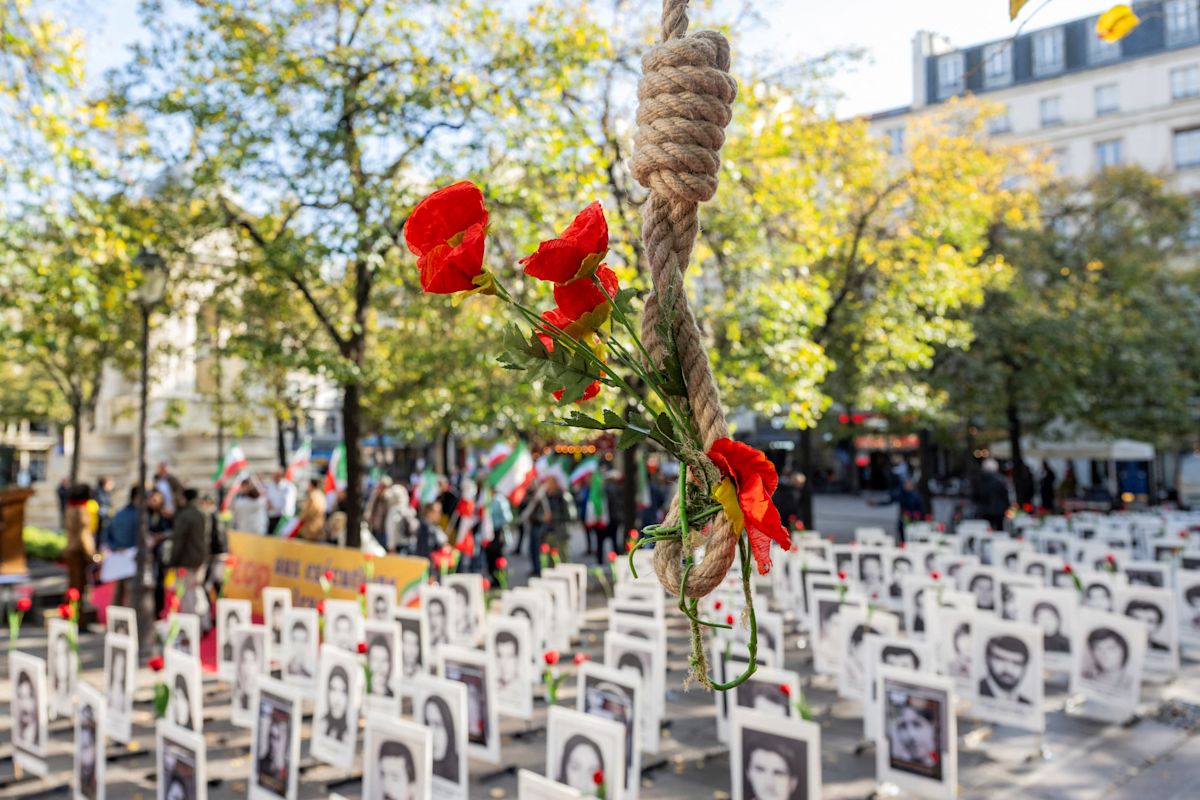
A WOMAN in the Netherlands holds a noose while standing near images of killed Iranian political prisoners, in 2024. (credit: Michel Porro/Getty Images)
Rights groups warned prison demolition could erase evidence of atrocities
Until its closure, human rights groups repeatedly documented torture and other abuses at the facility and warned that Tehran may demolish the site to destroy key evidence of the atrocities committed there. The site was already at the core of a Swedish legal case against Hamid Nouri, who was sentenced to life for his role in the executions and abuses but was traded to Iran in 2024.
Iran Human Rights Director Mahmood Amiry-Moghaddam said shortly after the sale that “Gohardasht Prison is the place where crimes against humanity were committed by those who currently hold key positions in the Islamic Republic.
We still don’t know the full scope of those crimes, and destroying the evidence is without doubt one of the key motivations behind its closure. The justice movement, Iranian civil society and the international community must do everything in their power to prevent the prison’s demolition.”
Iran presents prison redevelopment as cultural project amid criticism
The regime has presented the prison’s redevelopment as an opportunity to provide cultural facilities, university space and parks, according to Iranian media.
Mehdi Aslani, a former political prisoner at the prison, told Iran International that the demolition “is another attempt to erase the geography of blood from one of the most horrific tragedies in Iran’s contemporary history.”
“Memory is more resilient than the corrosion of oblivion. History has repeatedly proven this principle: crimes against humanity cannot ultimately be erased from history,” he said. “They say this is for urban redevelopment. They want to build a park and educational facilities on yesterday’s blood-soaked ground. And this is the bitter irony and injury of history.”