
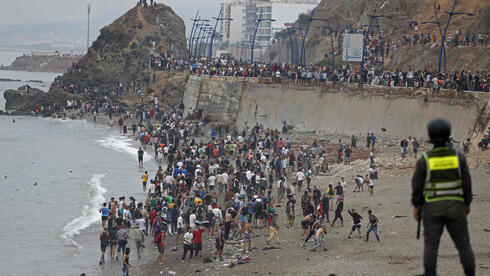
The moment you step off the ferry and leave the terminal in Ceuta, migrants approach from every direction. They are not asking for money. They point to their mouths or rub their stomachs. They are hungry. Within your first 20 minutes in the Spanish enclave on the North African coast, you encounter hundreds of them.
At the end of July, an estimated 80,000 to 100,000 undocumented migrants entered, or invaded, depending on whom you ask, this city of 84,000 people. Most were men, most from Morocco, with a smaller number from sub-Saharan Africa. Most returned within a day. Between 8,000 and 12,000 remained, at least a quarter of them unaccompanied minors.
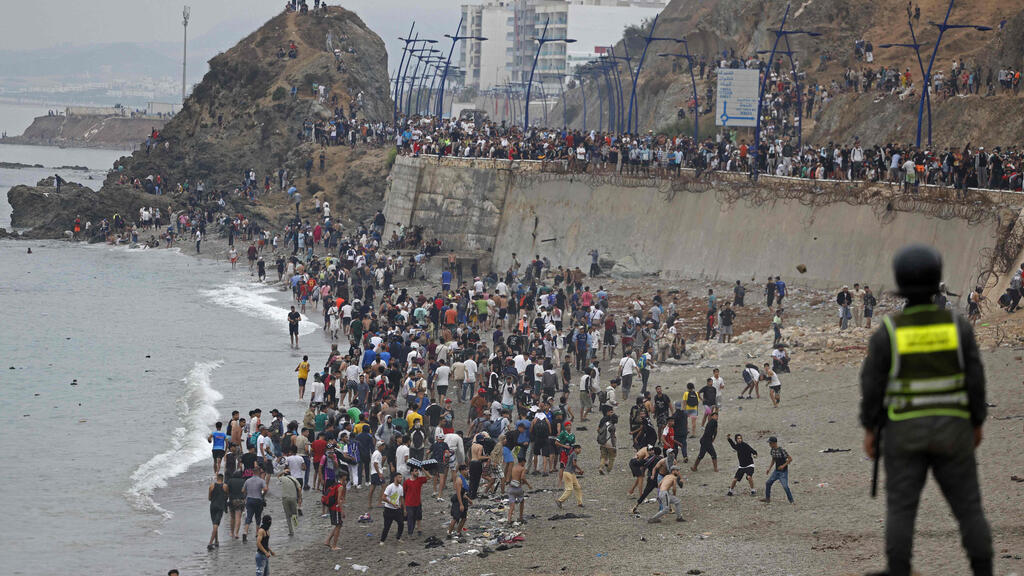
Migrant camp in Ceuta
(Photo: Abdel Majid Bziouat/AFP)
Groups of migrants are everywhere: on benches, in parks, along boulevards, in squares, courtyards, stairwells and playgrounds. They wander or stand around with nowhere to go, smartphones in their hands and blank expressions on their faces. Every few minutes, a fight seems to break out and local police move in. Sirens and helicopters provide the soundtrack to scenes that can feel almost dystopian. Spanish troops have been deployed to the enclave. Police and military vehicles, some armored, patrol the streets. Many migrants carry food, drink, tarps, bags, discarded materials, tires to use as pillows and palm fronds for makeshift shelters. The city’s only official reception center, built for 500 people, was already full before the influx. It now holds about 800 migrants, including 300 women, 180 girls and five pregnant women. Those turned away are left to fend for themselves. Many have cuts and scars on their arms and legs that have gone untreated. Some head toward El Príncipe, Ceuta’s impoverished, predominantly Muslim neighborhood, where they hope at least to find some sympathy.
Most have gravitated toward Playa del Trampolín, or Trampoline Beach, named for the migrants’ hope of using Ceuta as a springboard into Europe. Ceuta belongs to Spain and the European Union but is outside the Schengen Area’s passport-free travel zone, meaning reaching the enclave does not automatically open the way to mainland Europe. A sprawling makeshift settlement of at least 5,000 people has emerged between the N354 road and the sea. The stench of human waste and vomit hangs in the hot, still air. Stalls sell clothing, hygiene products and fish caught that morning. Drug dealers work openly. Bottles arranged in a rectangle mark out a prayer area. Most of the young men wear swimwear, sometimes with a shirt, often barefoot or in mismatched sandals. Some have dug shallow depressions into the ground and sleep packed into them, like communal graves for the living. They wash for long minutes under beach showers, scrubbing themselves without soap.
Behind the tent used by women and families is another fenced-off area. A minor who was raped is staying there, along with an older Moroccan migrant who was raped by seven men in the camp. Violence is everywhere, waiting to erupt, especially after dark. People fight over space, food and pride. Police and humanitarian volunteers leave around nightfall. During the day, aid workers distribute cups of noodles, white bread and water and provide places to charge phones. The Spanish government has installed three cellular antennas to improve Wi-Fi access. At night, however, the camp becomes largely lawless. To pass the time, men hold boxing, wrestling and makeshift weightlifting contests, using one another as weights.
At night on my hotel balcony, I wrote down the stories I had heard during the day: the escapes, the hours in the sea, bodies floating nearby, longing for parents, hunger, thirst and crime. On almost every piece of cardboard or paper they possessed, migrants had written the same word: Asilo, Spanish for asylum. Asilo, asilo, everywhere. All I could think was: Help, help.
This weekend marked exactly two months since the mass influx, yet no one can say with certainty why it happened when it did or how it grew so quickly. There are mountains of speculation and conspiracy theories. What is beyond dispute is what happened to Ceuta and to the people who crossed into it. Residents describe a small, relatively tranquil city transformed overnight into a crisis with implications far beyond its borders. Migrants describe believing they had swum toward freedom and the promised continent, only to discover that nobody was waiting for them. Instead, many found people determined to send them back. Whenever a new shelter opens, migrants race in from the beach, forests and other improvised camps, desperate for a bed, privacy and shade. In Ceuta today, few commodities are more valuable than shade.
Spain has controlled Ceuta and Melilla, another enclave bordering Morocco, for centuries and retained them after Morocco gained independence in 1956. Morocco considers the territories occupied, and their borders have long been a source of friction. Spain relies heavily on Moroccan cooperation to curb migration, drug trafficking and terrorism. Morocco, meanwhile, has repeatedly been accused of using control over migration as leverage in disputes with Madrid.
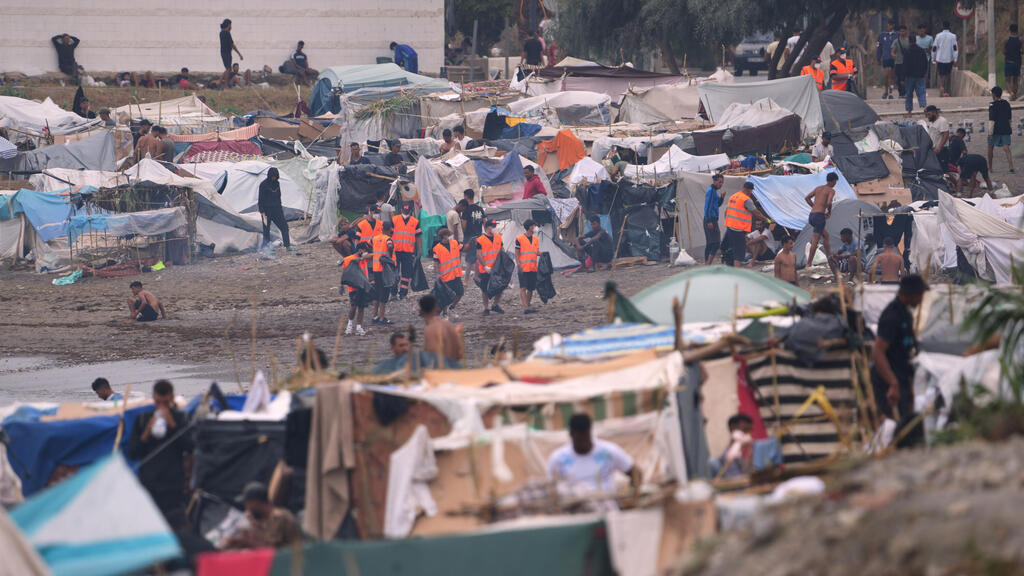
(Photo: Francis González/AP)
Economic pressures are also immense. Half of Morocco’s population is under 35, according to the article’s figures, while unemployment among young people stands at about 35%. In Fnideq, the Moroccan town immediately across the border, average annual pay is about 4,800 euros. In Ceuta, it is 36,800 euros. Seventy-one percent of young Moroccans have expressed a desire to leave. In January, Spanish Prime Minister Pedro Sánchez advanced a plan offering legal residency and work permits to hundreds of thousands of migrants who had entered Spain legally but remained after their visas expired. The aim was to bring people already working informally into the legal economy and tax system.
Then came July. Sánchez visited Algeria, Morocco’s bitter regional rival, for talks on strengthening relations and increasing gas purchases. Later that month, Spain’s Supreme Court issued a ruling restricting the immediate deportation of migrants who had not crossed a physical barrier without first receiving a hearing. That decision may have helped fuel the belief that reaching Ceuta by sea offered a route into Spain.
On July 30, King Mohammed VI marked the 27th anniversary of his accession to the Moroccan throne. As he spoke about economic prosperity, tens of thousands of young Moroccans were making their way toward Ceuta and Melilla by train, bus, taxi and hidden in trucks. Tens of thousands entered through the sea. Dozens drowned. When border police lost control, crossings also began over land. Europe watched with alarm, haunted by memories of the 2015 migration crisis. For the past decade, governments across the continent have tightened external borders, asylum procedures and deportation policies.
“A decade ago, when more than a million migrants came, every death, every body washed ashore, was headline news,” Ceuta resident Francesca González said. “We cried and mourned the tragedy. This time, 141 people died in two days, some of them babies and children, and nobody cares.” The influx hardened attitudes even in a city where roughly half the population has Moroccan roots. Shops closed their doors to migrants, sometimes refusing to sell them food or water even when they had money. Local groups armed with sticks tried to drive them from the city center. Police and soldiers pushed others back toward the border.
Gradually, a routine emerged: registrations, hearings and decisions. Unaccompanied minors are treated differently because they cannot simply be returned. “I will die before I go back to Morocco,” said Abu-Khaber Naji, 26, whom I met hiding in a forest in Ceuta.
The blame game began almost immediately. Residents accused Morocco, citing migrant testimony that Moroccan border guards had encouraged or directed people toward the crossing. Across Spain, Sánchez’s critics blamed his migration policies and his approach toward Rabat. Spanish intelligence officials said warnings of a mass crossing had been delivered in advance. Sánchez, meanwhile, accused Israel and Russia of spreading disinformation that led people to believe the border was open. Others blamed Donald Trump and ties among the United States, Israel and Morocco. Nearly everyone blamed social media.
The European Union has poured 109 million euros into new reception centers and border reinforcement in Ceuta, particularly facilities for minors. “For years we begged them to invest more money here in education and especially health care, and they always told us there was no budget,” González said. “Suddenly there are tens of millions to build reception centers with new infrastructure.” She described accompanying her daughters to school because soldiers were stationed outside and said she now feels compelled to tell them to dress more modestly when they leave home.
“They invaded our home, they stole my freedom,” she said, blaming Sánchez for abandoning the city. “I will never forgive that son of a b***h for turning me into a bad person who closes her heart to hungry children. I know I had to do it, but I will have to live with the images of those children, with the sand on their faces and in their hair.” “What I want is Ceuta’s old soundtrack back,” she said, “the silence, the waves breaking on the shore. But I know that isn’t coming back soon.”
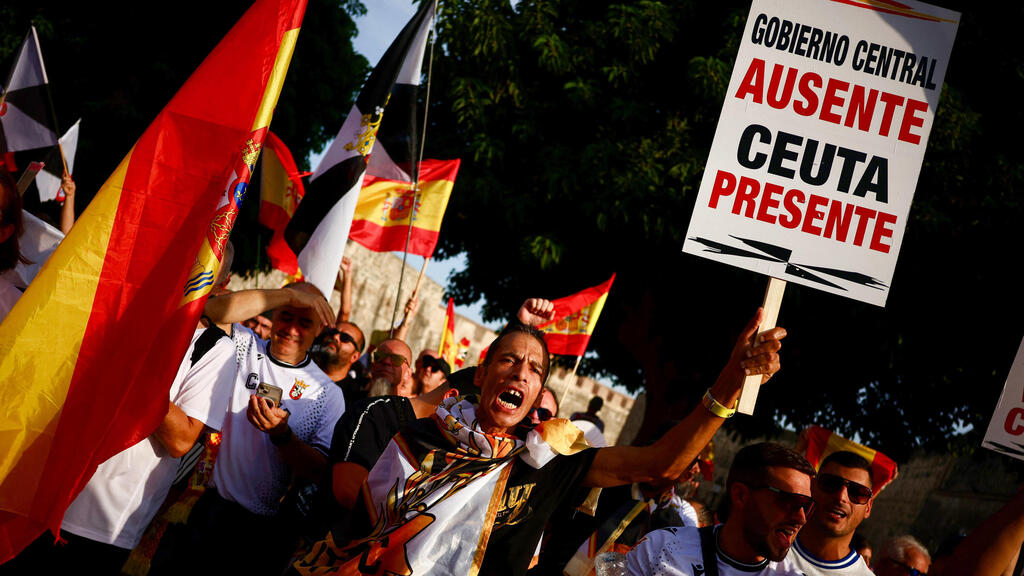
Pro-Ceuta demonstration in Madrid
(Photo: Pedro Nunes/Reuters)
That anger has spread into politics. Alberto Pérez, another resident, said locals understand the demographic and economic case for immigration. “We’re not naive,” he said. “We know there is a birthrate problem and immigration strengthens the economy, fills labor shortages and increases tax payments. We understand that this is the only way forward. But we also understand that it changes our identity.” “We are willing to accept immigration if we have control over our borders,” he added. “What happened here in July broke that trust.”
Anwar Saidi, 20, from Tangier, said rumors began circulating a day before the mass crossing. “WhatsApp and Facebook groups said the border was open to anyone who came by sea,” he said. “There was a lot of information: where to go, where to buy equipment, where to swim from.” Then came images of migrants supposedly already inside Ceuta, eating ice cream and flashing victory signs. “Only later did we understand it was staged, and smuggling gangs had paid locals to film it for TikTok,” he said.
Saidi abandoned work immediately. A friend brought along his younger brother. They climbed into the back of a truck with about 100 other people, got off near the border and entered the water. “It’s not a short swim, six or seven kilometers, six hours in the sea,” he said. “I know how to swim, but people who don’t know how grab you and pull you down. You’re in survival mode. Then you start seeing bodies floating beside you. More and more bodies. But there is no choice. You keep going.” His friend lost his younger brother in the water and still does not know what happened to him.
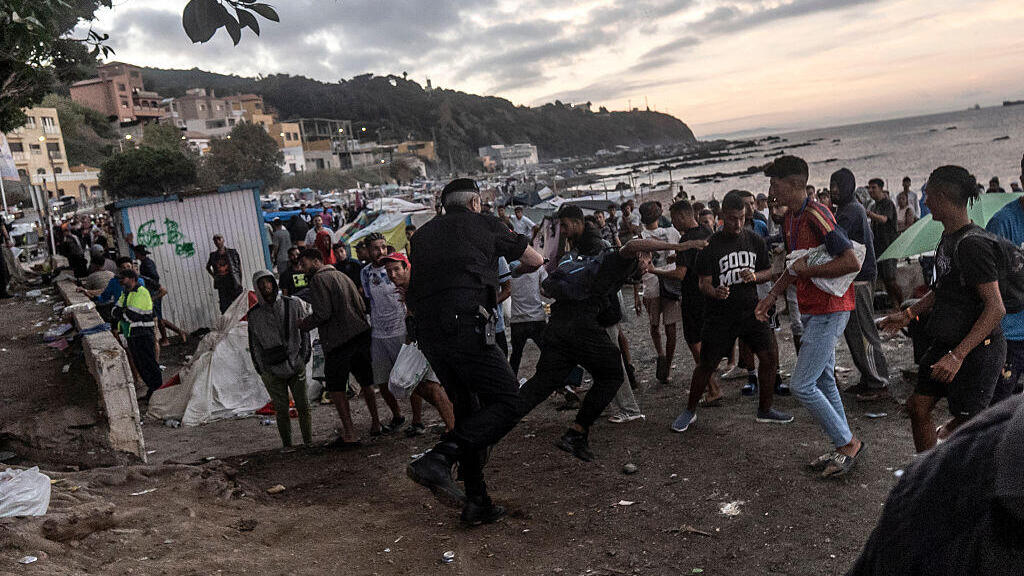
Clashes at the migrant camp in Ceuta
(Photo: Manu Brabo/Getty Images)
“When I reached the beach, it was the happiest moment of my life, but it lasted one second,” Saidi said. He fled soldiers, police and local gangs, then discovered he had nowhere to go. “My stomach growled for 48 hours. It was pain I can’t describe,” he said. “Before we came, we thought all we had to do was cross the border and continue to Barcelona, Madrid or Valencia. We didn’t know we needed special permission to leave here for mainland Spain.”
On Facebook, parents post photographs of children who left Morocco and vanished. Some may have drowned. Others are hiding in forests. “Sometimes they are only 10 or 12,” said local social worker Maria-Luisa Viadén. “Sometimes we find them and contact their families in Morocco, but the families say they don’t want them back. Everyone asks us where our heart is, but where is the parents’ heart?” Among those who attempted the crossing was Faten Ben Omar al-Azizi, a 26-year-old soccer player who drowned. The day officials came to inform her mother of her death, a letter also arrived approving her daughter’s visa application to Spain.
The Supreme Court ruling had been widely misunderstood. Morocco is considered a safe country by the European Union, and adults arriving from there are generally not entitled to political asylum solely on that basis. Over time, violence in Ceuta also shifted. In the first days, according to accounts in the city, most force was used by police. Later, some migrants began fighting back with tear gas and Molotov cocktails and setting police and military vehicles on fire.
Desperation and uncertainty have fueled the clashes. Whenever authorities open a new organized shelter for around 900 people, migrants rush in from beaches, forests, cemeteries and beneath bridges, sometimes violently, hoping for a proper bed, sanitation, privacy and shade. Some arrived with money or credit cards loaded into Apple Pay. Smugglers take others by speedboat across the strait toward mainland Spain, charging between 12,000 and 14,000 euros per person.
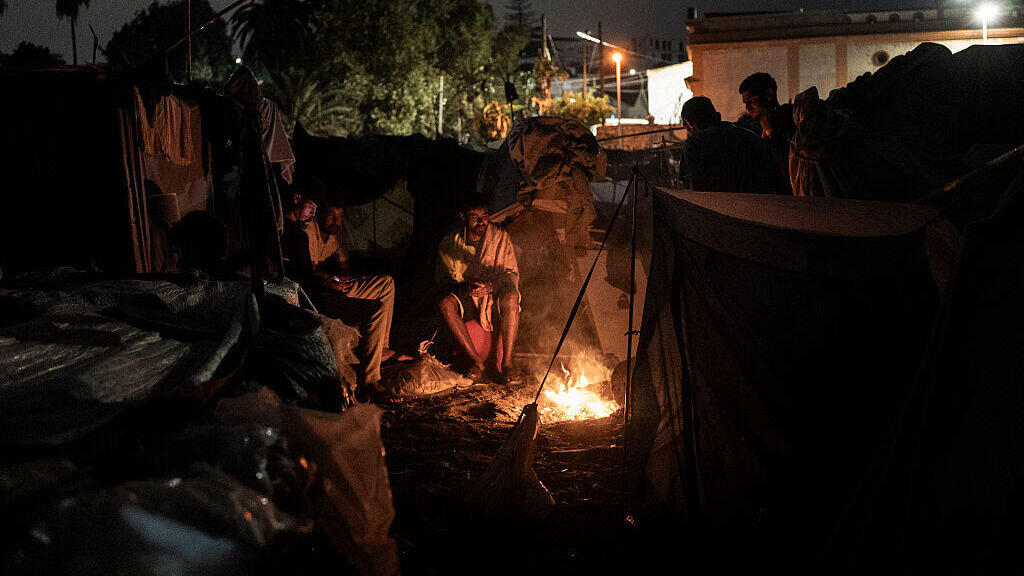
(Photo: Manu Brabo/Getty Images)
Almost none of the migrants still in Ceuta have identification documents. Before crossing, many carried out what they call harraga, burning their passports. “I want to get to Germany and become a truck driver,” said Ashraf Yousfi. “If I had somewhere to return to, I wouldn’t have come.” “I’m only going back to Morocco dead,” he said. “Give me a Rolls-Royce and a palace in Morocco and I’m not going back. I have no work there.” “If they opened the borders, half of Morocco would leave,” he added. “Those who went back only did it to prepare for the next attempt.”
For Yousfi, Spain is so close that it is almost cruel. “Spain is a dream we can see in front of us,” he said. “We see people who were born and immediately won the lottery. But to them we are noise. We have no faces. Nobody asks why we came. They only ask: How do I keep you out?”
Questions continue to follow Sánchez. Opposition leaders openly ask why his government has been so cautious toward Morocco, pointing to reports that Moroccan intelligence used Pegasus spyware to penetrate his personal phone and may have obtained sensitive information.
During five days in Ceuta, I visited the border several times. It is among the most formidable barriers I have seen: kilometers of double walls, barbed wire, police, soldiers, border forces, watchtowers and electronic surveillance. Spain spends hundreds of millions of euros financing, training and equipping Morocco to police the other side.
I looked at that monster of concrete, iron and steel again and again, struck by the fact that human determination had defeated it. It is a border separating hope on one side from an almost primal fear of that hope on the other. When the two collide, the result is explosive: a humanitarian disaster, lifelong trauma, a city turned upside down, parents who do not know where their children are and 141 dead, including babies and children, buried in Ceuta’s Muslim cemetery.
They were willing to risk death rather than return to Morocco, willing to die for the hope of freedom.