
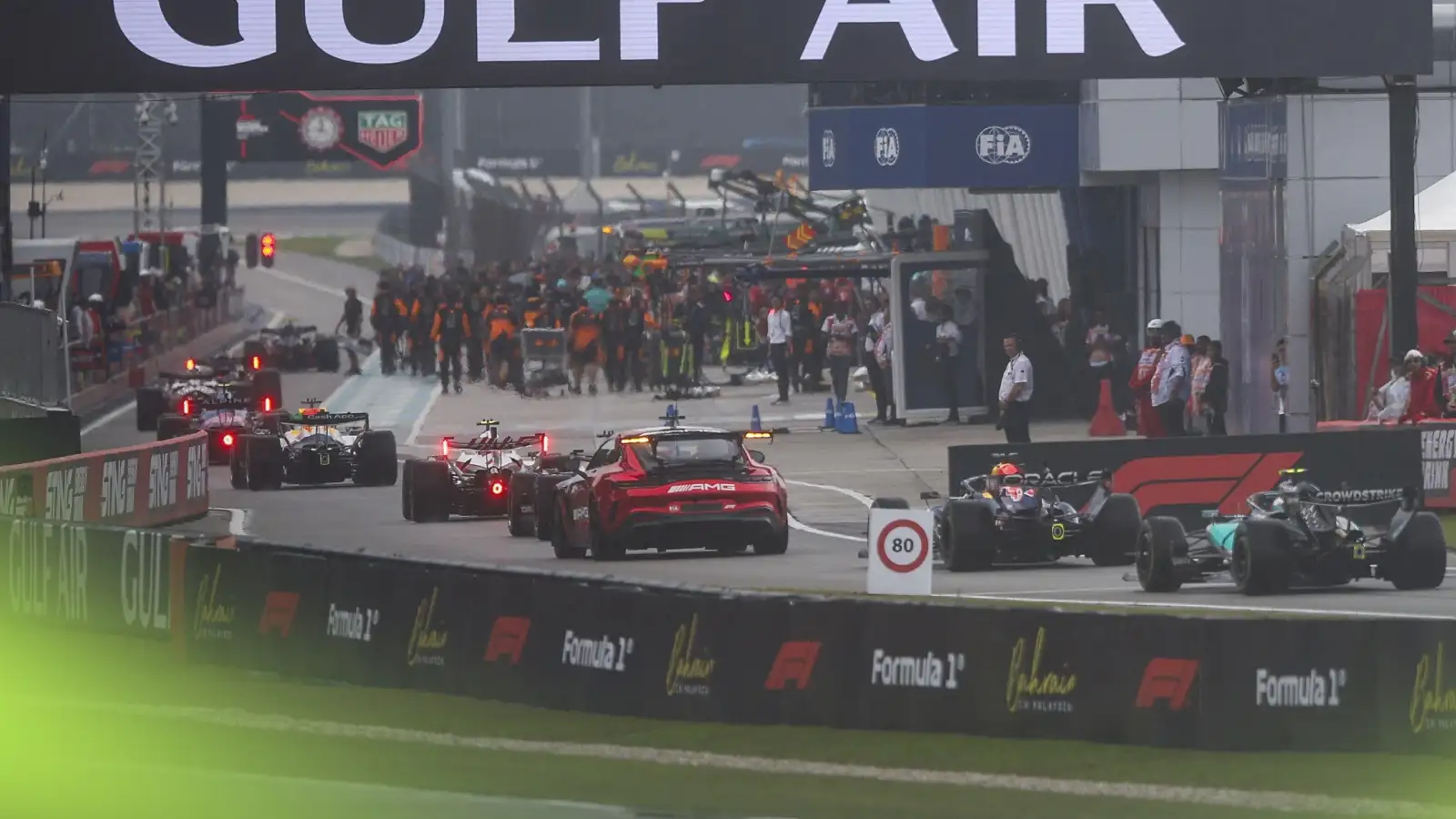
The formation laps at Sepang saw multiple drivers coasting to a halt as an unusual software problem emerged across the field.
The bizarre events of the formation laps in Sunday’s race resulted in a lengthy delay as FIA officials rolled out a software upgrade to ensure the race could go ahead.
FIA explains software failure that affected multiple Formula 1 cars
Multiple cars slowed to a crawl, unable to accelerate, during the two-lap formation to the grid at the initial start.
This started off with Lewis Hamilton’s Ferrari going slower and slower, falling back in the pack from second on the grid as others began to pass the ailing SF-26, while his Ferrari engineers desperately tried to resolve the software issue that had been spotted.
But Hamilton was far from isolated in his struggles and, moments later, fans were shown the bizarre sight of multiple cars stuck on the back straight and unable to accelerate: both Audis were affected, the two Haas cars, the Cadillacs, an Alpine, and a Racing Bulls.
With the start procedure suspended as Race Control realised something more serious was going on, the cars managed to get themselves back to the pits where a lengthy delay ensued, adding to the earlier race delay from the weather conditions.
With multiple teams pointing to issues with the FIA’s power unit software, a rather bizarre solution was quickly found and implemented: a software patch uploaded to the cars themselves, exactly like what you’d do with your phone or your laptop.
But what had actually gone wrong with the cars, and why did this problem suddenly appear out of nowhere two-thirds of the way through the first season with these power unit regulations?
Nikolas Tombazis reveals what caused the bizarre formation-lap failures
It’s been a year in which the complexities of the new hybrid power units has already been endlessly analysed and debated, but a whole new scenario was visited in Malaysia, and its the circumstances of this scenario that directly contributed to the confusion.
While the electrical output of the current power units is set at a 350kW distribution in a near 50/50 split with the internal combustion engine, this figure is reduced by regulation in wet weather conditions.
In order to help the drivers control the torque delivery of the electrical power, the figure is reduced to 250kW in low-grip situations, and this had been communicated to the teams at the start of the race, with them all having to load the software parameters, for the first time this year, to match the wet conditions.
However, there has not been a wet weather session so far in 2026, nor through testing, and, when the 250kW limit was switched to, the clustering factors of the circuit’s layout and the slow speed of the formation lap created the “perfect storm”, as one senior source labelled it, to create the mess.
“We didn’t manage to test the software as extensively as we would have liked because there has been very little wet running this year, and there was a bit of a combination of circumstances which caused this bug to kick in,” FIA single-seater Nikolas Tombazis explained to media, including PlanetF1.com, after the chequered flag.
“Basically, on the formation lap, some cars went very slowly, and almost came to a standstill. There was a bit of a concertina effect between cars, and some cars almost stopped completely. And that bug prevented the power unit to deploy for the cars to start again.
“I think if we had had a bit more testing, we probably would have managed to catch it in time and not have such occasions.”
The bug meant that the slow-speed corners saw the turbo RPMs drop and, coinciding with the reduced electrical output, meant the engines went into failsafe modes, with Hamilton getting his going again only by pulling over, stopping, and restarting at the side of the track.
Clearly, a fast solution was needed, and this is where the FIA came in: the software patch rewrote the constraints of the 250kW to ensure the MGU-K remained sufficiently alive through the sections with lower turbo RPMs.
“Once the problem happened, our guys realised very quickly what was happening and were under a lot of time pressure for an update on the software situation to the teams, and the teams had to install it on their cars. So all of that took about 20 minutes.
“It may have felt like five hours for spectators waiting a race and everybody else, which is understandable, and we are sorry about that.
“But I think it was quite a fast reaction, given the problem.”
The patch was created and rolled out very quickly, with the FIA officials then having to spend time validating the “rough job” to ensure the patch had successfully been installed across the field: this software is the standard software used by all the teams, created and validated by the FIA in collaboration with the standard ECU supplier [Motion Applied] and the teams themselves.
More from the Bahrain Grand Prix on PlanetF1.com
Bahrain Grand Prix in Malaysia 2026 – F1 race results (Sepang)
Christian Horner ‘disadvantage’ claim as Arrivabene addresses ‘Ferrari dream’
Why the FIA had not spotted the software problem before Sepang
Given the combination of factors that came together to create the problem, Tombazis was asked why the FIA had not foreseen the possibility of the 250kW reduction potentially having side effects.
But, with no representative track time ever occurring this year, Tombazis said it was clear that there had been an oversight.
“Any bug is a product of a mistake,” he said.
“I mean, I don’t know of any software that doesn’t have bugs and updates. Your computer probably gets updated every three days.
“Of course, anticipating these things is what one is supposed to do, but sometimes some very specific combination of events isn’t properly anticipated and causes the problem.
“The software was tested. It wasn’t tested in those specific conditions. What caught us out was the fact that cars went at very, very low speed, which was not normally contemplated.
“Now, when problems happen, people learn. Everything is based on learning things and improving.
“I’m not saying that no error happened, but by definition, an error, testing it better avoids errors. That’s obviously what people try to do. You learn, and you do a better job next time.”
While it appeared as though some power unit manufacturers or teams were affected more than others, with all the Ferrari-powered cars slowing, while Mercedes appeared to get away without any issues, Tombazis said this was circumstantial, down to the speeds they circulated at on the formation lap.
“Not all the cars reached the same low speeds in the formation lap,” he said.
“There was a bit of a concertina vector. I think Max slowed quite a lot from being in the front, and then some cars were braking harder and so on.
“So it was a bit of a concertina factor. Cars trying to not hit the front cars, and some cars slowed more, some cars less, and that caused some cars to create the problems that some others did not.”
With the race salvaged by the FIA’s fast work and the competent roll-out of a patch, a full investigation and debrief of the situation is set to be carried out by the governing body, with this particular bug having slipped through the net.
A statement from the FIA post-race said, “On the formation lap ahead of the Bahrain Grand Prix in Malaysia, an unprecedented combination of low engine speed, low-grip conditions, wet-weather energy management settings and the Sepang circuit’s sector configuration led to an unintended loss of power for a number of cars.
“As a result, the FIA technical department removed the energy limit constraint in the affected sectors through an updated software release distributed to all competitors during the race delay caused by heavy rain, enabling teams to make the necessary changes to the power unit before the start of the race.
“This issue had not been detected by the FIA or the teams during testing or during the laps to the grid. The FIA, together with the teams and power unit manufacturers, will undertake a full review of the issue.”
With several drivers hitting out at the issues, which are the latest in quite a list of complexities and unexpected behaviours from power units that are now near-universally regarded as overly complicated, the team bosses took a more circumspect view.
“I’d say better to resolve it than not resolve it,” Allan McNish said on the matter, when asked by PlanetF1.com.
“Obviously, it’s not ideal, and I think everybody is going to have an opinion on it. The reality was we were looking at how to fix the problem and get moved forward, as opposed to necessarily the optics of it at the time.
Very transparently, certainly, I don’t think anybody wants to have a situation where we have to come into the pitlane and then to have a further delay from there.
“But it is charting into a little bit new environment with the weather, the wet running, because that was the first time they’d really run in the wet.
“No one’s ever been in that position before, and so there’s an element of going into the unknown a wee bit.
“You can’t tick off everything. That’s the problem. I’m sure in the future there’ll be processes. That’s how you develop. You find problems, weaknesses, and then you find processes to make sure they, in theory, don’t happen again.”
Asked for his thoughts on the optics of what had occurred, Mercedes’ deputy team principal Bradley Lord summed it up: “I think it shows that Formula 1 is really difficult, and that, when we encounter situations we haven’t encountered before, I guess there’s a reason why we go testing before we go racing, and that was a situation, an untested situation, an untried situation.
“So we know that these cars are fiendishly complex, that the regulations that govern the cars are fiendishly complex, and that we can, even now at race 15 or 16, can still be caught out by certain elements of them.
“So I think the broad direction for the future is one of greater simplification rather than greater complexity. I think, what happened today, was a footnote in what was otherwise a really exciting afternoon of racing, so it probably won’t take up too many column inches or broadcast minutes!”
Want to be the first to know exclusive information from the F1 paddock? Join our broadcast channel on WhatsApp to get the scoop on the latest developments from our team of accredited journalists.
You can also subscribe to the PlanetF1 YouTube channel for exclusive features, hear from our paddock journalists with stories from the heart of Formula 1 and much more!
Read Next: Christian Horner sends message after landmark Red Bull victory