
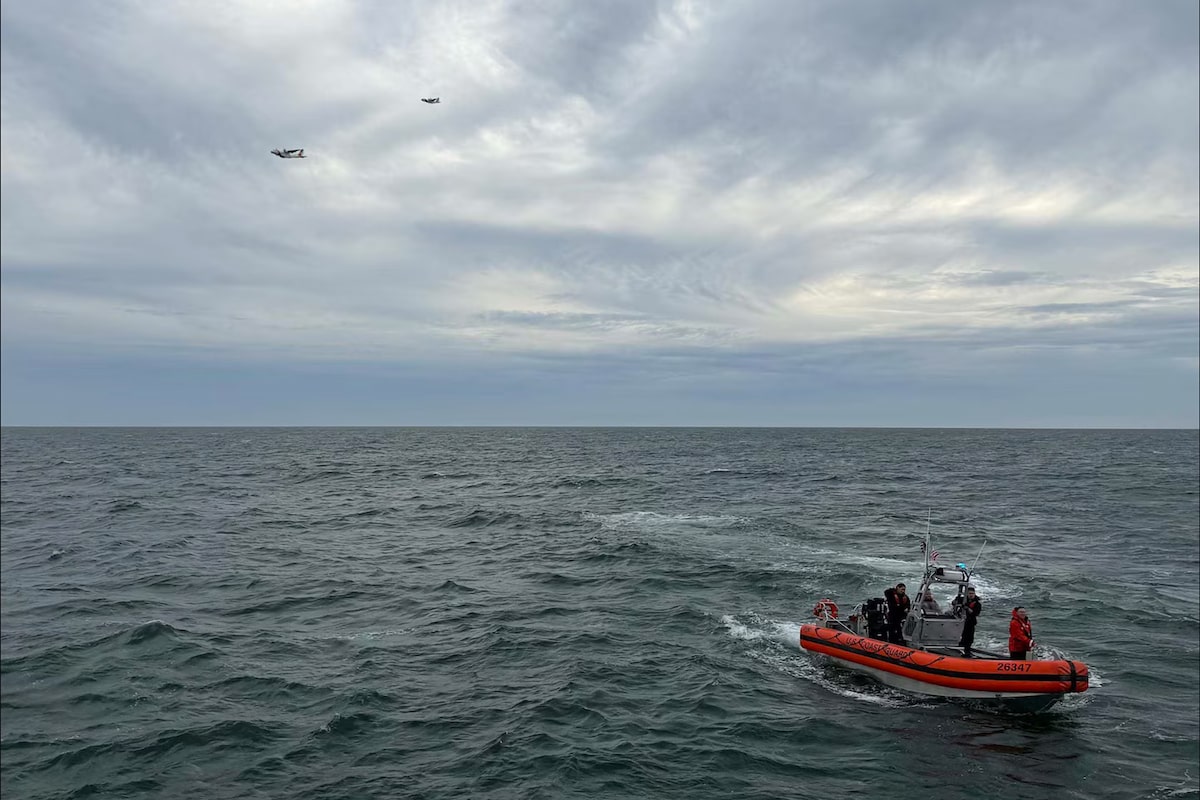
In a photo released by the U.S. Coast Guard, crew members search by air and on the water for a Boston-bound air ambulance that vanished off coast of Nantucket, Mass., on Saturday.Uncredited/U.S. Coast Guard
For 66 hours, a fleet of helicopters, planes and ships scoured more than 7,100 kilometres of ocean, searching for the six people on an Ontario-based air ambulance that went missing over the dark water near Nantucket Island early Saturday morning.
Finally, on Sunday night, the United States Coast Guard made the difficult call to end the search: The four Canadian crew members and two Bermudian passengers were not going to be found alive.
“Suspending a search is not an easy decision,” Rear Admiral Matthew Lake, Commander of the Northeast District, said in a statement. “We express our deepest condolences to the families and loved ones affected by the tragedy and our gratitude for our partner agencies who helped support search efforts.”
The rescue mission now becomes a recovery operation to collect the debris floating 32 kilometres from Nantucket, Mass., and sweep the ocean floor for wreckage, trying to explain how a seemingly routine patient transport flight ended with a plane shattered in the sea.
The Gulfstream G100, owned by Hamilton-based Latitude Air Ambulance, left Bermuda after midnight on Saturday, destined for Boston – a route this particular jet had travelled six times since early July.
A search remains ongoing off the Massachusetts coast for an air ambulance carrying six people that disappeared during a flight from Bermuda to Boston. A “debris field” was found later Saturday off the coast of Nantucket, the Coast Guard said.
The Associated Press
The plane was carrying two pilots and two medical crew members, along with a patient and their family member, for the one hour and 44-minute flight.
Clarence Togeretz, Latitude’s operations manager, said the company had been tracking the plane and lost contact around 1:30 a.m. Saturday as the jet neared Boston.
The Coast Guard launched its search half an hour later, eventually co-ordinating a fleet of fast-response ships and long-range helicopters and planes, with help from the New York Air National Guard. By late Saturday, they’d found a debris field and identified parts of the plane.
Staff at Latitude, Mr. Togeretz said, were coping with “as much positivity and optimism as we can,” and praying for a safe outcome.
As of Sunday morning, Captain John McTamney, who led the Coast Guard’s rescue operation, was still vowing to “search and saturate” the area until “we are confident that, if there were any survivors on the surface of the water, we would’ve found them.”
But hope was dwindling.
As of Sunday evening, the names of the crew and passengers have not been released by authorities.
This is the first time that Latitude had lost a plane in its 17-year history, Mr. Togeretz said on Saturday. On its website, the company claims “thousands of successful missions with a flawless safety record.”
Latitude is a privately held medical evacuation company based at John C. Munro Hamilton International Airport that offers emergency medical transportation worldwide to and from more than 130 countries, according to the company’s website.
Launched in 2009, with a single Bombardier Learjet 35 reconfigured as an airborne intensive care unit, the company has since expanded its fleet to include 10 aircraft according to Transport Canada.
From early July through to Oct. 3, the aircraft that crashed on Saturday was used for more than 90 flights in total, according to the aircraft tracking website FlightAware. Other long-distance routes included stops in Germany, Iceland, Corsica, the Azores, Mexico and the Caribbean, a flight to West Africa, and destinations across the U.S., including Florida and California.
Peter Byl, the company’s co-founder and chief executive officer, is a pilot with more than 24,000 flight hours, according to Latitude’s website.
Mr. Byl, along with his father, uncle, brother and cousin, have done medevacs in Canada and worldwide since 1958, he wrote in a LinkedIn comment posted three days ago.
Mr. Byl did not immediately respond to requests for comment on Sunday.
The company works with global insurers, governments and other organizations to fly patients between countries. In addition to the flight crew, the aircraft typically carry two medical crew and one to two patient escorts.
In 2023, Latitude broke ground on a new 44,000-square-foot facility at the airport, which was completed in 2024 and replaced space it had previously leased at the airport.
At the time, the company said it expected its work force, then 118 people, to grow by 50 per cent within two years of the facility opening.
In Canada, air ambulances are an essential part of the health care system, transporting critically ill patients to trauma teams and connecting rural and northern Canadians to clinical specialists in urban centres.
In 2025, for example, nearly 12,000 patients were transported on fixed-wing planes by Ornge, an Ontario non-profit group funded by the province.
But accidents involving Canadian medical transport airplanes are rare. In 2024, a Keewatin Air turboprop overran a runway in Goose Bay, Labrador. Nobody on board was injured and the plane sustained only minor damage, according to the Transportation Safety Board’s final report. In 2019, another Keewatin plane suffered significant damages when it landed short of the runway, but everyone on board survived.
In an interview Sunday, Gilbert Darrell, chief executive officer of Bermuda Air Ambulances, a medical transport company based on the island, spoke highly of Latitude’s professional reputation, and declared the company’s pilots and medical staff “the epitome of heroes,” for the risks they take.
He said about 200 patients leave Bermuda every year for medical emergencies that the country’s limited hospital resources cannot handle. “We can’t be thankful enough,” he said, for their contribution “to help some of our citizens.”
With reports from The Canadian Press