
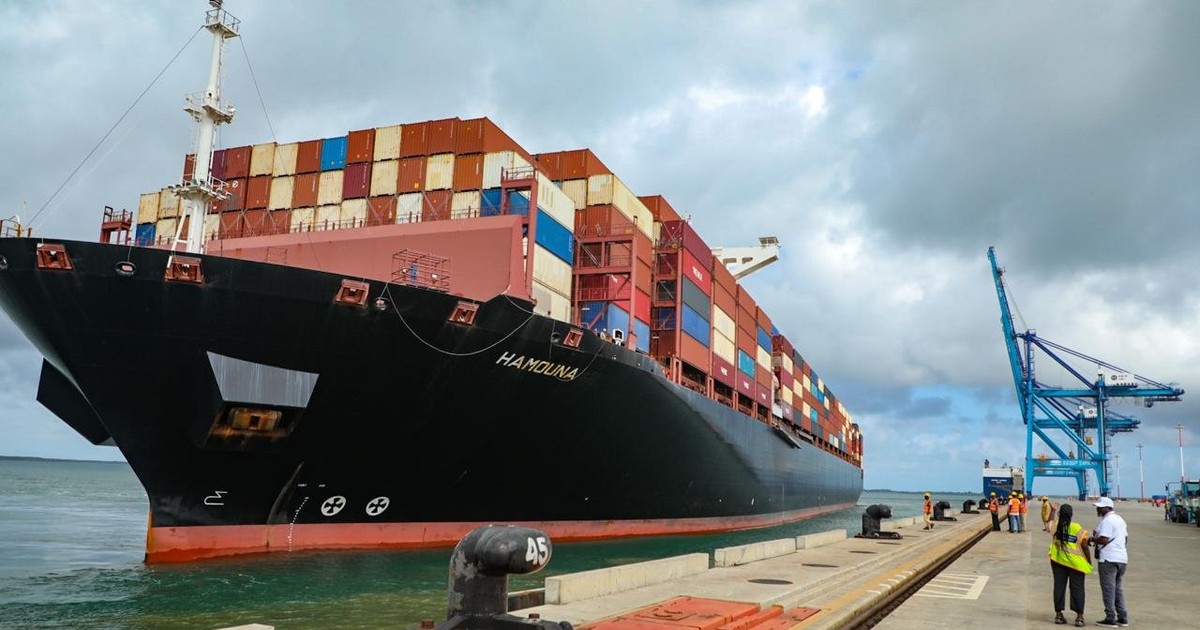
MV Hamouna, a 366-metre vessel operated by Iran’s Islamic Republic of Iran Shipping Lines (IRISL), arrived at Lamu carrying approximately 14,500 twenty-foot equivalent units (TEUs), with about 5,200 TEUs scheduled for discharge at the port.
According to the Kenya Ports Authority, the Port of Lamu’s deep-water harbour and modern berthing infrastructure allow it to accommodate some of the world’s largest vessels. Its berths have a depth of approximately 17.5 metres, providing sufficient draught for large ships.
The containers will be transferred to smaller feeder vessels for onward shipment to destinations across the region.
The record comes just days after Nigerian industrialist Aliko Dangote and Kenyan President William Ruto broke ground on a 700,000-barrel-per-day refinery in Lamu, positioning the port to play a much larger role in East Africa’s energy and maritime trade.

Lamu prepares for a new era of maritime trade
Kenya Ports Authority Managing Director Captain William Ruto said MV Hamouna’s arrival demonstrated the port’s ability to handle increasingly large vessels and strengthen its position as a regional maritime hub.
“This is the first vessel to discharge over 5,000 TEUs at once. Even our Mombasa Port has not surpassed this figure, making Lamu Port the next frontier in the maritime industry,” he said.
The vessel navigated approximately 14 nautical miles through Lamu’s Eastern Channel before berthing. The port’s berths have depths of about 17.5 metres, allowing it to accommodate some of the world’s largest vessels.
The latest milestone also comes as Lamu prepares for the much larger maritime flows expected from the Dangote refinery.
The refinery is expected to receive crude by sea and export diesel, petrol and jet fuel to Kenya and other East African markets. Reuters reported that the $16 billion facility is designed to supply refined products to Kenya and neighbouring countries once completed.
Lamu Port General Manager Captain Abdulaziz Mzee has said the refinery will generate a continuous stream of large crude carriers and cargo vessels, which will unload crude and reload refined petroleum products for regional markets.

The port’s infrastructure already gives it an advantage for handling large vessels. Kenya Ports Authority says Lamu has natural depths of up to 17 metres along its main channel and three operational 400-metre berths capable of servicing Panamax and Post-Panamax vessels exceeding 10,000 TEUs.
The refinery’s construction has already brought its first major project cargo to Lamu. MV Da Yang Bai He arrived on September 26 carrying about 2,930 tonnes of equipment for the refinery.
MV Hamouna is therefore another demonstration of Lamu’s ability to handle large-scale maritime operations as the port moves toward a bigger role in East Africa’s trade and energy supply chain.
Earlier this year, the 369-metre MV Baltimore Express also called at Lamu, while the 335-metre MV Nagoya Express set a previous vessel-size record in 2025.