
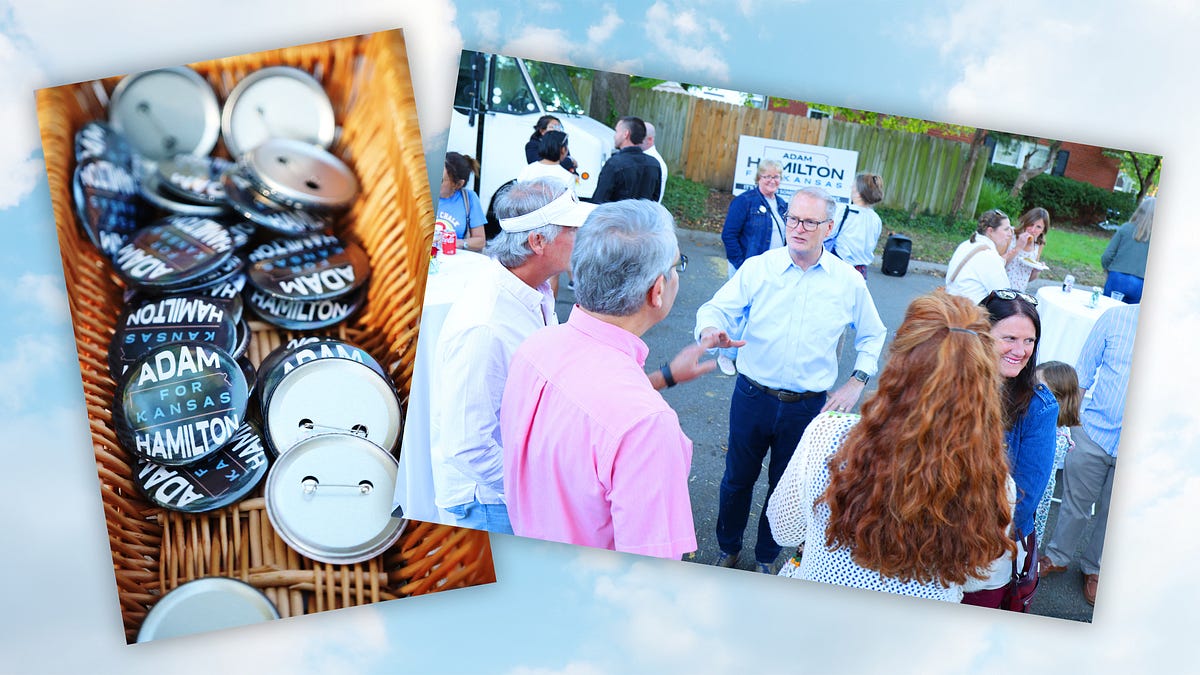
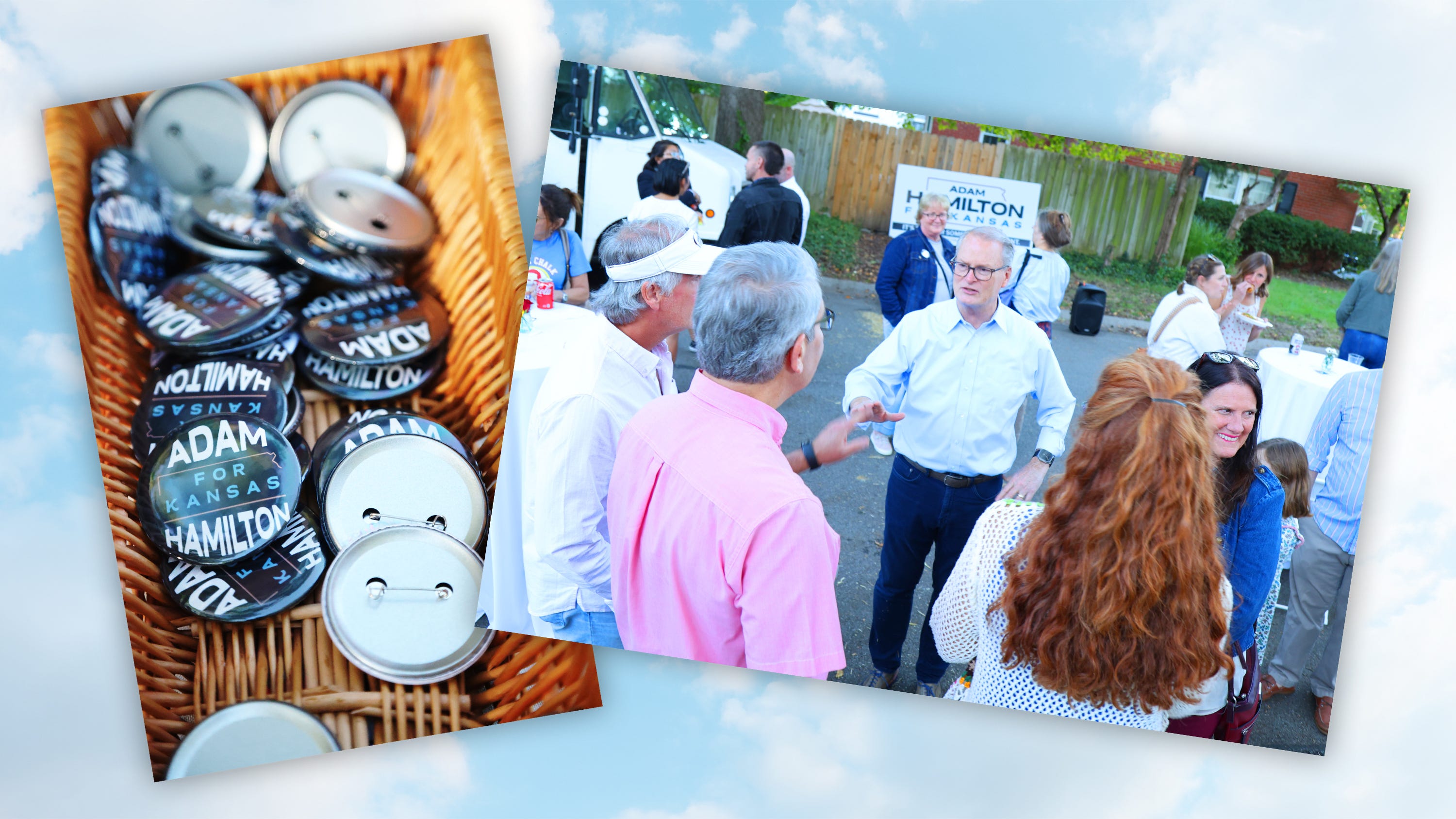
 (Photo illustration by Bill Kuchman/The Bulwark | Photos: Rupert Manderstam, Shutterstock)
Prairie Village, Kansas
STANDING IN FRONT OF A CROWD of roughly a hundred people on Friday evening, Adam Hamilton didn’t have the aura of a man whose entire life was about to be picked apart, whose political ambitions were set to be battered by millions of dollars of negative TV ads, whose campaign had become a vector of immodest hope for Democrats dreaming of an unfathomably successful midterm election.
Instead, the Democratic nominee for Senate in Kansas seemed calm, projecting an easy confidence as he stood on a hay bale.
Hamilton was addressing a block party of voters who had come to see him. And as those voters helped themselves to beer and wine from coolers—as the evening chill kicked in and the kids kept busy roasting marshmallows on a Solo stove—he seemed to welcome the target now on his back. He informed the crowd that the Senate Republicans’ top super PAC had pulled its money out of North Carolina and was diverting it to Kansas. The state’s airwaves, he warned, would feature a blizzard of ads against him, starting maybe within a matter of hours.
“They are afraid,” he said, his voice unshaken. “They should be afraid.”
Few Democrats would have imagined Kansas as a Senate battleground at the start of this cycle. Even fewer would have picked Hamilton as a candidate Republicans would fear. But the 62-year-old founding pastor of the nearby Church of the Resurrection, the largest United Methodist congregation in the country, has become just that—combining an atypical political biography with a congenial on-the-trail approach to potentially unseat incumbent Roger Marshall.
The polls suggest it could very well happen. The question now is whether Hamilton peaked too early. With a month to go, Republicans are rushing resources to the state. And even Hamilton acknowledged that he was entering a new phase of the campaign. Despite breaking fundraising records in Kansas, he told the crowd he still needed to raise millions more. He didn’t hide the personal toll that the campaign was taking on his church, his community, and his family.
When I asked Hamilton about it, he was confident in a way that perhaps only someone who regularly draws thousands of people to his church pews can be, saying:
Nobody likes a paywall. Including us.
But independent political reporting requires something that’s increasingly scarce: the time and resources to actually go find things out.
We know the value of talking to voters and candidates and campaign staffers. And as the midterms fast approach, we know you’ll find value in our work.
Help us keep putting reporters where the story is. Become a Bulwark+ member today.