

Fertility can be shaped by all manner of things. For example, fertility might be influenced by whether a friend or colleague recently had a baby. It can also be affected by car seat regulations, or even by whether or not you’ve had a parental care-like experience. And it now seems likely that worries about and accessibility to baby formula probably impact fertility, too.
In November 2003, the Israeli government banned a specific kosher baby formula, citing health issues in children using it. It later transpired that the formula had insufficient nutritional content, causing the death of at least two babies.
Exactly one year after the scare became public, the monthly Israeli crude birth rate, which had been rising, began to fall, plateauing around 16% lower than what it had been prior to the fall in February.
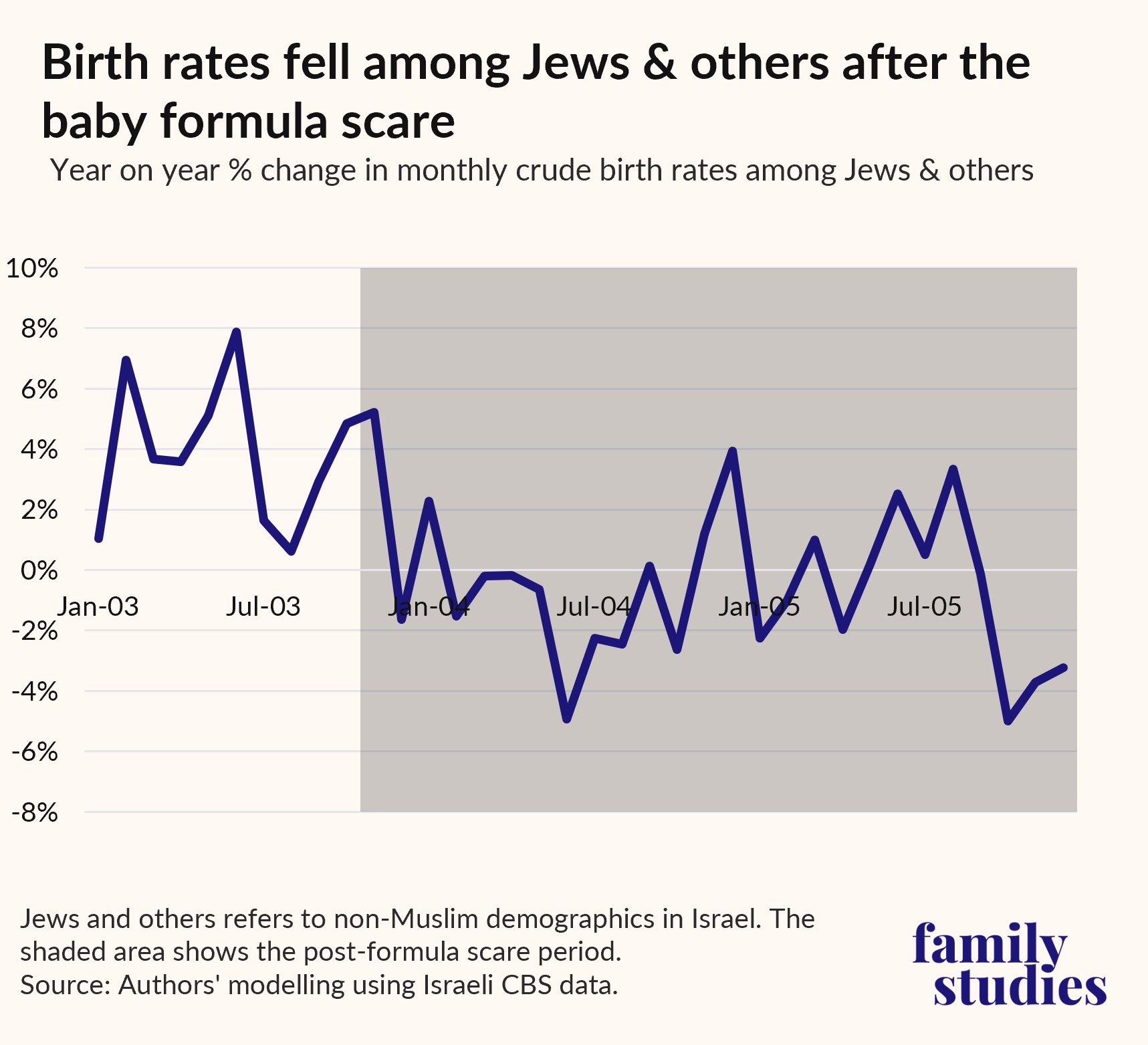
However, the Muslim birth rate did not change during this period. Muslims (who were, we can reasonably assume, not buying kosher formula in the first place) had around the same number of babies after the shock, whereas Jews and others—who were increasing their birth rate prior to the formula shock—began to see their birth rate fall exactly 12 months after the baby formula scare. Since pregnancies typically take around 9 months and time to pregnancy is commonly 2-4 months, this is exactly what one would expect if the baby formula scare had any immediate effects on the effort to conceive by Jews who keep kosher.
The discerning reader might remain unconvinced at this point! After all, it could be that other events in the country at the time (such as the intifada) impacted Jewish fertility without changing Muslim fertility. However, different Jewish groups breastfeed at different rates. The ultra-orthodox have low rates of formula use (likely on account of Orthodox Jewish teaching in favor of breastfeeding), while secular Jews are less likely to keep kosher, and therefore might be expected to switch to other kinds of formula milk following a baby formula scare. In contrast, traditional religious Jews both keep kosher and often use baby formula milk. If the baby formula scare did have some effect on fertility, we would expect traditional religious Jews’ fertility rate to decline the most, followed by orthodox Jews, and finally followed by the “not so religious” traditional Jews—meanwhile, we would expect secular Jews to be unaffected.
That is exactly what we see in the figure below! Each of the first three groups saw their fertility rates fall relative to secular Israeli Jews, and the higher the expected use of kosher baby formula, the more the growth in the fertility rate for those groups underperformed secular Jews.
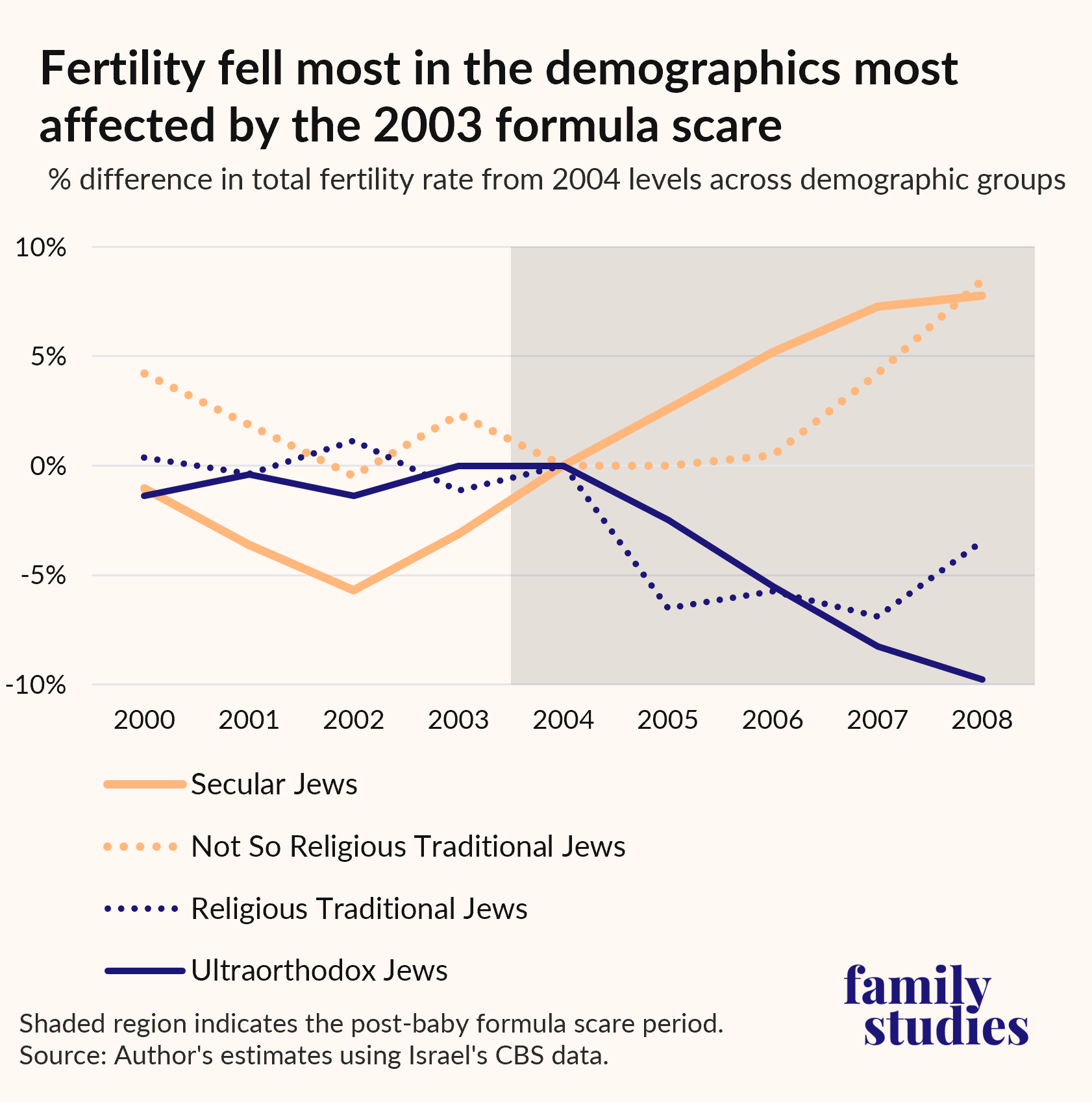
By 2005, the first full year after the baby formula scare, traditional religious Jews’ fertility rate fell by 5.4%, and the ultra-orthodox fertility rate fell by just 2.5%; whereas, the secular Jewish fertility rate rose by 5.9 percent.
The evidence is therefore highly consistent with the conclusion that Israel’s baby formula scare likely influenced fertility. But is this best understood as a matter of culture or a matter of the costs of parenthood?
Willingness to have children, even when it means that the option of using baby formula is uncertain, reflects cultural preferences, but it can also be understood as imposing a cost on parents (i.e., lack of ability to save time on infant feeding). This tells us that the question of whether changes in fertility can be ascribed to cultural or economic factors are not straightforward, since the two often interact.
Many commentators distinguish between “cultural factors” shaping fertility, and “cost factors” or “economic factors.” The case of baby formula shortages shows that “culture” and “cost” are not easy to separate. Specific cultural norms and practices around breastfeeding caused some groups to be more exposed to formula-related cost and availability shocks in Israel and the U.S., leading to differential changes in fertility. Was it cost or culture? The answer is: both.
The lesson for pronatalists is straightforward. If policymakers want to make it easier for people to reach their desired family goals, they will have to both offset parental costs and ensure that more family-friendly cultural norms are able to take root. What kinds of policies could do this? We’ve got some ideas, including in our latest report.
Peter Foreshaw Brookes is a Research Associate of the Pronatalism Initiative at the Institute for Family Studies.
*Photo credit: Shutterstock