
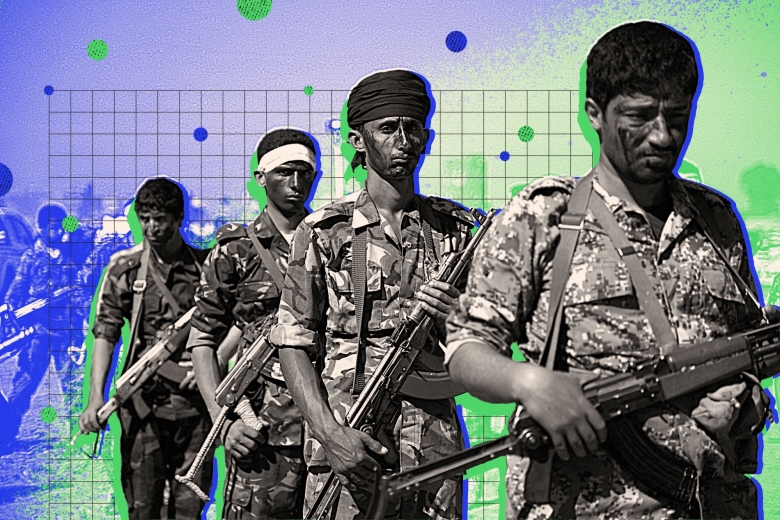
The two-strait energy coercion trap
In particular, the 9 September Iraq-based strike coinciding with the Houthi push for the Southern Red Sea coast and Bab al-Mandab is a good illustration of IRGC goals. By 11 September, the Houthi rebels, with deployed IRGC and Hezbollah support, held al-Mocha, al-Khokha, Hays, and Dhubab, as well as the strategic islands of Zuqar, Hunaish, and Mayyun/Perim, sitting above and in the middle of Bab al-Mandab. This extended control of the coastline and the trafficked international waterway tightens Iran’s leverage over the Arabian conundrum, its two straits, global energy flows, and ultimately intensifies the regional security conundrum.
Maximum proximity to Bab al-Mandab improves Houthi-IRGC surveillance, shortens strike and warning timelines, enables deployment of direct-fire arms including ATMGs and RPGs, and compresses the sensor-to-shooter gap for drones, missiles, rockets, booby-trapped boats, and naval mines that were already disrupting Red Sea shipping from a distance. The strategic significance beyond physical presence is the greater capacity to impose risk around the strait and secure illicit arms flows to sustain their transnational drone and missile capabilities.
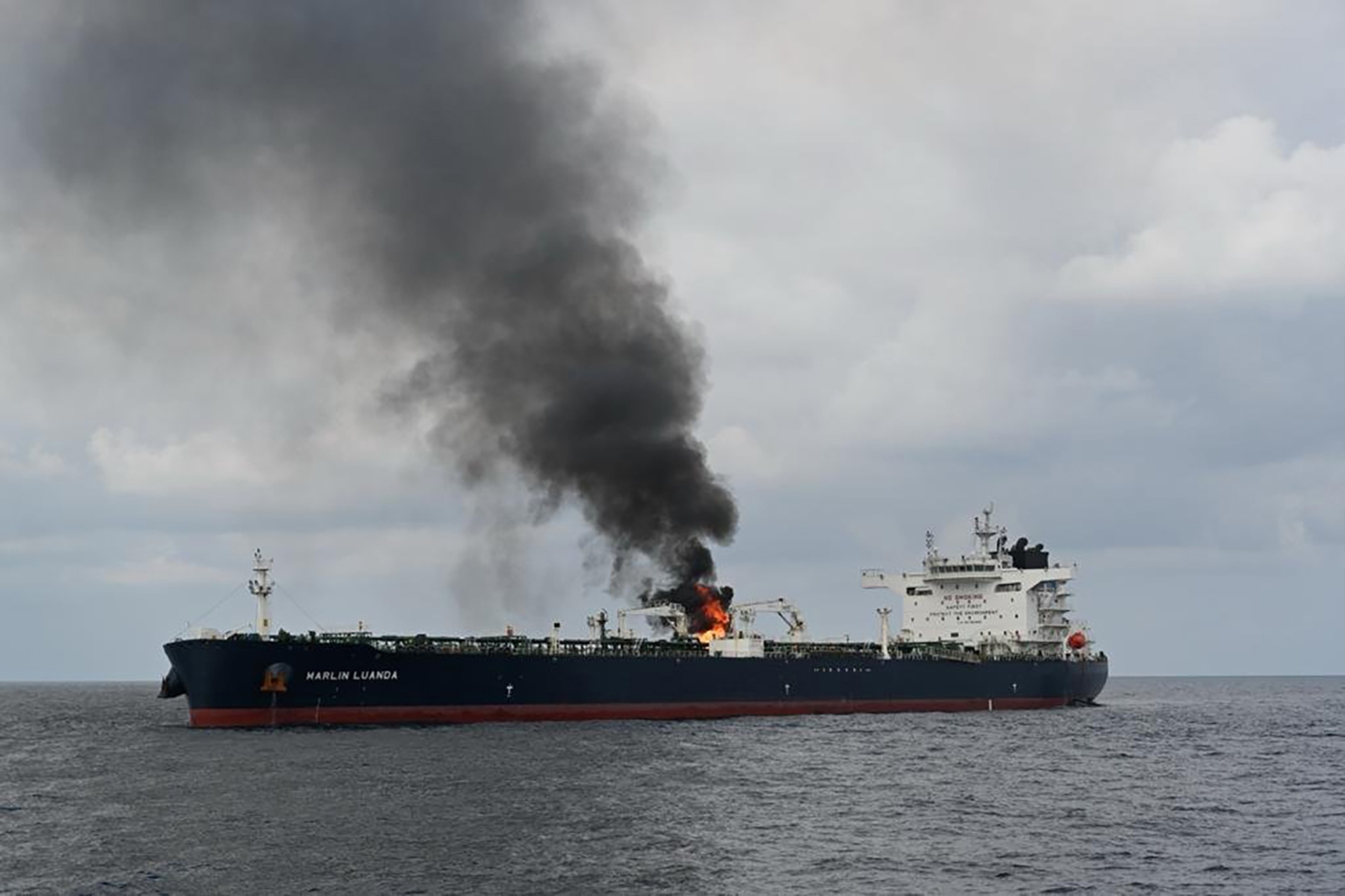 Fire breaks out on the vessel “Marlin Luanda” in the Gulf of Aden after being struck by an anti-ship missile launched from Houthi-controlled territory in Yemen.
Mindful of international offensive and defensive responses in 2024-2025, the Houthis have tried to limit the political fallout of the Bab al-Mandab advance by compartmentalising it. After September’s territorial gains, their messaging insisted international shipping remained safe while continuing to restrict Saudi-linked vessels, and their representatives met with US officials in Muscat to reassure Washington that American shipping would not be targeted.
They sent similar messages to the European Union (EU states, which are now considering expanding operation ASPIDES’ military ships. By attempting to sideline Western powers despite the impact of the two-state crisis and direct attacks on energy bypass from Hormuz, the Houthis are clearly attempting to reduce the likelihood of support from the US, the UK and the EU.
The IRGC’s multi-front, two-strait coercion campaign makes that objective increasingly unsustainable. Capturing another chokepoint and striking the country’s strategic hedge against Hormuz while maintaining pressure at Hormuz makes the pipeline and Red Sea flows more valuable at a time when layered attacks are attempting to make alternatives less reliable and resilient. Tehran does not need to shut down Hormuz, and Houthi and Iraqi militias do not need to target every ship or destroy each energy pipeline, respectively. The value of horizontal coercion comes from making all three options vulnerable at once, turning Saudi redundancy into strategic exposure. Although a Houthi or Iraqi militia strike could be filed as a Saudi-Houthi or a Riyadh-Baghdad problem, and Hormuz as part of the US-Iran-Israel confrontation, when the three targets threaten one energy system, Houthi compartmentalisation fails.
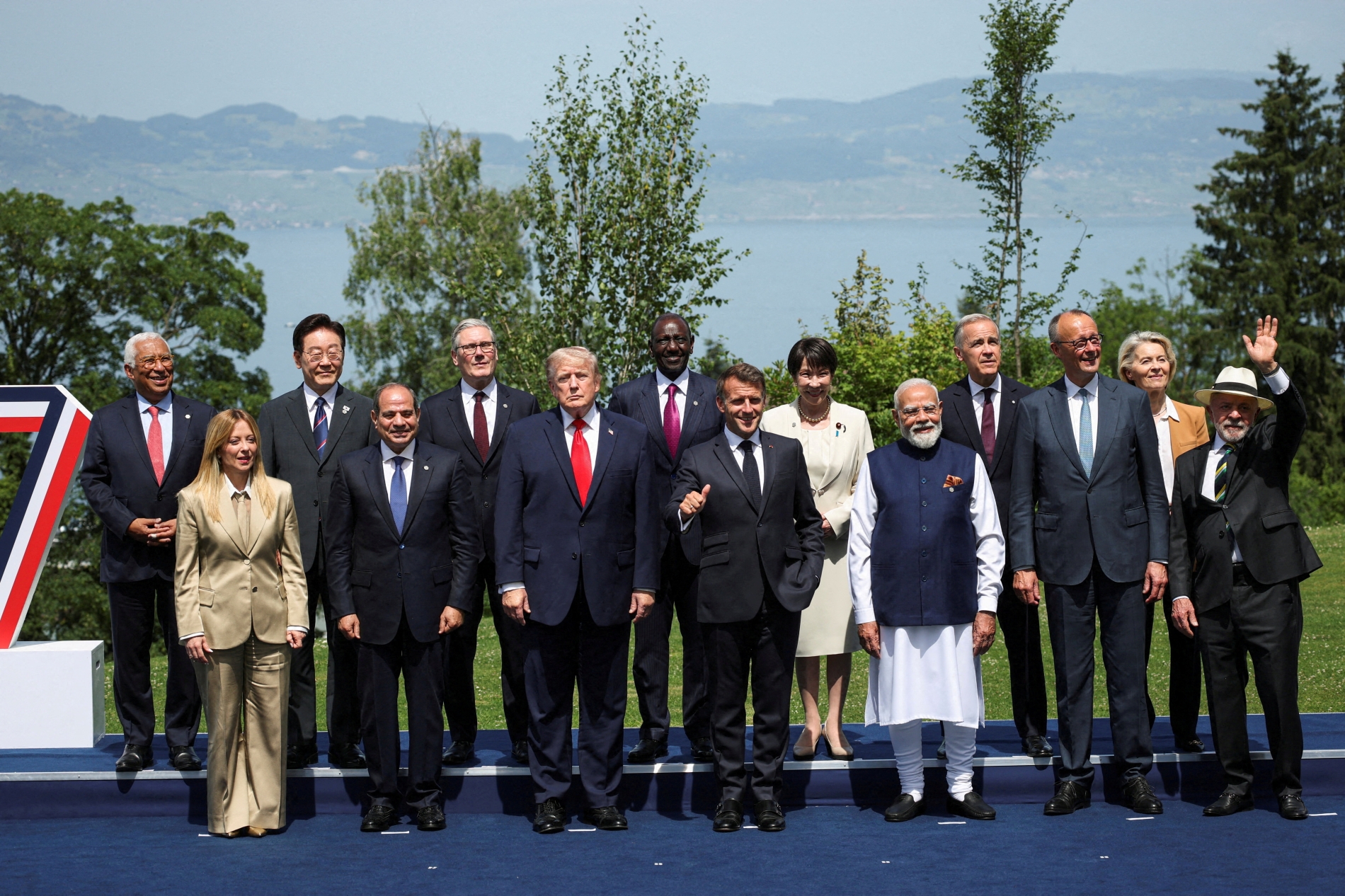 A family photo during the G7 summit, in Évian-les-Bains, France, on 16 June 2026.
The escalation trap
Increasing support for Riyadh, which is diversifying its defence and offence posture, is already visible. The G7 explicitly linked Houthi attacks, Bab al-Mandab, and global energy and supply-chain security in a 22 September statement, while Britain and France, citing the impact of regional instability on their own economies and global responsibilities, have gone further operationally, making defensive commitments to Saudi Arabia. London began dispatching an RAF Voyager to refuel Saudi jets. At the same time, Paris announced intent to deploy radars, surveillance equipment, and defensive systems to secure Yanbu’s energy flows and boost Saudi capabilities.
President Trump has been considering another round of attacks on the Houthis and even called Yemeni President Rashad al-Alimi, as Washington deepens its intelligence and targeting support for the Saudi and Yemeni governments. The Mecca Joint Defence Pact allies, Türkiye and Pakistan, have also condemned Houthi attacks and committed to supporting Saudi Arabia, with military, intelligence and arms transfers done quietly. All contributions are already channelled through the Joint Coalition Forces Command, and the Saudi-led Defensive Maritime Coalition—and coalitions are as strong as their members commit and unite around a strategic threat.
While this remains short of direct engagement in a full-scale war to degrade the Houthis, disengagement and inaction are clearly not a strategic option. Mounting IRGC-Houthi-PMF threats to global energy security and Red Sea commerce are making a middle position harder to hold. The IRGC-directed, multi-front campaign intended to deepen Saudi dependence is instead honing its incentive to reduce it, hence increasing its strategic choices by rallying the world around the Houthi-IRGC capture of Bab al-Mandab. Put differently, the more successful Tehran, the Houthis, and Iraqi militias become at narrowing Saudi choices, the more reasons they offer other countries to align strategically with Riyadh, and the more Riyadh’s strategic choices expand again.
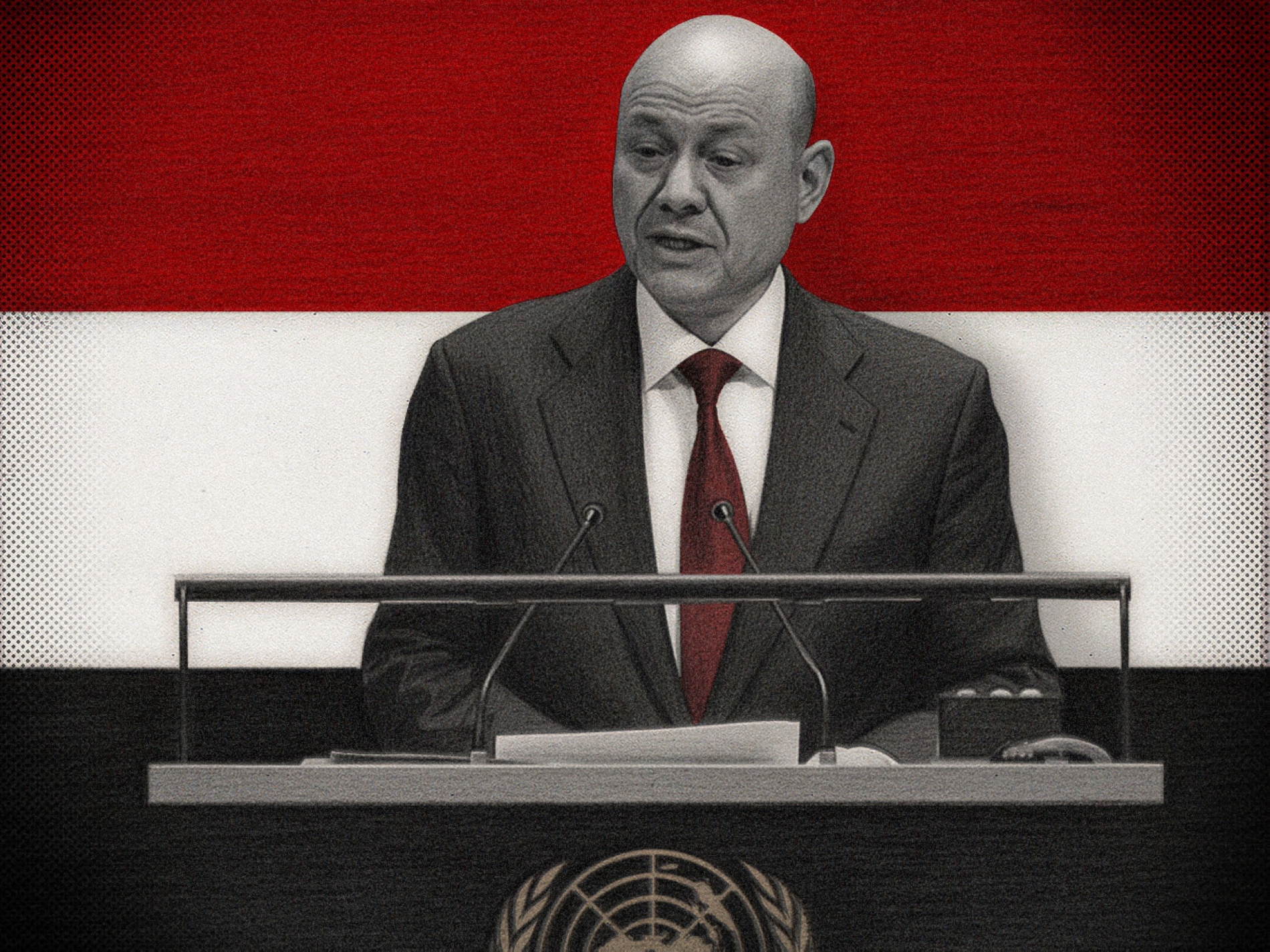 Chairman of the Yemeni Presidential Leadership Council, Rashad al-Alimi.
What next
For Western policy, the question is not whether the Houthis are a long-term Yemen and Red Sea challenge but whether Washington can keep perceiving Yemen, the Red Sea, Hormuz, Saudi energy security and regional connectivity projects as separate files. None of this argues for another incoherent US air campaign against the Houthis, mindful that short-term, regionally uncoordinated operations risk emboldening, rather than credibly degrading, the Houthis, and serving their resilience and strength narratives.
Instead, it calls for recognising that the Houthis are Iran’s last resilient and most capable cross-border actor controlling another chokepoint amid a two-strait crisis spanning from Bab al-Mandab to Hormuz, and the unwavering intent of Iran’s Axis to maximise global energy disruptions by striking alternatives from four directions. Iran’s leverage across the two arteries of the Arabian Peninsula and over 30% of global energy flows raises strategic risks, requiring an internationally supported, regionally coordinated, Yemeni-led operation to roll back the Houthis and ultimately weaken, if not defeat, them.
Cutting Iran’s tools of power projection at the southern tip of the Peninsula will weaken Iran, perhaps in a way more guaranteed than targeting Iran itself and restoring the Red Sea coast of Yemen is achievable within a month if the right resources and strategy are synced. President Al-Alimi’s announcement of a full-scale military initiative to liberate and extend authority across the rest of the republic marks the start of a Yemeni-owned, regionally supported effort that merits strategic international backing.