
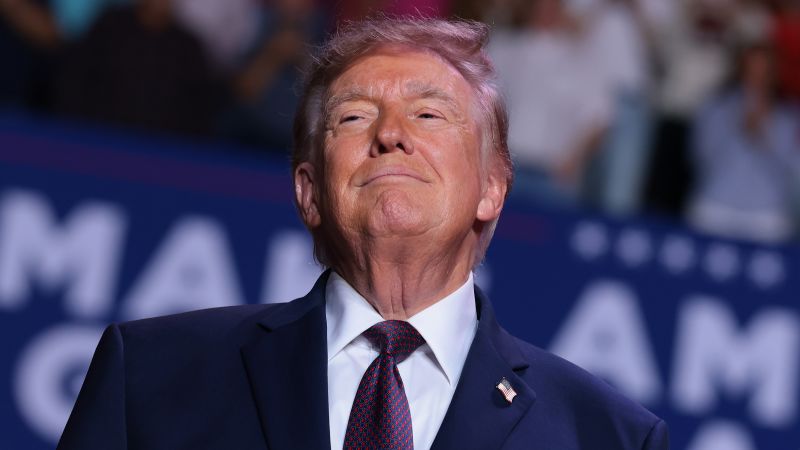
President Donald Trump is ramping up his efforts to use taxpayer money and resources to help Republicans win the 2026 midterm elections.
And it’s not at all subtle.
At last month’s Republican midterm convention, he severely pushed the envelope by promising every adult US citizen $5,000 if Republicans hold both the House and the Senate. That was already stunning — to offer voters money for a specific outcome. But Trump has only continued pushing the envelope since then.
Over the last 10 days, he has run more than a dozen different government-funded ads that are geared toward promoting himself and his supposed accomplishments.
The road to the 2026 midterms starts now
Last week, Trump held two separate White House events in which he made exaggerated promises about major economic projects in key states holding crucial Senate races.
Also last week, the administration sent $500 checks to nearly 1 million Obamacare recipients.
By Friday, the administration apparently found yet more money to send out: $90 for around 20 million senior citizens to help pay for their Medicare Part B premiums.
And in recent days, Trump has re-upped his $5,000 pitch on social media and featured it prominently at rallies in Alabama and Oklahoma.
Any one of these examples would be controversial on its own. But the combination and the details make the intent unmistakable:
His promised $5,000 checks are explicitly part of a quid pro quo in which he’s trying to compel voters to give him the outcome he desires. And even some on the right have labeled it a “bribe.”
Despite the administration’s claims that the ads are public service announcements and are “very clearly not campaign ads,” they bear virtually no resemblance to past PSAs. And at least one of them is quite literally a campaign ad run by Trump’s 2024 presidential campaign. Some Republicans have also criticized this, with outgoing Sen. John Cornyn of Texas saying it’s “not even a close question” that the ads are inappropriate.
Both of the economic projects Trump announced — in Alaska and Iowa — were quickly revealed to be far less iron-clad than his pitch made them sound.
Trump has now sent or floated giving Americans direct payments in three different ways, all with just weeks to go before the election.
Trump’s $500 checks to Obamacare recipients come with a politicized letter from him promoting his administration’s anti-fraud efforts and attacking the Biden administration, which the letter claims “overcharged you.”
The stated purposes behind both the $500 and $90 payments are highly suspect. Experts dispute that Obamacare policyholders were wrongly overcharged. And the $90 payments to seniors come from the $2.2 billion Medicare Improvement Fund, which the Congressional Budget Office says is supposed to be used “to make improvements to Medicare’s hospital and medical insurance programs.”
In other words, Trump is mining whatever direct benefits he can muster from his official job to pump up himself and Republicans ahead of the midterms.
And if that sounds uncharitable, it’s worth recalling what Trump himself has said about such things.
He repeatedly accused the Biden administration of trying to buy votes even when the proximity to the election wasn’t as obvious and the money was appropriated by Congress.
In 2023, he accused Biden of buying votes by using congressionally appropriated funds to do infrastructure projects.
“He goes around saying, ‘We’ll build a bridge. We’ll build whatever you want,’ you know – trying to buy votes,” Trump said in December 2023.
And in both 2023 and 2024, Trump painted Biden’s efforts to cancel student loan debt through executive action as part of a similar effort. He even called it “corrupt.”
“We have a crooked president. We have a corrupt president, very corrupt,” Trump said in June 2023. “But this was a way of trying to buy votes. That’s all it was.”
The question from there is: Will Trump’s efforts help his cause?
There are reasons to doubt they will.
The ads have real money behind them, judging by the fact that there are so many of them and that they are being run during expensive time periods like NFL games. But they could seemingly backfire by putting a president that Americans overwhelmingly dislike front and center in the campaign.
The $90 and $500 payments are real money. But the former is a small amount, and the latter will go to only roughly one of out every 200 eligible voters.
And Americans appear skeptical that they would ever actually get the $5,000 checks. A CNN poll last month showed 77% said it was “not too likely” or “not at all likely” that they would get the money as promised if Republicans hold both the House and Senate.
And those who believed it were overwhelmingly those who approve of Trump; just 11% of his disapprovers thought it was even “somewhat likely.”
(Indeed, Americans are right to be skeptical. The more than $1 trillion cost of such payments would balloon the deficit and risk spiking inflation. It’s also pretty evident that Congress would have to sign off on them, and even if Republicans are united on the payments — which they’re not — it would require Democratic votes to clear the Senate’s 60-vote threshold.)
And it appears voters might judge Trump negatively for even making the promise. The CNN poll showed Americans said 64%-36% that it was not a “worthwhile” use of federal government money, while a Reuters-Ipsos poll showed registered voters said 66%-18% that it was “inappropriate” for Trump to make such a promise.
However, if even a small percentage of voters finds themselves compelled by Trump’s handouts or his promises of major projects in Alaska and Iowa, that could matter on the margins.
But regardless of the political impact, a big consequence here is that Trump is obliterating the line between official business and party politics.