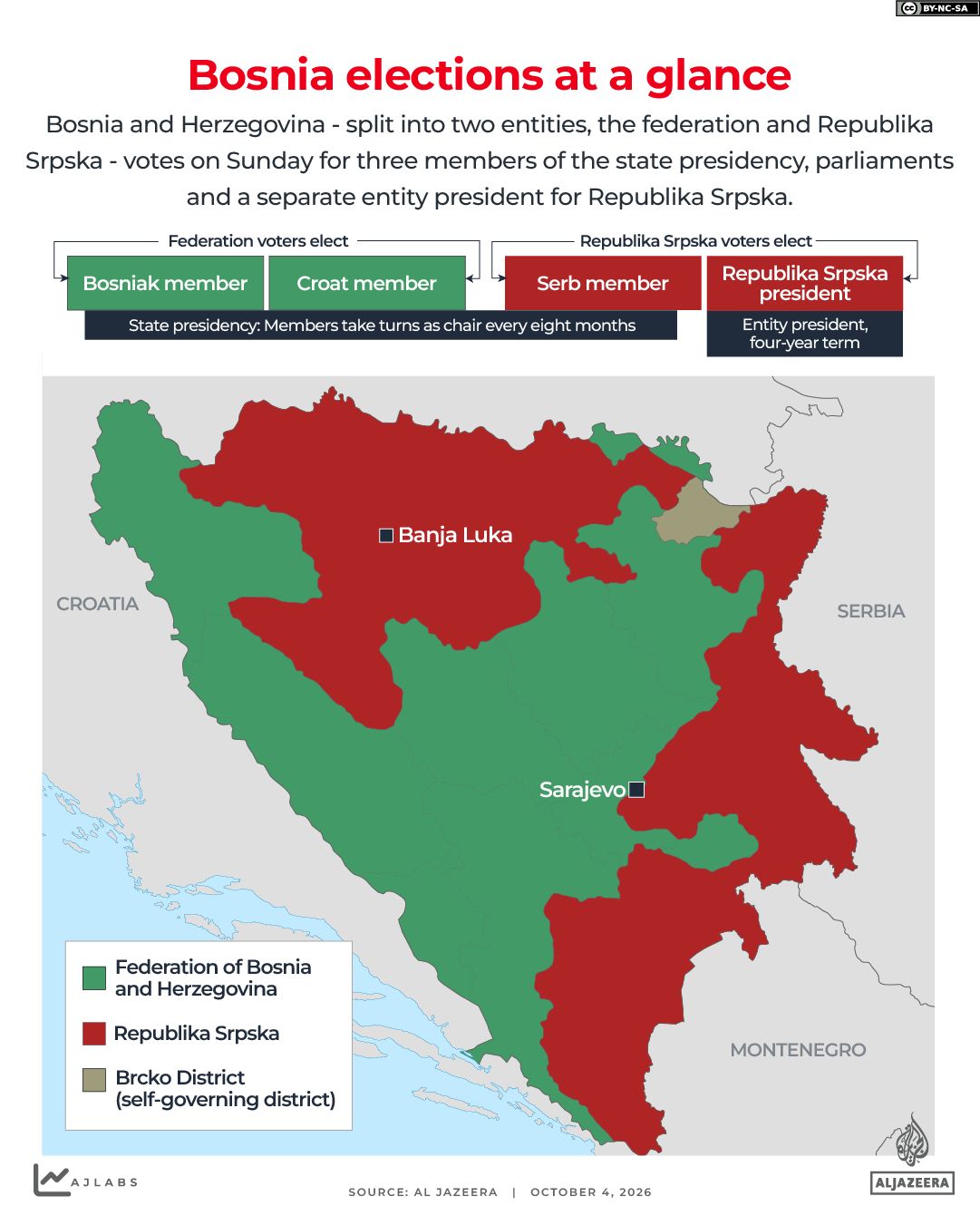
Voters cast their ballots for a dizzying number of officials across multiple tiers of government.

Published On 4 Oct 20264 Oct 2026
The party of banned Bosnian Serb leader Milorad Dodik has retained its grip on power in Bosnia and Herzegovina’s predominantly Serb Republika Srpska entity, with his ally set to keep the Serb seat in the country’s three-member presidency.
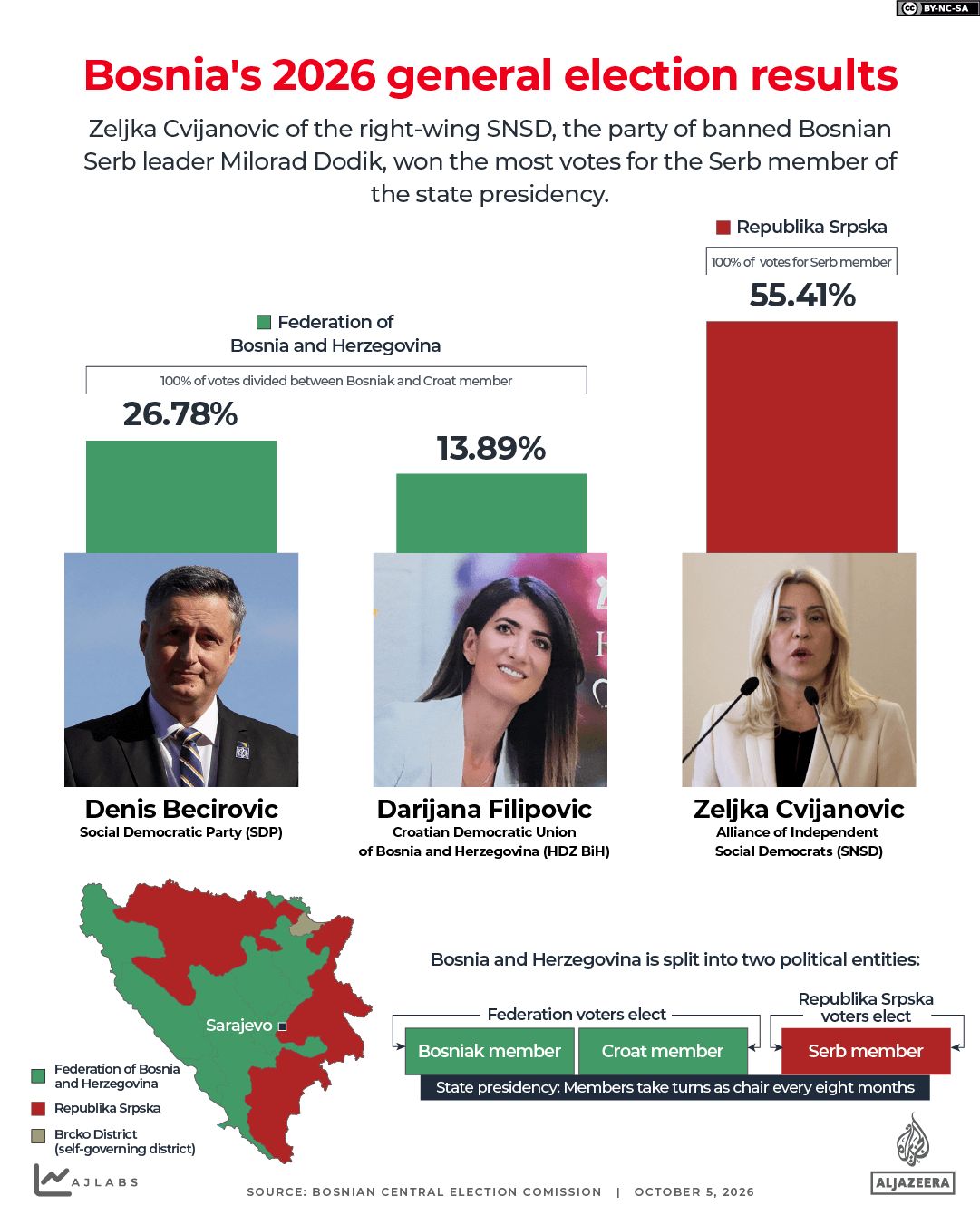
Preliminary results from Sunday’s general election showed Zeljka Cvijanovic of the right-wing Alliance of Independent Social Democrats (SNSD), led by Dodik, ahead in the presidential race.
Recommended Stories list of 3 itemsend of list
The result reinforced Dodik’s political influence despite his conviction and ban from public office, leaving a party that has repeatedly challenged state institutions in a strong position.
 (Al Jazeera)
Dodik was not on the ballot after being convicted last year of defying decisions by the international envoy charged with overseeing the 1995 peace agreement that ended the Bosnian War.
Speaking to supporters late on Sunday, he said his party would not alter course.
“No one should ask us to change our politics,” Dodik said, while also praising United States President Donald Trump’s 2024 election victory and thanking Russian President Vladimir Putin, a longtime ally.
Nationalist figures Cvijanovic and Darijana Filipovic, as well as leftist moderate Denis Becirovic, were leading the race as the Central Election Commission released preliminary results shortly after polls closed.
Becirovic, representing the Social Democratic Party (SDP-BiH), led the contest for the Bosniak seat. Cvijanovic of the Alliance of Independent Social Democrats (SNSD) led the race for the Serb seat. The Croatian Democratic Union’s (HDZ-BiH) Filipovic led the field for the Croat seat.
About 3.4 million people were eligible to vote in Sunday’s election to choose the three members of the country’s multiethnic presidency, legislators for the national Parliament and heads of institutions for the country’s two entities: the Federation of Bosnia and Herzegovina (FBiH) and Republika Srpska.
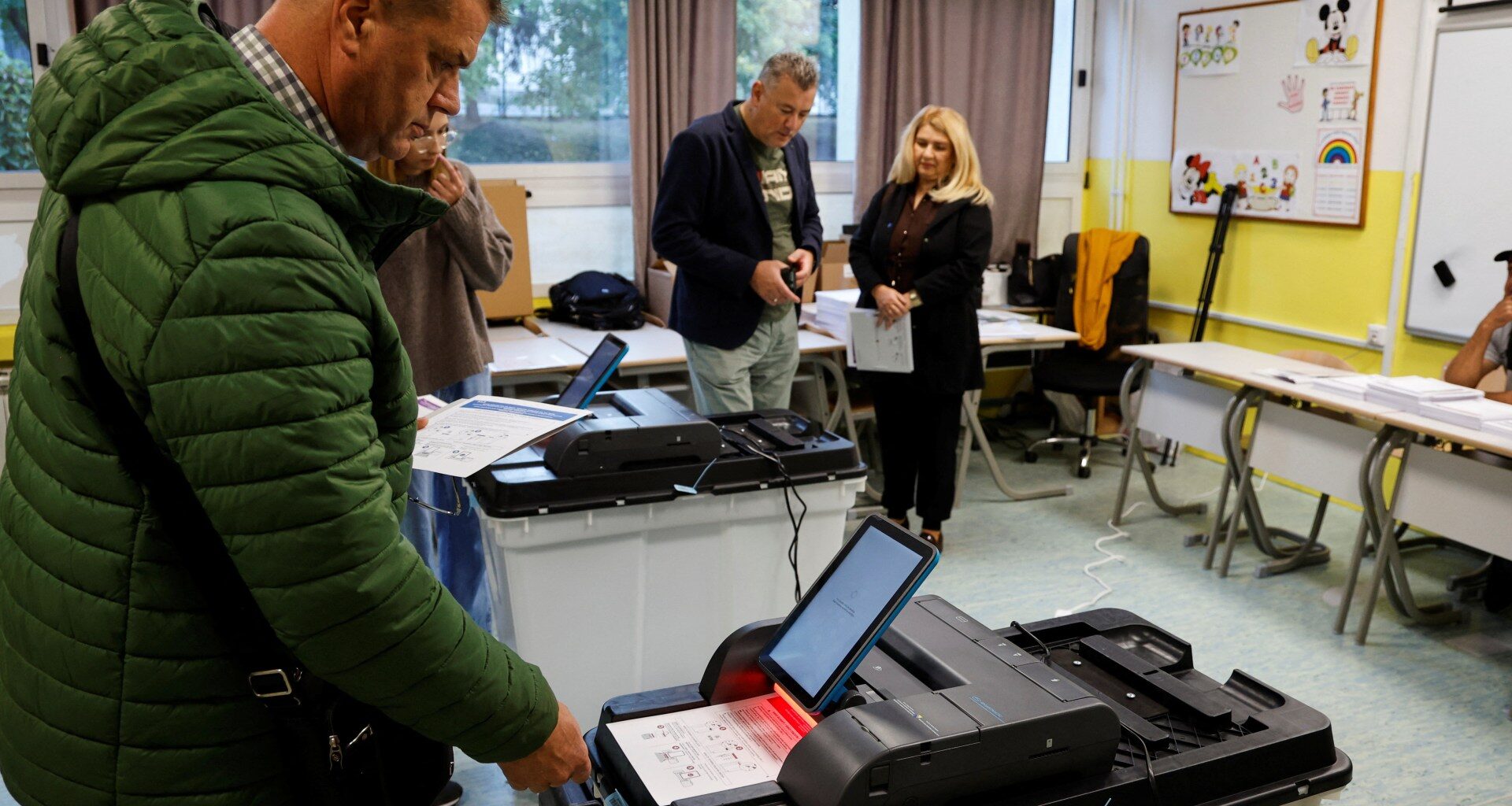
 A voter at a polling station in Sarajevo identifies himself using a fingerprint scanner during the general election in Bosnia and Herzegovina on October 4, 2026 [Hazim Aljovic/EPA]
Bosnia’s complex web of governing institutions was created by a US-brokered peace agreement in 1995 to manage the ethnic divisions between Muslim Bosniaks, Orthodox Serbs and Catholic Croats that gave rise to the 1992-95 war.
The major parties’ repeated focus on war-era rhetoric, and the division was frustrating for some voters, activist Adi Selman of the Karton Revolucija protest group told the AFP news agency.
“I don’t think these new elections in Bosnia will change anything,” the 34-year-old said in the northern Bosnian town of Tuzla ahead of the vote.
“The choice is limited to political parties that have already been around for 30 years and basically pick up votes by harping on about war, tensions, divisions and the past.”
“Bosnia and Herzegovina is dead; it is an impossible country,” Republika Srpska’s former President Dodik told the final rally of the SNSD in the entity’s capital, Banja Luka, late on Friday.
EU membership bid
In the FBiH, Bosniak parties are pushing for a stronger central state, with incumbent Bosniak presidency member Becirovic pledging a renewed path to the EU and NATO.
The European Union granted Bosnia candidate status in December 2022, but accession negotiations scheduled for 2024 were delayed as Brussels demanded the country pass stronger anticorruption laws and reform its judicial system.
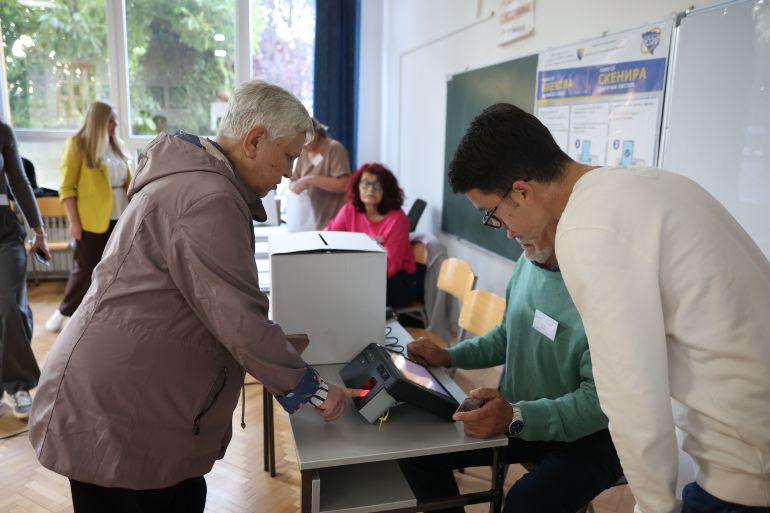
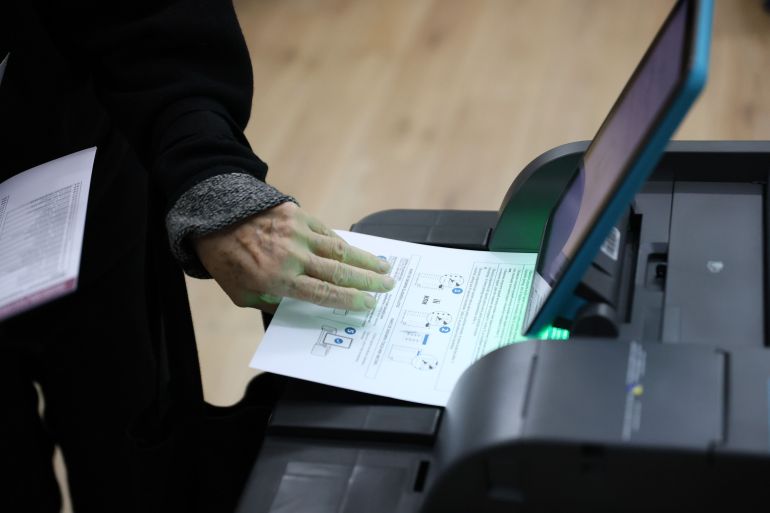 A voter at a polling station in Sarajevo feeds a paper ballot into an optical scanner during the general election in Bosnia and Herzegovina on October 4, 2026 [Hazim Aljovic/EPA]
Croat nationalist parties are also pushing for electoral reform, demanding a greater say in choosing the Croat member of the presidency in the entity they share with the more numerous Bosniaks.
Meanwhile, Russia is accused of slowing down the country’s path towards joining the EU, while also holding close ties with the SNSD, which favours secession for Republika Srpska, dominated by ethnic Serbs.
This general election is the first in the country to use new electronic tools to scan ballot papers and biometric fingerprint verification to reduce fraud.