
Sign up for Executive Dysfunction, a weekly newsletter that highlights one under-the-radar story about how Trump is changing the law—or how the law is pushing back—and keeps you posted on the latest from Slate’s Jurisprudence team.
A year ago, I warned that President Donald Trump was poised to marshal federal government forces to subvert the 2026 midterm elections, just as he attempted to do after losing the 2020 U.S. presidential election to Joe Biden. True to form, Trump and his administration have since been relentless in attacking election integrity. He directed the United States Postal Service to issue a rule that would have completely shut down mail balloting nationwide for the 2026 midterm elections. His former national intelligence director, Tulsi Gabbard, ordered government seizure of Dominion voting machines from Puerto Rico in an apparent gambit to concoct a new election-rigging conspiracy theory. Trump’s Department of Justice seized Fulton County, Georgia’s 2020 presidential election ballots, sued 30 states and D.C. to obtain their unredacted lists of voter information, and threatened election officials with federal prosecution if they did not hunt for voter fraud to the administration’s satisfaction.
Our guardrails have held so far, dooming most of these efforts, but the most dangerous period for election integrity is yet to come. Concrete steps in these final weeks can ensure a fair and safe November election and peaceful transition of power in Congress, if the polls are accurate about the direction of the nation’s voters.
My earlier analysis pointed to the three bulwarks against attempted election subversion—the state and local governments that administer elections, the courts that protect rights, and the American people who are democracy’s ultimate safeguard. Each played a role in checking some of Trump’s attempted meddling in the past year. For example, when the Department of Homeland Security made unsupported claims that states were allowing thousands of noncitizens to remain on their voting rolls, state and local election administrators demanded evidence. After Nevada got the data and investigated, the DHS list of 16,000 potentially ineligible Nevada voters fell to zero.
Federal district courts, an appeals court, and the United States Supreme Court stopped USPS’s efforts to impose its mail-ballot rules before the system was ready to be deployed; a contrary decision likely would have disenfranchised millions of elderly voters, disabled voters, rural and Native voters, and military voters throughout the country. DOJ also has gone 0 for 25 so far in lawsuits to obtain state voting rolls containing personal information including addresses and Social Security numbers. Voting rights groups successfully lobbied the Senate against passing one of Donald Trump’s top priorities, the SAVE America Act, which had the potential to disenfranchise millions of voters.
Now, with a month before the election, Trump’s interference options are limited. What is left for him to try, and what could states, courts, and the people do in response?
National Emergency Declaration
The president indeed has the power to declare a national emergency—he has already done so for a purported immigration crisis at the United States’ southern border—but a declaration does not unlock any magic powers over elections. Those indulging in this fantasy mistakenly believe that emergency declarations trigger temporary dictatorial powers, overriding the constitutional power given to states, and Congress, to set congressional election rules. Courts have confirmed that the president has no role to play in administering American elections, and even the very conservative Supreme Court almost certainly would stop any new power grab dressed up as a matter of national security.
In any case, elections are like battleships: not easily turned around, even by an unconstitutional presidential decree. Ballots are already being mailed, voting machines are deployed, and people are already voting. The time for an emergency declaration has run out.
Armed Federal Agents at the Polls
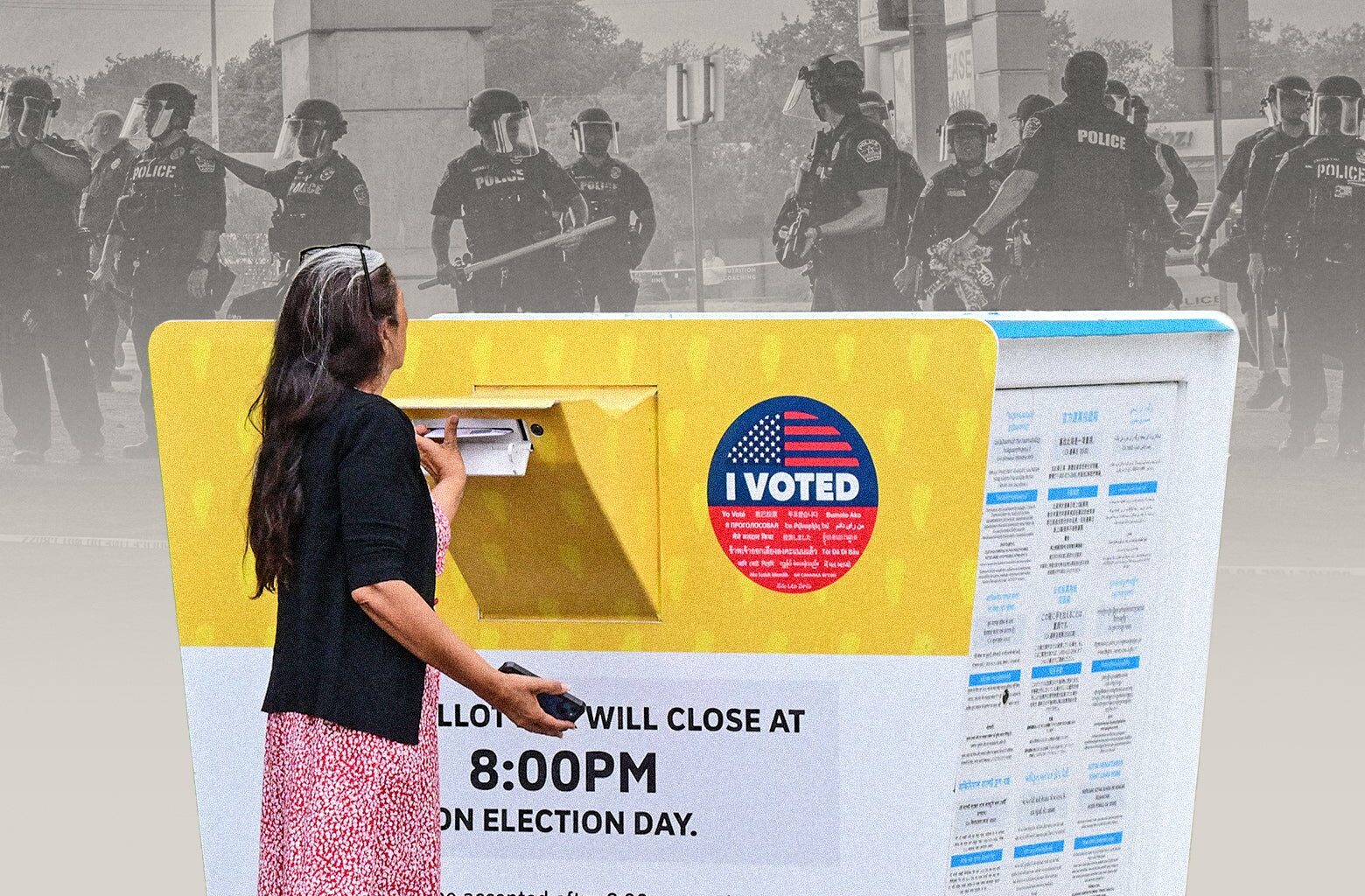
Federal law prohibits armed federal agents at the polls, including both National Guard troops and Immigration and Customs Enforcement. Courts would quickly shut down such ham-handed actions, and local election officials have already gamed out how to respond to potential disturbances at the polls. The Minneapolis protests over ICE raids that led to the deaths of peaceful protesters Renee Good and Alex Pretti show that people would take to the streets to protect American democracy. On the individual level, voters can minimize any remaining risk of polling-place disruption by voting early, either in person or by mail, when state law permits.
Seizure of Ballots, Voting Machines, or Other Election Materials
Although Trump’s administration has seized both voting machines from Puerto Rico and ballots from Georgia, these seizures did not relate to an election already in progress, and a seizure of live election materials would be unprecedented for modern times. This risk worries me the most because the actions very few law enforcement officers, outside of public view, could call election results into question. Seizing election materials can break the chain of electoral custody by which local election administrators control access to already-voted ballots to make sure there have been no additions, subtractions, or alterations. And Trump has expressed regret that he did not seize voting machines as he contested the 2020 election.
Ian Prasad Philbrick
Is Trump All There? A New Interview Gives Us Five Serious Reasons to Wonder.
Read More
DOJ could attempt a ballot seizure anywhere that there is a close congressional or Senate race. A judge who does not understand how the electoral chain of custody works and the irreparable harm that a ballot seizure could cause to election integrity could issue the department a search warrant. The Fulton County ballot seizure happened after an FBI agent submitted a search warrant application to a federal magistrate judge that was filled with discredited conspiracy theories about election rigging in the 2020 presidential election.
The key precaution is to educate the judiciary of these dangers, and this work is underway. The California Supreme Court held in late September that Riverside County Sheriff Chad Bianco’s seizure of California ballots from a past ballot-measure election broke California law, shining light on the issue. Justice Goodwin Liu’s concurring opinion in that case urged local election administrators to be prepared to seek a court order blocking any attempted seizure. UCLA Law’s Safeguarding Democracy Project has circulated a white paper to thousands of judges nationwide on sensible steps to take in response to a ballot seizure request. In extreme circumstances, voters could form a human chain around local election offices to prevent a ballot seizure until a court could hear from election administrators and rule on the request.
Failure to Seat Congressional Democrats if They Have Won a Majority in the House
Analysts have spun out a number of far-fetched scenarios whereby current House Speaker Mike Johnson, who will no longer be speaker at noon on Jan. 3, 2027, has put in place an unscrupulous clerk of the House who would refuse to seat Democrats who had won their election, thereby depriving Democrats of a House majority and control of the body.
Although scholars have repeatedly and calmly explained such a gambit would be very unlikely to succeed, a more fundamental limitation is political reality. If Republicans refused to allow a peaceful transition of power in the House to victorious Democrats, it would trigger massive and sustained public protest, and the failed move could well result in eventual criminal charges after the end of a Trump presidency.
Undermining Voter Confidence in Election Integrity
This Content is Available for Slate Plus members only
Are the Polls Wrong Again? Or Is the Blue Wave a Blue Tsunami? We Took a Closer Look.
This Content is Available for Slate Plus members only
Democrats Are Struggling to Beat Susan Collins. You Can (Still) Blame One Man.
This Content is Available for Slate Plus members only
How Trump Can—and Cannot—Still Mess With the Midterms
I am afraid that on this score, Trump has already won, at least for now. His constant haranguing about stolen elections and election rigging, and the subversive actions he has tried in the name of preventing malfeasance, have taken their toll. A recent University of California, San Diego, survey found that fewer than half of the country’s voters expect free and fair midterm elections. Democracy depends upon what political scientists call “loser’s consent,” the idea that election losers may grumble but they accept the election results as legitimate. As such consent frays, democracy itself is in danger.
The corrosion in voter confidence well illustrates the point that it is going to take a lot of work well after the end of Trump’s presidency—by courts, states, the people, and eventually again by the federal government, too—to get U.S. democracy and elections back on track.
In the meantime, if everyone remains vigilant and ready, we should make it safely to January. Then, with any luck, Donald Trump, having no personal stake in future elections’ outcomes, will end his anti-democracy crusade.
Copy Link
Share
Gift Story
You have remaining gift available this month. This gift link is valid through .
There was an error with your gift link. Please try again.
Copy link
Link copied!
Only Slate Plus members can gift Slate stories. Become a member to share 10 free articles a month.Become a Plus Member