
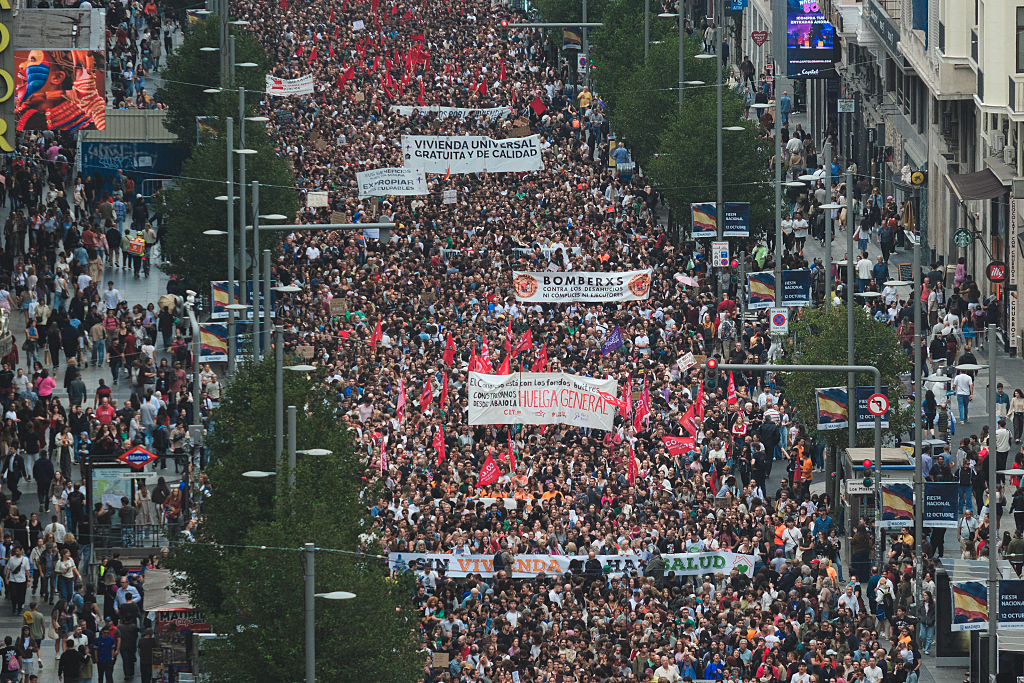
“Where is the progressive government?” asked another chant, in an ironic snub to Sánchez’s preferred term for his coalition government. Snap elections called for November 29 could well mark the end of its time in power. The new protest wave is by and large motivated by discontent at what the previous political cycle achieved through its strategy of electoral politics, at the many problems that were not resolved, and at the many new social issues that seem to have ballooned.
This discontent may sound curious for people outside of Spain and for left-wing movements that have not had the same luck as their Iberian counterparts. Indeed, the 15-M political cycle has been in many respects the most impressive and consequential chain of events for post-2008 left-wing mobilizations in the West: starting from the streets and leading to the creation of a new left party and the formation of a coalition government. It has delivered comparatively progressive social policies, such as a significant increase in the minimum wage. However, what has become even more apparent with a relatively progressive government is that many social problems have gotten so deep that the mildly reformist policies offered by the technocratic policymakers of Sánchez’s Socialist Party (PSOE) are no real cure.
Housing policy is the most evident demonstration of how reluctant the PSOE is to break with the powers that be and resolutely take the side of working people. In a country where massive tourism has traditionally gone hand in hand with real estate bubbles, the PSOE has continued to harbor fears of antagonizing large investment funds and homeowners. Its housing minister, Isabel Rodríguez, one of the most unpopular ministers in the entire government and the owner of multiple apartments, came under fire in 2024 for suggesting that the solution to the housing crisis would come in the form of homeowners voluntarily keeping prices low. Meanwhile, the radical-left parties Podemos and Sumar have increasingly focused on housing — an issue that significantly affects their mostly young and urban base — while invariably disagreeing on both strategy and tactics.
Sánchez’s response to the protests was to issue two decrees: one containing more moderate measures, the other more radical ones. He aimed to win the support of the right-wing Catalan nationalist Junts party for the first decree, while giving the Left symbolic reward with the second. However, ultimately Junts rejected the first decree too, forcing Sánchez to call snap elections.
The post-15-M political cycle in Spain has been in many respects the most impressive and consequential chain of events for post-2008 left-wing mobilizations in the West.
Calling the November 29 vote is a major gamble for Sánchez, whose reputation as a comeback leader will be put to a major test. The right-wing Partido Popular and Vox parties boast over 50 percent support, according to recent polls, and the “alternative left” parties are extremely divided and unprepared. They will once again try to organize a last-minute “coalition list,” this time using the name Frente Amplio (Broad Front), but they will struggle to enthuse their base.
Sánchez is hoping to cannibalize part of the radical-left vote. But he will struggle to explain why in eight years of government, his action on the housing question has been so indecisive. This largely owes to the fact that PSOE represents many homeowners who have themselves benefited from rising house prices. While the PSOE has made a more progressive turn in recent years, it is still very far from parting ways with the neoliberal belief in the sacredness of property and the superiority of the “free market.”
The coming elections will thus be a major test, for both popular movements and the institutional left. Whatever the outcome, we have witnessed the beginning of what has all the look of a new political cycle: one strongly concerned with material issues and class inequality, starting with housing, and driven by the belief that the only solution to social injustice is class organization, strategy, and persistence. It’s a quite different creed from the post-15M and Podemos years — but one that seems well suited to the new challenges of our time.