
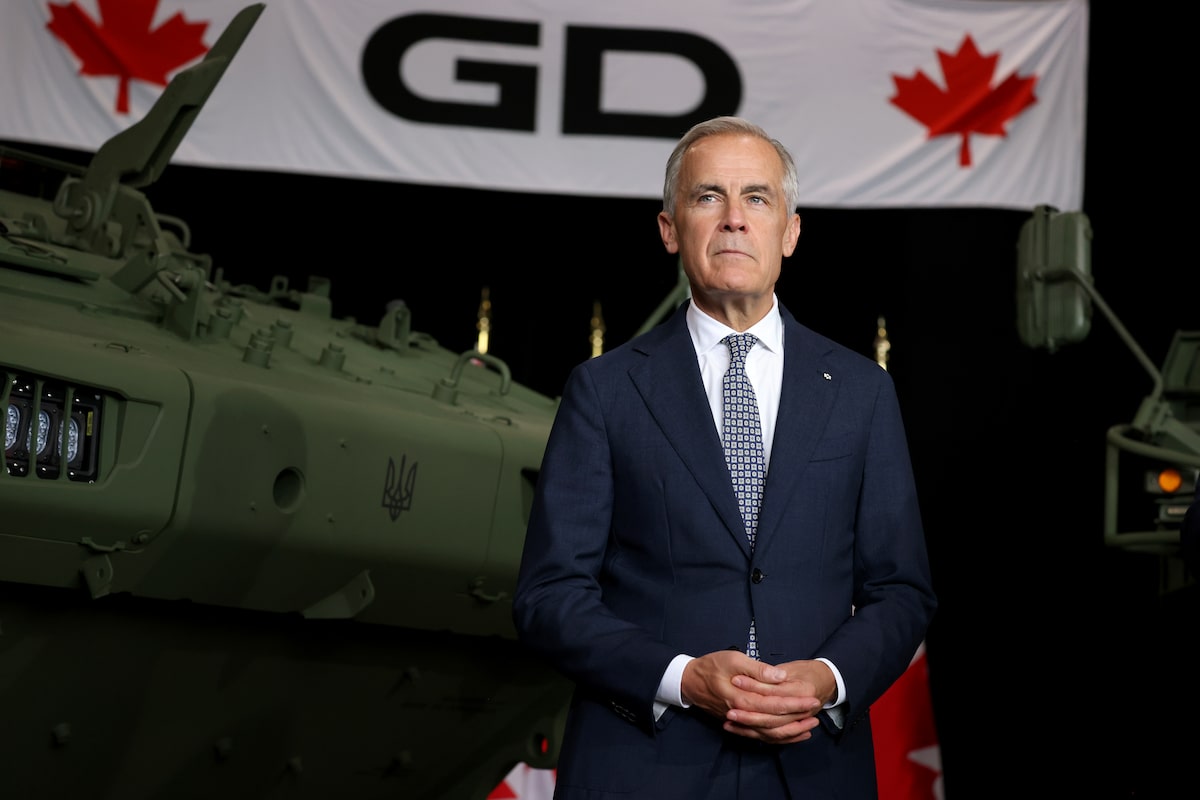
Prime Minister Mark Carney during a visit to defence equipment manufacturer General Dynamics in London, Ont.NEO/The Canadian Press
Canada plans to turn its new agency for speeding up purchases of military gear into a Crown corporation, three sources say – a transformation that will give the organization and chief executive Doug Guzman far more authority in decision-making.
Prime Minister Mark Carney’s government created the Defence Investment Agency to streamline the procurement of military purchases worth $100-million or more. Last year, Ottawa committed to the biggest ramp-up of defence spending in more than 70 years in an effort to bolster self-reliance and meet rising targets agreed to by members of the North Atlantic Treaty Organization.
The three sources said legislation being tabled this week by Procurement Minister Joël Lightbound includes measures to make the DIA a Crown corporation. The Globe and Mail is not identifying these sources because they are not authorized to discuss the matter publicly.
The government is making the move more than three weeks after Mr. Guzman sent a mass e-mail to staff informing them he intends to remain CEO of the DIA and has no intention of quitting, despite reports he was frustrated and ready to leave.
The title of the bill on the House of Commons order paper is “An Act respecting production, procurement and investment in relation to national defence and national security.” Two of the sources said the legislation would be tabled Tuesday in the Commons.
MPs to debate economic and labour bill, plus new plans for national defence and security procurement
The Prime Minister’s Office said it would not comment on legislation that has not yet been tabled in Parliament.
Philippe Lagassé, a professor at Carleton University who researches defence policy, said that if Ottawa turns the DIA into a Crown corporation, it would operate at arm’s length from the government.
“It would likely give the CEO far more discretion and authority over purchasing – so basically disentangling procurement from various aspects of the bureaucracy and day-to-day ministerial control,” he said.
Prof. Lagassé said he will still need to see the mechanics of the legislation, but making the DIA a Crown corporation could move its military equipment purchasing out of the cabinet and departmental committee process and potentially reduce the role of the Treasury Board in future big-ticket defence spending.
“It basically keeps politicians at a greater distance,” he said.
“Crown corporations operate at arm’s length from the government, so they’re state-owned enterprises, but they are not technically part of the executive in the traditional sense,” Prof. Lagassé said.
“Ministers are accountable to Parliament for what Crowns do, and ministers provide very high-level direction and guidance, but the day-to-day operations of these corporations are handled by the CEO or the person running it, and that person is in turn accountable to a board of directors appointed by cabinet.”
The Carney government announced in April that it planned to create a cabinet position, the minister of defence procurement, to steer purchasing.
Three sources said the legislation being tabled Tuesday also will lay out the duties of this new minister.
Former fighter pilot Stephen Fuhr, a Liberal MP, has been tackling defence purchasing reform as Secretary of State for Defence Procurement, but has not so far been appointed as a minister.
Defence Investment Agency head Doug Guzman informs staff he’s staying at the helm
Dozens of federal Crown corporations exist, each of which is accountable to Parliament through a designated minister. Via Rail is accountable through the Transport Minister. Export Development Canada is accountable through the Minister of International Trade.
Mr. Guzman played a key role in Mr. Carney’s July decision to purchase up to 12 submarines from German company TKMS for the Royal Canadian Navy.
In his e-mail to staff Sept. 13, Mr. Guzman said he felt he had not completed the task of reforming defence spending. He wrote that he was sending the message to end speculation about his future. “It seems there is a new headline about me every day,” he wrote.
Mr. Guzman’s note also addressed reports about his past use of the phrase “triangle of inertia” in regards to defence procurement. This, he said, was the original assessment of a problem the DIA is mandated to address. “It is not a description of the present, a criticism of our past or of our people or partners across government,” he wrote.
Mr. Carney recruited Mr. Guzman, a close personal friend, from the Royal Bank of Canada, where he was deputy chair.