
Neighbouring countries say coastal states must govern Red Sea as fighting escalates in northern Ethiopia.

Published On 5 Oct 20265 Oct 2026
Ethiopia’s Prime Minister Abiy Ahmed has insisted that his landlocked country must have access to the Red Sea, even as neighbouring countries have said responsibility for the sea rests with the states along its shores.
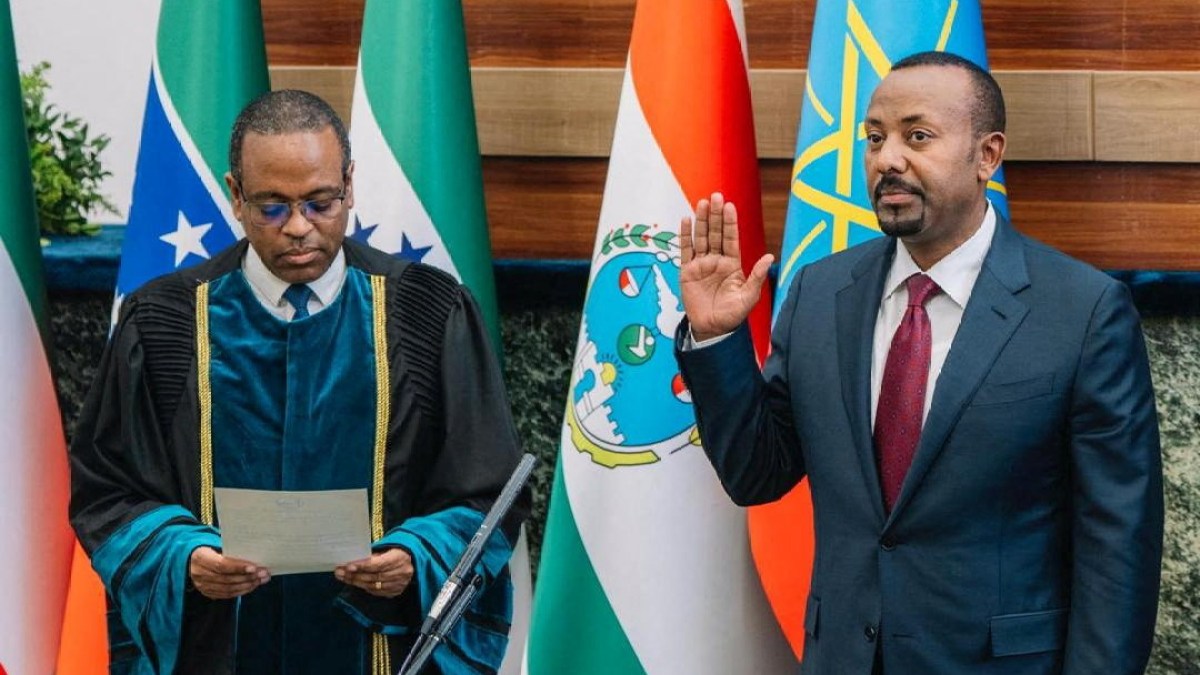
Abiy made the demand as he was sworn in for another five-year term on Monday.
Recommended Stories list of 4 itemsend of list
Repeating previous assertions, Abiy said in a speech in Parliament that the country would work to secure a port on the Red Sea, saying that access was critical to Ethiopia’s “civilisation”.
“Based on the principle of give and take, we will work diligently to ensure that Ethiopia has an outlet to the sea,” he said.
Ethiopia lost direct access to the Red Sea in 1993 after Eritrea, formerly a region of Ethiopia, became independent.
Abiy’s call came as Ethiopia’s relations with its neighbours have worsened in recent months, with Addis Ababa accusing Eritrea, Egypt and Sudan of supporting opposition forces in Tigray following a resurgence of the fighting against Abiy’s government in the northern region.
![Members of the Ethiopian pro-government Tigray Peace Force (TPF) ride in a pickup truck while Ethiopian federal and allied forces enter the Tigray capital of Mekelle, October 4, 2026 [AFP]](https://www.newsbeep.com/wp-content/uploads/2026/10/afp_6ac4015e5e71-1791230302.jpg) Ethiopian pro-government Tigray Peace Force fighters ride in a truck as federal forces enter Tigray’s capital of Mekelle, on October 4, 2026 [AFP]
Ethiopian pro-government Tigray Peace Force fighters ride in a truck as federal forces enter Tigray’s capital of Mekelle, on October 4, 2026 [AFP]
For its part, Eritrea has accused Ethiopia of seeking access to the sea through its territory. A separate dispute over Ethiopia’s Grand Ethiopian Renaissance Dam on the Nile River has strained relations with Egypt and Sudan, which rely on the river for water.
Four of the five countries bordering the Red Sea – Egypt, Eritrea, Sudan and Somalia – met on Sunday in Egypt’s New Alamein and called for cooperation on regional issues.
They said governance of the Red Sea was the exclusive responsibility of its coastal states and rejected actions that could affect Egypt and Sudan’s use of Nile waters.
The following day, Ethiopia’s Foreign Ministry said discussions over the Red Sea must account for the country’s “legitimate interests and enduring connection” to the body of water.
Somalia’s president, Hassan Sheikh Mohamud, who attended the Egypt summit, congratulated Abiy on his re-election.
“I look forward to working closely together to strengthen Somalia-Ethiopia relations & advance peace, stability & shared prosperity for our peoples & the Horn of Africa,” he said in a post on X.
Mohamud had previously told Al Jazeera that Somalia did not object to Ethiopia gaining access to the Red Sea through Somali territory but added that the two countries would need to officially negotiate.
Evariste Ndayishimiye, Burundi’s president, also wished Abiy “every success during his renewed mandate”. Mahmoud Ali Youssouf, the chairperson of the African Union Commission, also sent a message of congratulations.