
As government-aligned forces advanced along Yemen’s southwestern coast, the Houthis stepped up pressure around Taiz, one of the country’s largest cities, leaving a battlefield moving in two directions at once.
The reversal came as Saudi Arabia, Turkey and Pakistan activated their Mecca Joint Defense Agreement following an emergency meeting in Riyadh, saying they would accelerate the deployment of agreed military forces and capabilities to Saudi Arabia.
Together, the developments point to a potentially consequential new phase of the Yemen war. But whether the counteroffensive can be sustained, and what any lasting reversal would mean for Iran’s position in Yemen, remains unclear.
“I think it’s too early to talk about sustainable gains against the Houthis at this point,” Thomas Juneau, a Yemen expert and non-resident fellow at the Sana’a Center for Strategic Studies, told Iran International.
“I think we need more time to see the dust settle.”
Iran watches a critical coastline
The importance Tehran attaches to Yemen’s western coast was apparent even as the latest Houthi gains were being reversed.
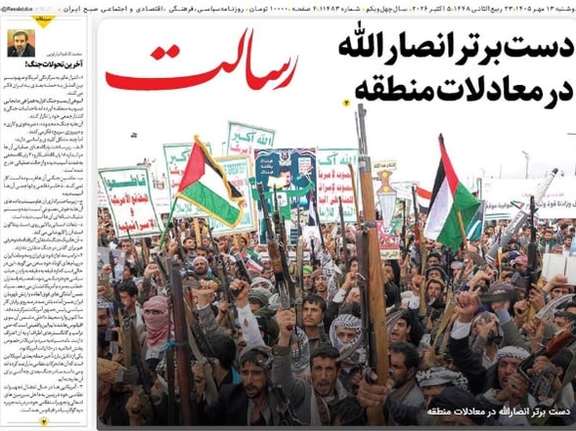
An IRGC-aligned Iranian newspaper led its coverage Monday with the headline “Ansarullah’s Upper Hand in Regional Equations,” arguing that Houthi positions around Bab al-Mandab translate into deterrence and regional leverage extending far beyond Yemen.
But the territory captured during the Houthis’ September advance was always going to be difficult to defend.
Juneau described southwestern Yemen as flat and exposed, with few natural defensive advantages and increasingly stretched Houthi supply lines.
“If it turns out that the losses are limited to the southwest corner of Yemen, that is not surprising in the sense that that was difficult for the Houthis to hold,” he said.
Even if pushed farther from Bab al-Mandab, the Houthis remain close enough to threaten Red Sea shipping with missiles and drones.
“So that would not be a strategic setback for them,” Juneau said.
Fatima Abo Alasrar, a Yemeni scholar, senior policy analyst and founder of Ideology Machine, said the Houthis’ September push had IRGC backing and caught Saudi-backed Yemeni forces poorly coordinated to respond.
Monday’s counteroffensive, however, demonstrated how quickly those gains could be reversed.
“The biggest takeaway is that this myth of Houthi invincibility is no longer there,” she said.
Hodeidah and Taiz complicate the picture
The more consequential test may now lie elsewhere.
The Houthis still control Hodeidah farther north on the Red Sea coast, preserving their ability to threaten maritime traffic even without holding territory immediately around Bab al-Mandab.
“Bab al-Mandab was just the icing on the cake,” Abo Alasrar said.
The possibility of attacks can itself increase shipping and insurance costs, meaning the Houthis do not need to physically control the strait to retain leverage over maritime traffic.
A loss of Hodeidah would represent a much more significant change to their strategic position. Late on Monday, the Saudi-led coalition said its naval forces struck Houthi military infrastructure in Yemen’s Hodeidah governorate, including weapons storage sites, facilities housing explosive-laden boats and stockpiles of sea mines.
At the same time, the Houthis are increasing pressure around Taiz, one of Yemen’s largest and most densely populated cities.
The geography presents a very different battlefield from the exposed southwestern coast and raises the prospect of a costly war of attrition.
“What I’m watching right now is the population centers,” Abo Alasrar said. “It’s in the cities, it’s in the population centers that the Houthis can inflict real damage.”
Iranian media has also shown growing interest in the fighting around Taiz, with Tasnim closely tracking Houthi advances there.
The simultaneous movement on the two fronts is one reason Juneau cautioned against drawing broad conclusions from the coastal counteroffensive.
“I don’t think we’re in a position to say yet that the Houthis are sustaining losses,” he said.
Two wars increasingly intertwined
The fighting is unfolding against the backdrop of the wider confrontation involving Iran, but Yemen cannot be understood solely through that lens.
“The war in Yemen is unlikely to end without a broader resolution to the war with Iran,” Mohammed al-Basha, a Yemeni-American analyst and founder of the Basha Report, told Iran International.
“But ending the confrontation in the Strait of Hormuz will not, by itself, end the war in Yemen.”
“The two conflicts are interconnected, but they are also distinct, with their own actors, grievances, battlefields, and political dynamics,” he added.
That distinction is important in assessing what the latest Houthi setbacks mean for Tehran.
Iran’s support has helped the Houthis develop into a powerful regional actor, but the group also operates within a distinctly Yemeni conflict shaped by domestic political, tribal and territorial dynamics.
A battlefield setback for the Houthis therefore does not translate automatically into an equivalent strategic loss for Iran.
Saudi Arabia signals it can absorb the risk
The activation of the Mecca Joint Defense Agreement adds another dimension to the confrontation.
Following an emergency meeting in Riyadh, Saudi Arabia, Turkey and Pakistan said they would move immediately to implement their joint-defense commitments and take measures to provide agreed military forces and capabilities and expedite their deployment in Saudi Arabia.
The three countries said the security of each member state was an integral part of their collective security and that implementing the agreement would strengthen deterrence.
“This is an important signal. It is a deterrent signal,” Abo Alasrar told Iran International following the announcement.
Saudi Arabia entered the counteroffensive knowing that supporting Yemeni government forces could expose the kingdom to retaliation from Houthi drones and ballistic missiles.
In Abo Alasrar’s assessment, the agreement signals that Riyadh is preparing to absorb that risk rather than allow the threat of retaliation to constrain the campaign.
It also sends a message about time.
The Houthis had hoped they could pressure Saudi Arabia and eventually emerge with concessions, she said. A Saudi signal that it is prepared for a prolonged confrontation potentially changes that calculation.
“This changes the rules of the game because Saudi Arabia is basically signaling that it’s going to play their game,” Abo Alasrar said. “It’s going to stay at this war as long as they want to, and that they’re ready to absorb the costs until they deal with this problem.”
Whether that deters the Houthis or leads to further escalation remains to be seen.
Limits to a broader government advance
Saudi-backed forces face another obstacle if they try to turn Monday’s counteroffensive into a broader campaign: divisions within the anti-Houthi camp.
Juneau said Iranian assistance explains only part of the Houthis’ resilience.
“Anti-Houthi forces remain fragmented and disunited,” he said.
The Houthis, by comparison, remain a considerably more coherent force, while rivalries among their opponents have repeatedly undermined efforts to establish a united front.
That is one reason Juneau remains skeptical of increasingly confident statements from Yemen’s government about eventually retaking Sana’a.
“When I hear the president of the Presidential Leadership Council, Rashad al-Alimi, talk about getting Sana’a back, as of now, I think that’s wishful thinking,” he said.
The contrast captures one of the central uncertainties surrounding the latest offensive: demonstrating that Houthi territorial gains can be reversed is one thing; translating that success into a sustained campaign against the group is another.
Tehran’s longer game
For Iran, the strategic calculation extends well beyond the movement of individual frontlines.
The Houthis have become an increasingly important part of Tehran’s regional network, particularly as other members of the so-called Axis of Resistance have come under intense pressure.
In Juneau’s formulation, small territorial losses along Yemen’s western coast are “the tree.” The durability of Houthi power is “the forest.”
“The forest, from Iran’s perspective, is the long game of seeing Houthi power in Yemen becoming institutionalized, becoming legitimated,” he said.
Juneau pointed to what appears to be an understanding under which the Houthis refrain from attacking US vessels in the Red Sea while Washington refrains from directly attacking the group.
The precise nature of any understanding remains unclear. But Washington dealing with the Houthis as an entrenched power is itself significant, he said.
“The US is making deals with the Houthis, you know, de facto a mutual non-aggression pact, which in practice legitimizes Houthi rule in large parts of Yemen, which is exactly Iran’s objective,” Juneau said.
Monday’s counteroffensive showed that recent Houthi territorial gains can be rapidly reversed. It has not yet shown that those reversals can be sustained or translated into a broader weakening of Houthi power.
Nor is the battle confined to Bab al-Mandab. The Houthis remain in control of Hodeidah, are applying pressure around Taiz and face opponents whose internal divisions have repeatedly worked to their advantage.
For Tehran, that leaves the picture similarly unsettled: one of its most important regional partners has shown itself vulnerable on the battlefield, but the foundations of the leverage Iran has built through the Houthis remain, for now, largely intact.