
Throughout the election campaign, Parti Québécois leader and premier-elect Paul St-Pierre Plamondon has remained on message when it comes to the province’s anglophone community — a message enunciated unequivocally in the PQ’s Livre Bleu, its blueprint for an independent Quebec.
“The anglophone community is a historic and fundamental component of the Quebec nation,” the Livre Bleu says. “Quebec independence never has been nor ever will be a project of ‘revenge’ on the anglophone minority, on the contrary: independence seeks to build a new model founded on social peace and the idea that we are all Québécois.”
The passage continues by noting that “many rights of the anglophone community that now exist will be constitutionalized (in an independent Quebec), even in a transitional constitution.”
The Livre Bleu permits English in the courts and in National Assembly debates. Additionally, it guarantees anglophones access to English-language education “from kindergarten to university” as provided by law; management of their schools; and access to health and social services in English where resources allow. Those protections could not be altered without “the consent of the anglophone community.”
The PQ, led by St-Pierre Plamondon, has no quarrel with anglophones, the document asserts, but with a federal system the party contends has routinely overridden the province’s jurisdiction and aspirations.
“We are all in the same boat,” the PQ leader said in an open letter published in the National Post in August. “I am convinced that we all share this assessment.
“Over the past months, many Anglo-Quebecers have told me they would vote for the Parti Québécois (PQ) for the first time in their lives, simply because they agree with our stances on a vast majority (of) issues. Underneath that pledge is also the fact the Anglos don’t fear the PQ anymore, since Anglos and Francos share the same realities and concerns.
“Public discourse has too often encouraged the mistaken belief that the concerns of French-speaking and English-speaking Quebecers are fundamentally at odds. Nothing could be further from the truth. We are all in the same boat. We live under the same institutions. We pay the same taxes. We deserve the same high-quality public services and individual financial well-being…we would be wrong to believe that our interests somehow diverge simply because of the language we speak at home.”
More recently, St-Pierre Plamondon stood up for the “fundamental right” of anglophone voters to receive their mailed-in election documentation in both of Canada’s official languages.
The provisions of language law Bill 96, adopted by the government of then-premier François Legault and then endorsed by his successor Christine Fréchette, were cited by Élections Québec for its decision to have anglophone voters use a QR code provided with their French-only mailouts to access detailed voting information online in English.
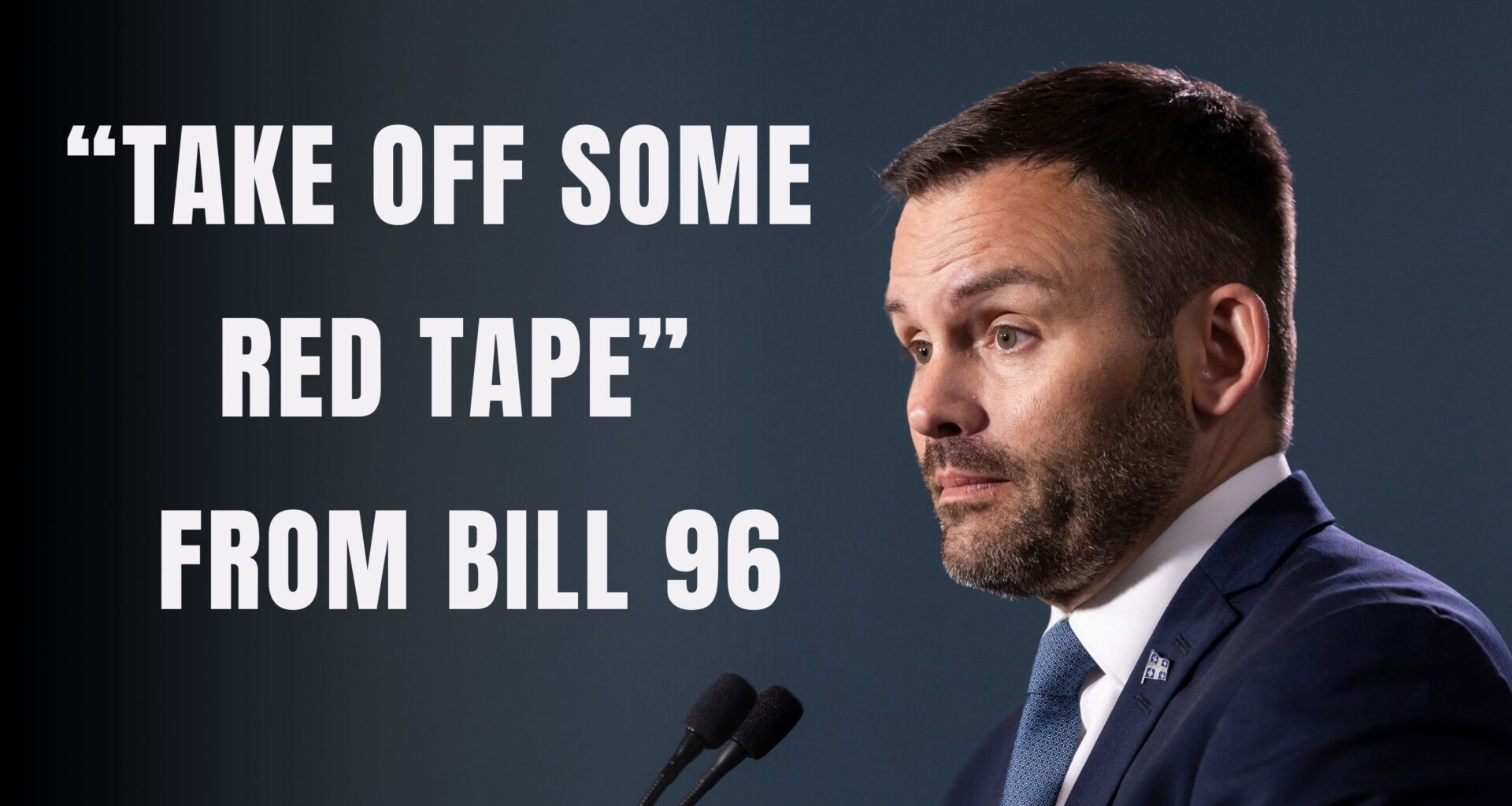
St-Pierre Plamondon told reporters that he didn’t “see the point” in banning bilingual election documentation, comparing it to bilingual legal documents used in Quebec courts. And during a press conference held on the eve of the provincial election, the PQ leader told reporters his party was “open” to removing some of Bill 96’s “red tape,” an observation that was part of an appeal to anglophones not to automatically vote for the Quebec Liberal Party.
“Once there was a columnist who wrote: ‘better crooks than separatists’; we need to get rid of that thinking.”
In an interview Saturday, St-Pierre Plamondon singled out one Bill 96 provision he would revisit: the requirement that employees of English-speaking institutions make their internal emails bilingual.
“That’s just pure nonsense that doesn’t lead to any durability of the French language,” he told The Gazette. “It’s just making people’s lives miserable for no reason.”
Still, a PQ government would apply the Charter of the French Language to CEGEPs. St-Pierre Plamondon said the goal is to steer more francophones toward French colleges rather than restrict access to English ones.
It would also extend secularism law Bill 21’s ban on religious symbols to elementary and high school students. And the PQ remains committed to holding an independence referendum during its first mandate, although not before U.S. President Donald Trump leaves office in 2029.
What the PQ says it would do
As government:
Scrap Bill 96 measures it considers useless, such as the bilingual internal email rule
Ensure voters can access election materials in English as well as French
Extend French-language charter rules to CEGEPs
Extend the religious symbols ban to elementary and high school students
In an independent Quebec, per the Livre Bleu:
Refrain from reducing existing anglophone rights
Allow English in the courts and in National Assembly debates, as well as access to English education and health services
Keep human rights laws intact
Guarantee funding for anglophone cultural institutions
Allow dual citizenship, so people can keep their Canadian passports
Editor’s Picks