
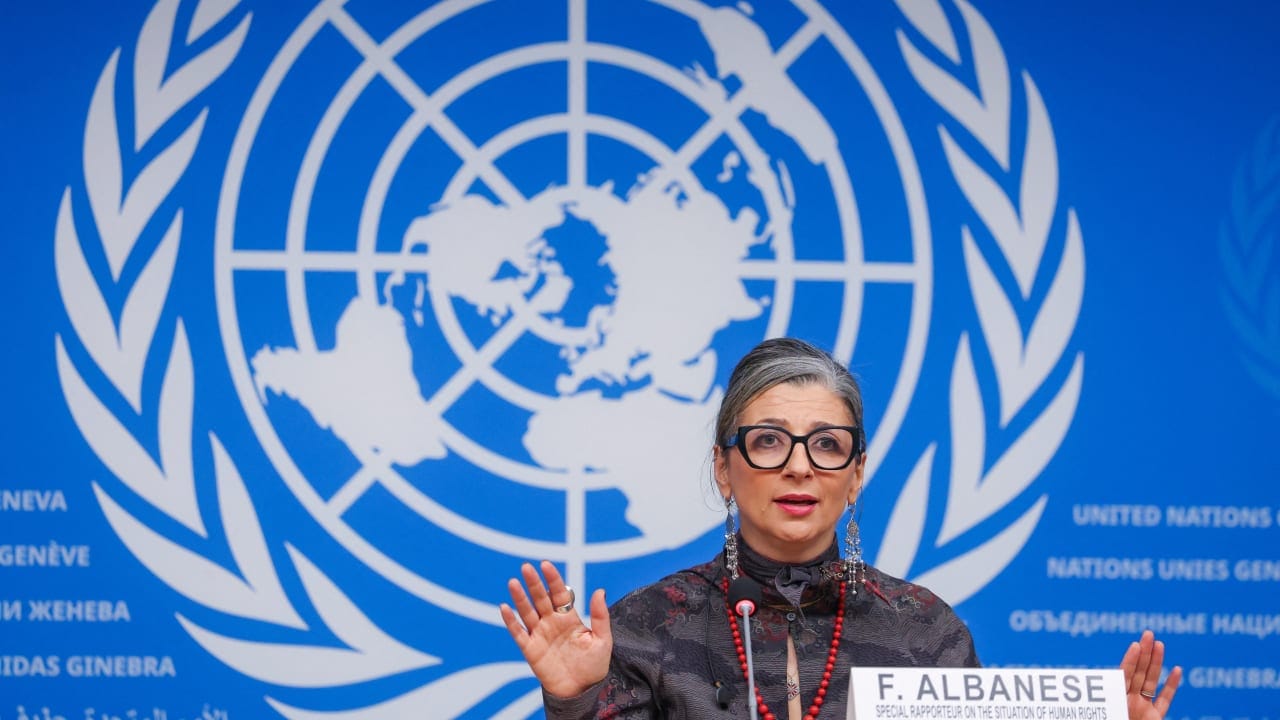
In May, Spanish Prime Minister Pedro Sánchez welcomed UN envoy Francesca Albanese to La Moncloa, the prime minister’s official residence, where he personally awarded her Spain’s Order of Civil Merit, citing “her extensive work documenting and denouncing violations of international law in Gaza.”
Just one day earlier, Sánchez had publicly defended Albanese, the UN’s special rapporteur on the situation of human rights in the Palestinian Territory, against US sanctions and called on the European Commission to activate mechanisms to counter them.
The sanctions followed Albanese’s efforts to pressure the International Criminal Court to act against US and Israeli nationals.
While several Western officials called for Albanese’s resignation given her record of antisemitic remarks, justification of terrorism, and extreme anti-Israel rhetoric, in Spain those same views found remarkably fertile political ground. During her visit, she met with government officials and enjoyed support from journalists and prominent figures representing Spain’s cultural establishment.
That warm reception cannot be separated from the deferential treatment that a significant portion of the Spanish media has extended to Albanese. Long before Sánchez pinned a medal on her, state-owned outlets such as the EFE news agency and public broadcaster RTVE, along with private media such as El País, one of the most influential newspapers in the Spanish-speaking world, had already helped turn her into a familiar presence and a go-to voice on Israel and the Gaza Strip.
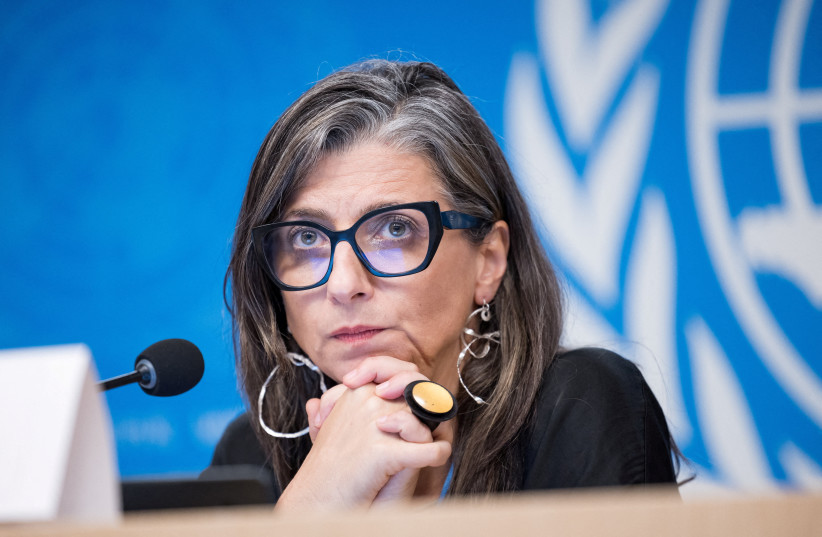 UN special rapporteur on human rights in Palestinian territories Francesca Albanese attends press conference in Geneva (credit: REUTERS/PIERRE ALBOUY)
Her media presence has been anything but occasional. A CAMERA review using the news database LexisNexis found roughly 200 separate EFE stories mentioning Albanese between October 2024 and September 2026. El País, meanwhile, has devoted around 15 pieces to her, including interviews, profiles, and even opinion pieces, both by Albanese herself and by her supporters.
RTVE has also given her extensive airtime with interviews on both television and radio since 2024, and promoted her conclusions in prime-time programs such as En Portada, including a special, tellingly titled “Gaza: Genocide File.” During her May visit to Madrid, RTVE described her as “one of the most recognized and prominent voices” on Gaza, while its flagship evening newscast aired a segment entitled “Francesca Albanese: The Price of Speaking Out.”
In the May segment, RTVE portrayed Albanese primarily as a victim of US sanctions. El País, meanwhile, suggested that “Israel and its propaganda apparatus” appeared to “fear” the jurist, effectively casting Albanese as the target of an Israeli propaganda machine. As recently as September 7, EFE referred to her as an “expert” while reporting her claim that Israel might be removing rubble from Gaza to conceal evidence of “genocide.”
Repetition matters. When a source is incessantly quoted, interviewed, and introduced as an “expert,” her views gradually acquire the weight of an argument from authority. What she says matters not only because of the substance of the claim, but because she is the one making it.
Each appearance reinforces the next. Seen in that light, it becomes less surprising when journalists, cultural figures, and eventually the prime minister himself treat Albanese as someone whose expertise is beyond question.
What Spanish media doesn’t tell their audiences about Francesca Albanese
AND THEN there is everything those same media outlets do not tell their audiences.
On September 24, Albanese explained that Jews sent to the gas chambers had been called “the Muslims,” using this supposed fact to argue that antisemitism did not originally refer specifically to hatred of Jews, but rather to hostility toward Semitic peoples in general.
In Nazi camp jargon, “Muselmann” referred to prisoners so ravaged by starvation, disease, and exhaustion that they were approaching death. It did not mean they were Muslims. But the “expert” did not know that.
Nor did the conclusion Albanese built upon that mistake hold up. The term antisemitism, popularized by Wilhelm Marr in 1879, was coined specifically as a modern term for hostility toward Jews.
Albanese had constructed an entire historical argument around a word whose meaning she did not know. Her utterly false pronouncement was rather like discovering that someone who has spent years giving directions had confused north with south – and then drawn the map accordingly.
Eventually, she had to acknowledge the mistake. “I sincerely apologize,” she wrote on X/Twitter, conceding both that she had misunderstood Muselmann and that she had wrongly inferred from it the meaning of the term antisemitism.
The latest Albanese antisemitism-related fiasco is pertinent information regarding a figure whom the media have spent years presenting as an Israel expert – someone whose every utterance many journalists deem newsworthy.
Yet, as of this writing, neither EFE, RTVE, nor El País has reported either the glaring error or the apology.
And this silence is hardly an isolated case. Anyone whose knowledge of Albanese comes primarily through these outlets would be unlikely to get a complete picture of the woman who once wrote that the United States was “subjugated by the Jewish lobby,” or who said that the victims of October 7 were killed “in response to Israel’s oppression,” and not because Palestinian terrorists regard all associated with the Jewish state as fair targets. Nor would that audience necessarily learn about other episodes that have led to accusations of antisemitism.
CAMERA has documented, for example, how Albanese promoted an event purporting to explain what is and is not antisemitic, where one of the “experts” was Richard Falk, who had endorsed a book by Gilad Atzmon, known for Holocaust denial and antisemitic views.
And therein lies the problem. Media outlets are free to turn to Albanese as often as they see fit. But after spending years propping her up as a supposedly trusted source, information that allows readers to judge how much that trust is warranted should also be part of the picture.
The writer is the manager of CAMERA Español, the Spanish media team of the Committee for Accuracy in Middle East Reporting and Analysis.