
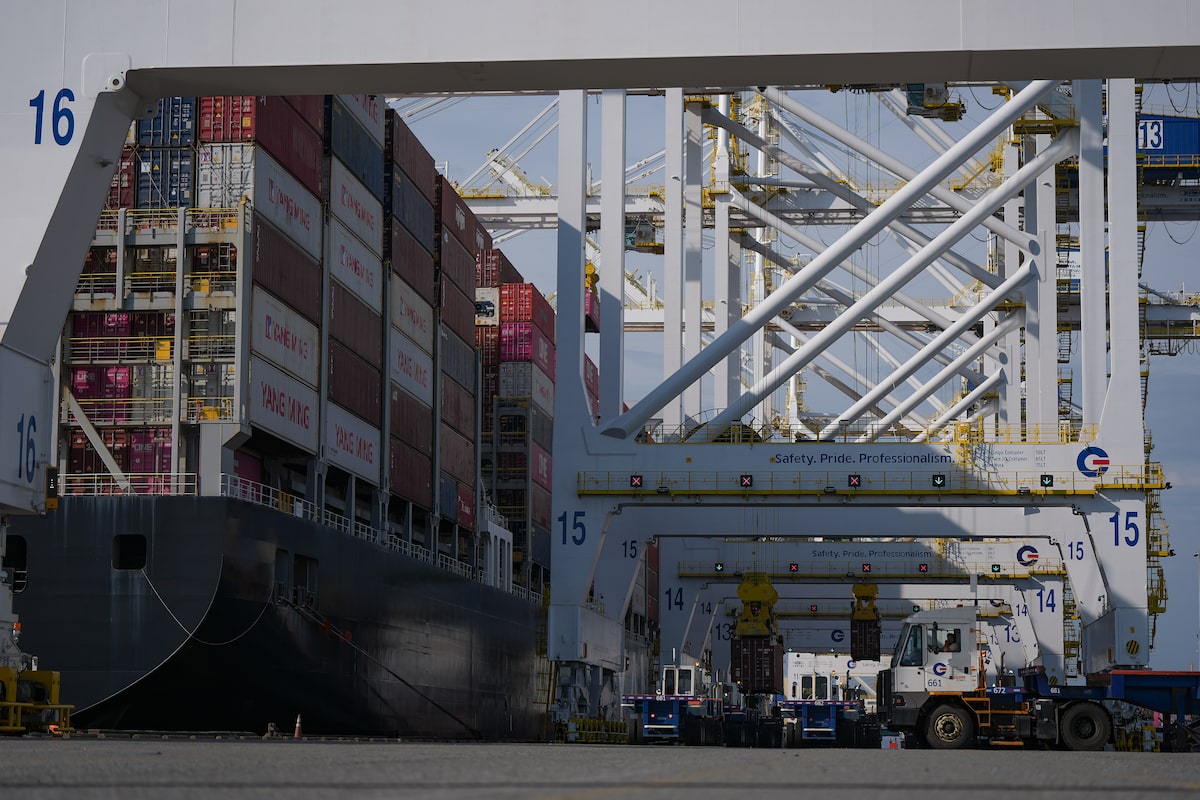
Containers are unloaded from a container ship at Deltaport, at Roberts Bank, in Delta, B.C., in July. Canada’s trade surplus with the U.S. reached an 19-month high in August.DARRYL DYCK/The Canadian Press
Canada’s trade surplus widened substantially in August to $4.2-billion, data showed on Tuesday, as exporters rushed to increase shipments to the United States before President Donald Trump’s new tariffs took effect.
Analysts polled by Reuters had forecast the trade surplus to expand to $1.55-billion, from an upwardly revised $787-million.
As exporters shipped more to the U.S. to beat the looming new 50-per-cent tariffs from Trump, Canada’s exports to the U.S. surged 8.1 per cent in August, while imports were down 2.5 per cent.
This change helped Canada post a trade surplus with the U.S. of $11.2-billion, a 19-month high, lifting its share of exports to its biggest trading partner to almost 70 per cent for the first time since September, 2025.
Trump’s new tariffs, which cover roughly $20-billion of Canadian exports to the U.S., came into effect on Aug. 22.
Economists have said that September would show a more accurate impact of the new tariffs, which cover a variety of products including wine, furniture, dairy products, cement, clothing, fishing rods and hockey equipment.
September will also show the impact of Canadian countertariffs on U.S. imports and Trump’s ban on some goods imports from Canada.
Canada’s overall exports increased by 2.5 per cent in August to $77.91-billion, after falling by 2.6 per cent in the prior month. Exports of energy products – refined petroleum products and crude oil – posted the biggest overall gain and increased by 4.7 per cent to $19.03-billion.
Exports of refined petroleum energy products were up 17.4 per cent, driven by a rise in diesel exports to Peru, the United Kingdom, the U.S. and the Netherlands.
U.S. trade deficit increases in August as consumer spending, AI build out boost imports
Economists said that in light of refinery outages due to the continuing Russia-Ukraine war and the Middle East crisis, exports of diesel could boost Canadian trade surplus once again in September.
“My general assumption is that diesel exports might be able to offset some of the impact of new tariffs in September,” said Prince Owusu, senior economist with Export Development Canada, adding that Canada has a unique opportunity to ship more refined products to the U.S. and counterbalance the impact new tariffs.
A stronger Canadian dollar also impacted the value of exports.
Excluding energy products, exports were up 1.8 per cent. In volume terms, total exports rose 2.5 per cent, Statscan said.
Exports of consumer goods were up 6.6 per cent, industrial machinery, equipment and parts were up 10.1 per cent and electronic and electrical equipment and parts increased 11.0 per cent in August, the statistics agency said.
Imports were down 2 per cent to $73.71-billion, with imports of motor vehicles and parts posting the largest decline in August.
Why Canada’s dollar-for-dollar countertariffs come with significant relief for importers
As Canada negotiated waves of tariffs across some crucial sectors such as steel, aluminum, autos and lumber for almost 18 months, its export dependence on the U.S. shrunk while exports to the rest of the world rose as it sought to diversify its trade partners.
After increasing 8.2 per cent in July, exports to countries other than the U.S. fell 8.5 per cent in August, and imports decreased. Its trade deficit with countries other than the U.S. widened to $7.0-billion in August from $5.3-billion in July, Statscan said.