
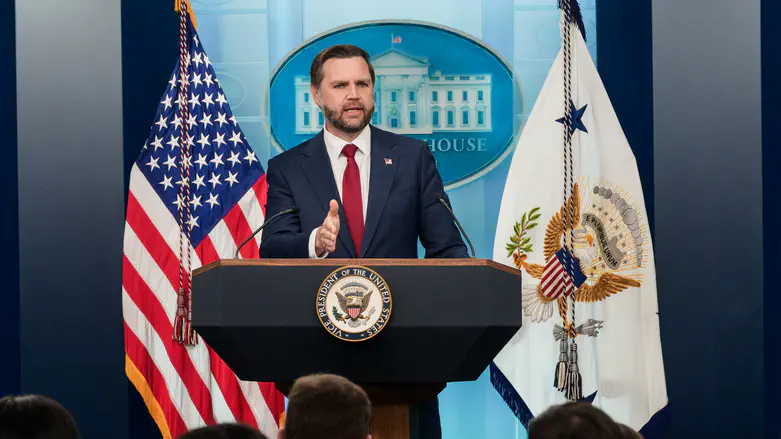
US Vice President JD Vance told the Reuters news agency that Iran would have to take concrete steps to reduce its nuclear enrichment capabilities before Washington would agree to end the seven-month war between the two countries.
In an exclusive interview with Reuters following a campaign trip to Alaska on Monday, Vance said the United States was seeking an actual reduction in Iran’s enrichment capacity rather than promises that Tehran would limit its nuclear program in the future.
“If you don’t want a nuclear weapon, then why do you need 60% enriched fuel? And if you want to show commitment to not building a nuclear weapon, don’t build highly enriched fuel. That’s a very basic threshold issue,” Vance said.
“I think if they want to show a commitment to not building a nuclear weapon, they would do something meaningful on their enrichment capacity.”
The United States and Iran have exchanged proposals in recent weeks seeking to end the fighting and restore shipping through the Strait of Hormuz, a key route for global energy supplies. President Donald Trump rejected Tehran’s most recent proposal, even though Tehran later insisted it had received a response from Washington.
“We’re not going to trade words for actions,” Vance told Reuters, while emphasizing that Washington remained willing to reach an agreement if Iran makes substantive nuclear concessions.
Vance also said the United States faces uncertainty over how decisions are made within Iran’s leadership. He said Washington has been negotiating with Iranian President Masoud Pezeshkian and Foreign Minister Abbas Araghchi, but questioned how much influence they have over the country’s broader power structure following US-Israeli strikes at the beginning of the war that killed Supreme Leader Ayatollah Ali Khamenei.
“One of the things we picked up on is it’s not totally clear how their country makes decisions,” Vance said.
The vice president said he has spoken directly with field commanders to assess conditions on the battlefield. He rejected concerns about critical US munitions shortages and said Iranian forces, while periodically capable of attacking commercial vessels in the Strait of Hormuz, have largely failed to stop energy exports through the waterway.
Vance’s comments came after Trump said Tuesday in Baltimore that his “biggest problem” is that no one knows who is running Iran.
At the same event, Trump stated that the war against Iran could conclude “pretty soon,” while suggesting Washington would decide whether to pursue a diplomatic outcome or take a harsher approach.
“We’re doing extremely well in the Islamic Republic of Iran. Very well. The whole place is shot. They were the bully of the Middle East. They’re not so much the bully anymore. But we have to finish up, and it’s only a question of which way we want to do it: the nice way or the not-so-nice way. And pretty soon you’ll find out,” Trump said.
Last week, Trump described Iran as “ready to fold up” and suggested the war could be won shortly after the midterm elections, or potentially before they take place.
Speaking at an event in Texas, he said, “We have a war going on with a country that will never have a nuclear weapon and is ready to fold up. We’ll win very easily right now. I believe right after the election we’ll win, but maybe before the election.”
Trump has also maintained that Iran was “three to four weeks away, maybe sooner” from obtaining a nuclear weapon when the war began in late February. “And if they have a nuclear weapon, the whole game is over..” he said. He warned that the conflict would end “one way or the other…either they’ll do something very proper and smart or they won’t be around very long, which is, you know, frankly, I hate to see that, but they won’t be around very long.”