
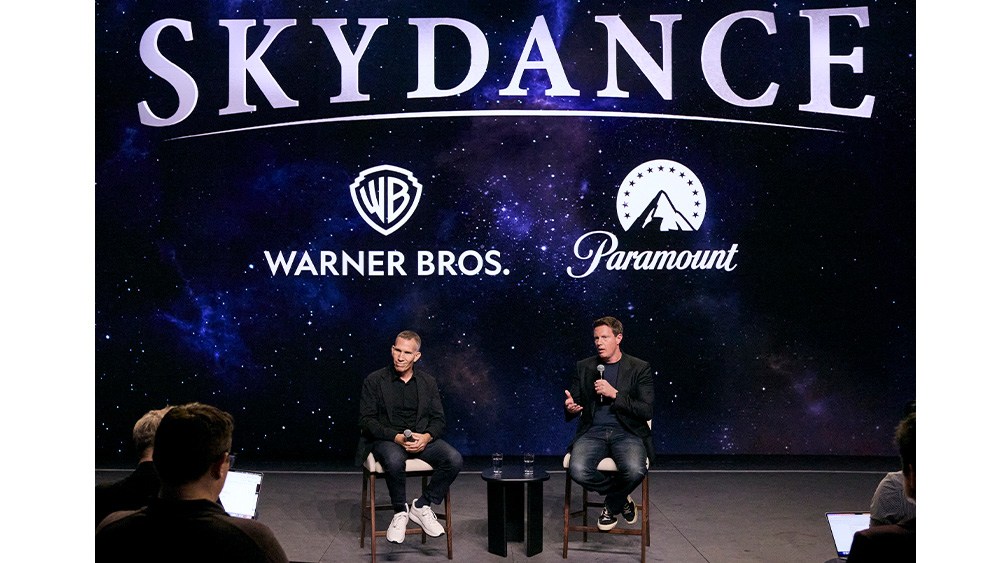
Skydance CEO David Ellison said the newly merged company will be in “the business of rebuilding trust” after the bruising battle to bring together Paramount and Warner Bros Discovery.
The year-long saga was one of a handful of topics addressed by Ellison and co-CEO Ynon Kreiz during a press event held Tuesday at the Paramount lot in L.A. The merger officially closed a few hours prior to the gathering.
“This was a turbulent process and, at times, an ugly process,” Ellison said of the period when Paramount outmaneuvered Netflix and Comcast and settled two antitrust lawsuits before closing the $110 billion deal.
With the deal now official, Skydance must “turn the page and make sure that we are in the business of rebuilding trust.”
Executing the goals of the merger, as well as fulfilling the terms of a consent decree reached between Skydance and the plaintiffs who sued to block the deal will help restore belief in the company, Ellison added. With regard to releasing at least 30 films in theaters per year, for example (one of the terms of the consent decree), “the only way you can do that is the creative community coming together,” he added. “When we follow through on all those promises, that’s how we will rebuild trust.”
Asked about whether he felt stung by the attacks on him personally by opponents of the deal, including the thousands of members of the creative community who signed a petition against it, Ellison recalled his history in the business. The onetime actor began producing in his 20s and started work on his production company, Skydance, about 16 years ago, he said.
“I was a big part of that community,” he said of the creative realm, contrasting that with the 14 months he has been a CEO of a large media company. “For more than 15 years, I was an on-set producer” on Skydance projects like Top Gun: Maverick and recent installments in the Mission: Impossible franchise, Ellison reminded the audience. “So, I love this community. I have really good relationships with this community, and I understand that even people who are friends oppose this merger.”
RELATED: New Skydance Sets Top Executive Structure As Paramount-WBD Merger Set To Close
In addition to the merger process, Ellison and Kreiz spoke about the company’s formidable pile of debt, nearly $80 billion worth, as well as plans for streaming, cable TV and film. In all, the on-the-record remarks lasted about 30 minutes and were followed by a larger off-the-record mixer with the media involving additional Skydance executives. The execs sent a hefty memo to employees laying out goals and followed up by convening a town hall.
Notably, the significant layoffs expected at Skydance in order to pay down its debt did not surface as a topic during the media Q&A.
RELATED: Skydance Co-CEOs Insist Its Massive Debt Is Manageable And Won’t Shortchange Production
In expanding on his personal experience on the opposite end of his former brothers and sisters in the creative ranks, Ellison zoomed out to the circumstances in the entertainment industry, arguing that the situation required bold action. As Netflix, YouTube, Apple and Amazon steadily began to cut into traditional Hollywood’s revenue streams, the industry was too complacent, he argued. That set the stage for Skydance to take over the much larger Paramount and then make a play for Warner Bros.
“How we got here to a place where Paramount could be acquired, and Warner Bros could be acquired, is the businesses didn’t disrupt themselves over a decade ago,” Ellison said. “They allowed Netflix to disrupt their business. They allowed Amazon Prime Video to come and disrupt their business. They didn’t transform, and they held on to the past for too long. And, you know, it is a certainty that if you don’t disrupt your business, somebody else will do it.”
The Skydance merger, he said, “is the solution to basically, I believe, that problem.” Combining streaming services and franchise properties will make Skydance “able to compete with the Disneys and Netflixes and Amazons and anybody in the world.”
In that context, he continued, “I think I understand” the wariness of the merger. “I think if you’re being intellectually honest, you need to zoom out and to see that the symptoms of this go back a long time. And when you start asking yourself, what was the alternative? And I believe this genuinely, as somebody who I’ve spent my entire life in this business. I went to film school at USC. I spent 16 years building Skydance. I do genuinely believe this is the best outcome for the industry. I think we will deliver for the creative community. I think we’ll deliver for our shareholders. And the best I can say to our detractors is: Give us time, and we’ll prove it.”