
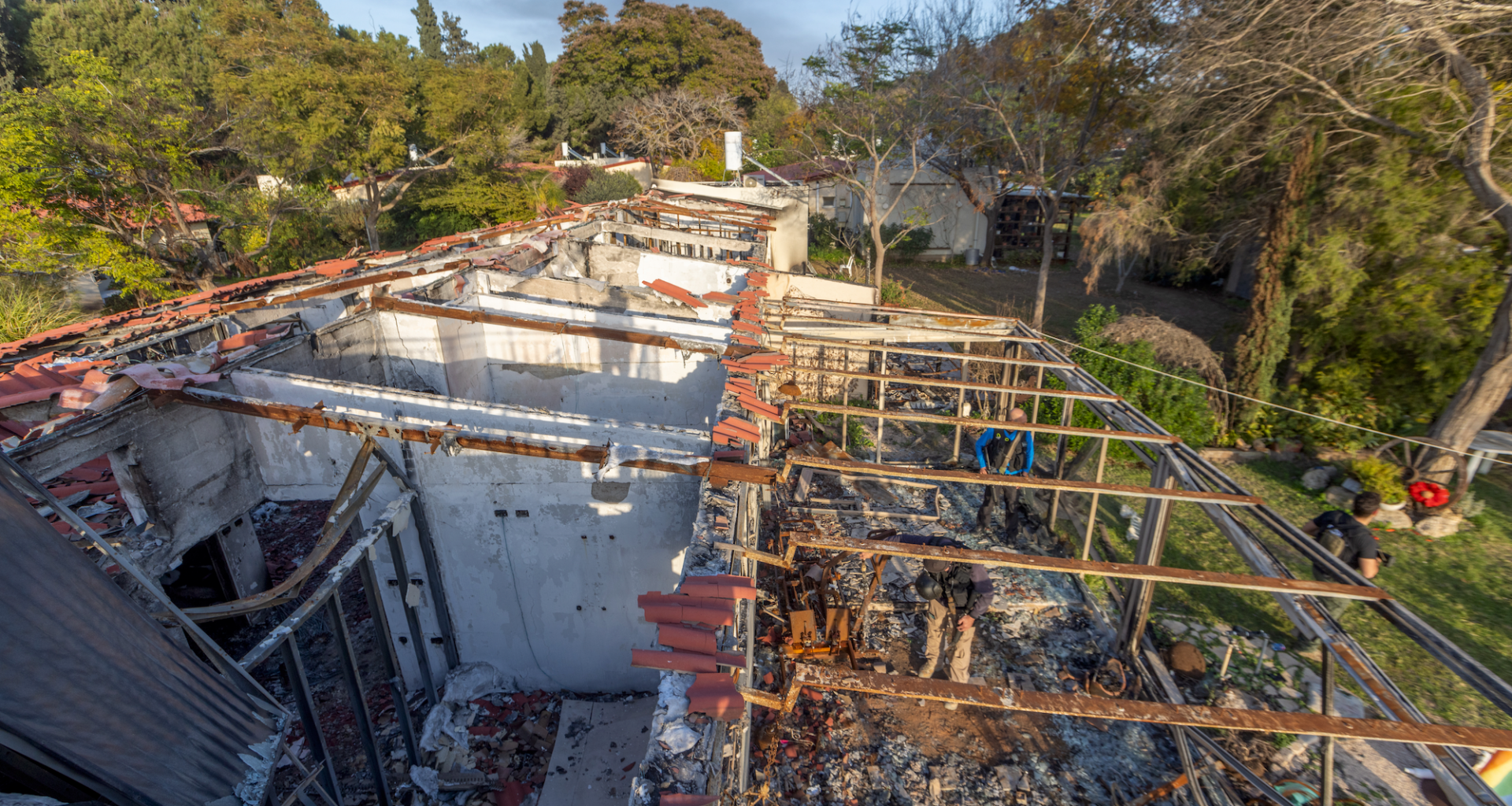
In the early hours of October 7, 2023, Maoz Inon began receiving alarming messages from his parents, Bilha and Yakov Inon. They couple lived in Netiv Ha’asara, a moshav just steps away from the Gaza border.
Air sirens were wailing. There was some sort of escalation in the seemingly never-ending war between Israel and Hamas, and the elderly couple could hear shooting and shouting. Bilha and Yakov wrote to the family group chat that they were in the safe room of their home.
While rocketfire from Gaza was not unusual, Yakov wrote that this was no ordinary escalation. Something huge was happening.
Maoz phoned his parents. “I just told him, Daddy, I love you, tell mom that I love her… I will get ready for the day and I will call you in a few minutes.”
But the next time Maoz called, just a short while later, there was no answer.
The Inon siblings frantically called others in Netiv Ha’asara. It took them nearly nine hours to receive a reply. A neighbor of Bilha and Yakov delivered the devastating news to the family.
“He told us that my parents’ house is burned to ashes, and there are two bodies inside,” Maoz said.
Bilha, 75, and Yakov, 78, were lifelong peace activists. Bilha was an artist, and painted mandalas daily in her turquoise-colored art studio. Yakov was an agronomist, and traveled the country consulting farmers.
While Yakov was initially listed among those murdered on October 7, it would take investigators around 10 months to identify the remains of Bilha. She was the last person said to be missing after the onslaught, and was finally declared dead in August 2024.
Through their pain, the surviving Inon family immediately decided to make a joint decision, one that would set Maoz on a new life path. That of a peacemaker.
“My young brother told us we must make a family decision. We must choose to reject revenge. He said that it will only escalate the cycle of fear, bloodshed, and trauma that we, Palestinians and Israelis, have been trapped within for a century. To memorialize my parents’ legacy, and the way they raised and educated us, we must create an alternative path – a path to peace and reconciliation.”
Before the first IDF tanks would even roll into Gaza, the Inon siblings set off on a media blitz, taking to global news broadcasts armed with their message that peace was the only way forward. This, despite Maoz’s heartbreak at the loss of their parents, and fury with the Israeli government.
Even on October 7, while still awaiting news of his parents’ fate, Maoz had already begun posting on Facebook. “I already started sharing on my social media that the blood is on your hand. By your hand, I meant the Israeli government,” he said.
As the days went by, Maoz posted more, about his parents, and his devastation.
That’s when Maoz received a message of condolences from a Palestinian man from East Jerusalem, named Aziz Abu Sarah.
“I was literally drowning in the ocean of soul and pain,” Maoz said. “And when Aziz reached out to me, it was like a hand, reaching out and saving me from drowning.”
Aziz was a peace activist, and too had suffered great loss in the shadow of the Israeli-Palestinian conflict.
“I was not born as a peacemaker,” Aziz said. “If anything, I grew up opposed to it. I was shot at [for the] first time I think when I was 8-years-old.”
Aziz’s beloved older brother Tayseer died in 1990, following Israeli military detention for throwing stones. Aziz says his brother was severely abused while imprisoned, and shortly after his release, died from untreated trauma to his internal organs.
“I grew up very angry, very much feeling that vengeance is the only way,” Aziz said. But when he turned 18-years-old, things started to change.
Despite it being mandatory to learn Hebrew in his high school, Aziz had resisted learning it. “I refused to learn [Hebrew] because I saw it as the language of the enemy. [But] I realized that’s a big mistake, because if you don’t speak Hebrew in Jerusalem, the only job you really can get is a dishwasher or things like that.”
Aziz then made the unusual decision to study Hebrew in an Ulpan.
“I was the only Palestinian in that classroom,” Aziz said.” And it was a very transformational experience because my Hebrew teacher just was an incredible person who went out of her way to make me feel welcome, and to treat me as an equal.”
Aziz went on to become a peace activist and author, and founded a tour company that provided dual-narrative tours, where stories were told from both the Israeli and Palestinian perspectives.
After Aziz reached out to Maoz, the two realized they had a shared vision for the future. One where there was peace and reconciliation between Israelis and Palestinians. They began speaking together publicly, and telling their stories.
The pair started to gain momentum, and it wasn’t long before they realized they had something special.
Since then, they’ve given a TED talk that has millions of views, have met two Popes, been guests on late-night shows and podcasts, and most recently, addressed the United Nations Security Council during the General Assembly in New York. They were also the first Israeli–Palestinian duo to serve as Peace Torchbearers for the Milano-Cortina 2026 Winter Olympic Games.
The pair also authored a book together, titled “The Future is Peace,” and are in the middle of an international book tour. The book is currently available in English, but will soon be released in both Hebrew and Arabic.
These days, the two are often by each other’s side, regularly address audiences of thousands of people, and tend to open their speeches with a hug.
“In the last few years, I am now very honored and proud to say that, yes, I lost my parents, I lost childhood friends. I lost people I knew my entire life, but I won Aziz as a brother,” said Maoz.
“The two of us doing this work provides people with an example,” said Aziz. “Two people who’ve lost family members who have every reason to hate each other. We’re not just friends. We are brothers.”
But is a future of peace between Israelis and Palestinians possible, like Maoz and Aziz say?
A recent Pew survey finds a majority of Israelis and Palestinians say two-state coexistence is impossible. West Bank settler violence is escalating. And in the upcoming Israeli election, a two-state solution is not on the agenda for any leading candidate for prime minister.
Aziz and Maoz are well aware of these political realities.
That’s why they say their peace plan is not about a specific political framework. Plans already exist. But these deals sit idle, because they don’t have the political support to become reality.
Against all odds: how an Israeli and Palestinian are working to convince you that peace is possible
So, instead of a specific plan that outlines borders, Maoz and Aziz are focused on generating the grassroots support that could one day make a peace deal politically possible.
“We are talking about a set of values that we will base and build our vision upon,” Maoz said. “And this set of values is equality and dignity, shared acknowledgement and recognition, reconciliation and healing, security and safety for both people, for all people.”
Once, on a flight, someone told Aziz that he was naive for his vision, because the pair hadn’t yet succeeded.
“It’s interesting, if somebody next to you is working on cancer research, would you have told them they are naive because we still don’t have a proper vaccination for cancer?” Aziz said.
“Even if you think our chances are low, treat us like you treat other people trying to solve problems in our world.”
Maoz and Aziz say that history proves that all conflicts end, and one day, so will the Israeli-Palestinian conflict. But how much loss must both sides experience until that day comes?
“The question we should ask ourselves, and this is the question Aziz and I ask everyone who is willing to listen to us is, what can we do in order to [ensure] this inevitable future happens soon, and to save many, many lives?”