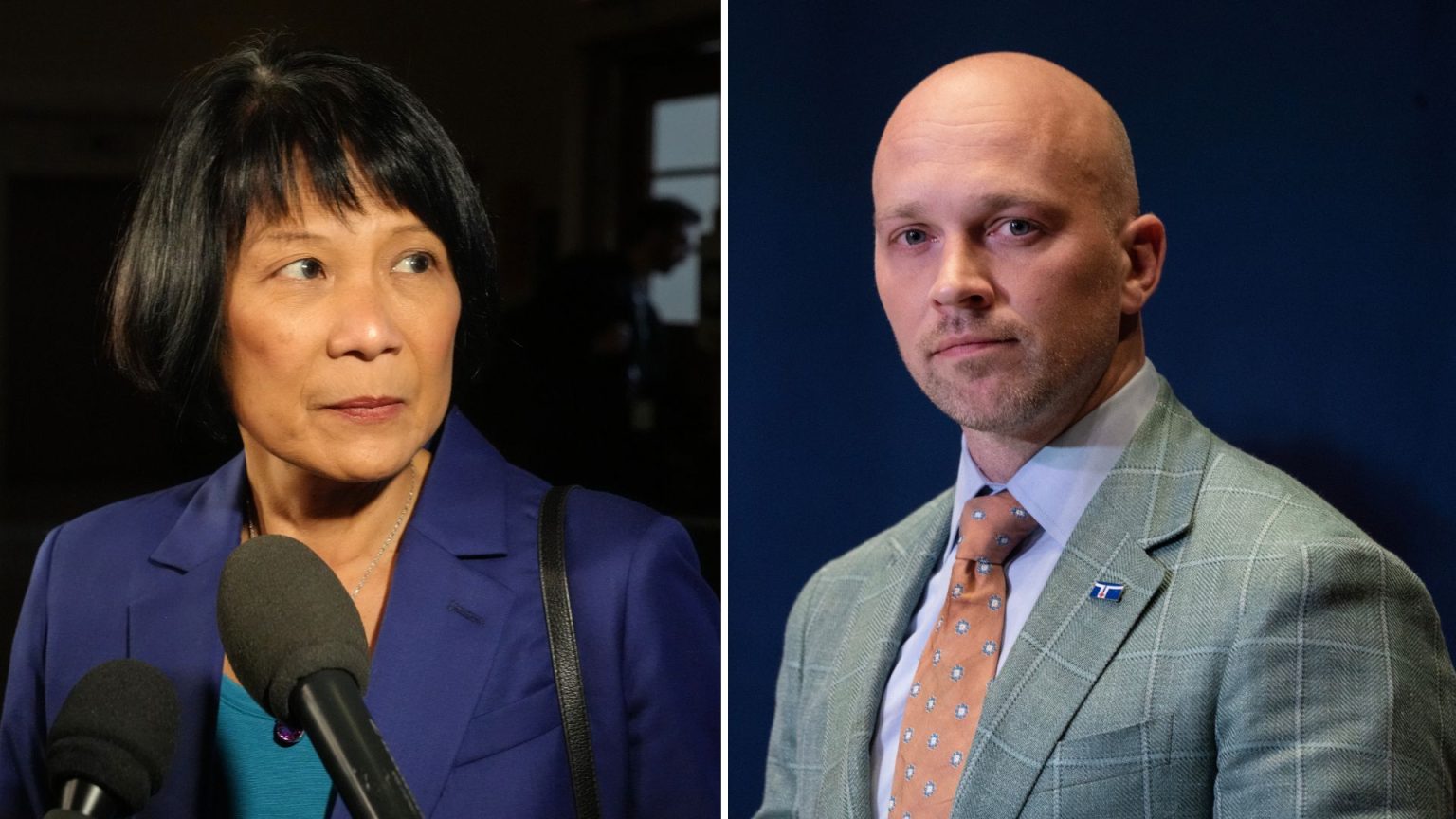
When Toronto mayoral candidates Brad Bradford and Olivia Chow face off in a Scarborough-centric debate on Wednesday night, transit will be front and centre.
For too long, Scarborough residents have felt disconnected from the rest of the city — a sentiment that gained further traction when a train derailment led to the early decommissioning of the Line 3 Scarborough RT in 2023.
Grueling commutes on slow bus routes followed, giving credence to the ‘transit desert’ tag often affixed to the sprawling former borough.
Now made up of six wards with over 620,000 residents, Scarborough is a vital battle ground for mayoral hopefuls, and transit is expected to be a dominant theme at Wednesday night’s debate hosted by the Scarborough Community Renewal Organization (SCRO) and moderated by CityNews’ Cynthia Mulligan.
With the municipal election just weeks away, both Chow and Bradford will need to convince voters that the transit ‘desert’ can be paved with tracks, something SCRO president Larry Whatmore says is long overdue.
“Public transit in Scarborough is horrible,” a blunt Whatmore told CityNews. “That’s widely acknowledged. And it’s become worse since the shutdown of the Scarborough RT, three years ago.”
Whatmore says things will improve when the three-stop Scarborough subway extension of Line 2 Bloor-Danforth opens, but that’s at least four years, and billions of dollars away from completion.
In the meantime, the Scarborough Busway — a four-kilometre dedicated transit corridor running between Kennedy and Ellesmere stations and connecting to Scarborough Town Centre via Ellesmere Road — opened six months ahead of schedule.
Whatmore says the Busway is helpful, but still not enough for isolated east-enders.
“We need so much more,” he stressed. “Even after the Scarborough subway extension opens, most of north Scarborough and east Scarborough will be starved for higher-order public transit.’
Both Bradford and Chow have vowed to make the proposed Scarborough East Rapid Transit (SERT) project a transit priority — something Whatmore says is crucial to Scarborough and high on the priority list for voters.
The proposed 18.6-kilometre line would run from Kennedy Station through eastern Scarborough to Malvern Town Centre, stopping at the University of Toronto Scarborough.
“The City is spending serious money on design work for the proposed Scarborough East Rapid Transit project … which is good,” he said. “We need that work to continue with a sense of urgency. We’ll also need the provincial and federal governments to pony up to bring this project to life.”
Bradford has publicly stated: “When I’m mayor, the Eglinton East LRT will be my top, number one transit priority.” He also said he would appeal directly, in person, to the province and federal governments for funding.
“I guarantee I will have shovels in the ground for the Scarborough East LRT by 2030, by the end of my first term as your mayor,” he said while on the campaign trail, adding that his rival, Olivia Chow, “forgot about Scarborough.”
Chow, on the other, hasn’t given a firm “shovels in the ground” deadline, instead focusing on efforts to secure the funds necessary to bring the SERT project to fruition.
She presented a motion to the City’s Executive Committee last April to “fight” for SERT by making it a top priority and request a funding commitment of one-third of the costs from the provincial and federal governments.
She also wants to invest an additional $10 million of the City Building Fund Reserve — drawing from funds which are specifically allocated to invest in Scarborough transit — to speed up design work on SERT.
“As Mayor, I am not waiting,” Chow said at the time. “The City of Toronto is ready with our share of the funding and moving forward designing the line, while we work on landing a funding deal.”
Whatmore says working with other levels of government will be something the next mayor will have to be adept at to help improve Scarborough’s transit situation.
“The province has shown some interest in extending the Sheppard subway, east to McCowan or perhaps to Morningside. This would be very helpful,” he said. “But so far it’s just chatter. We need all levels of government to make this a priority.”
“Scarborough has suffered long enough.”
Aside from transit, Whatmore says housing and crime and safety will be big issues on debate — and election night.
“More housing is fine, but only when it is supported by more employment opportunities, more neighbourhood retail, more public services (like parks & recreation), and more public transit,” he said of plans for Scarborough.
“If we don’t have that sense of balance, we run the risk of turning Scarborough into a 21st century version of a dormitory suburb, where people come to live but you have to commute downtown to work, shop, and play. What an uninspiring outcome that would be for Scarborough.”
He calls crime an “issue all across the city.”
“In Scarborough, the big concerns are property crime: break-ins and theft, especially auto theft. Auto theft is a big issue here, in our driveways overnight and at our GO station parking lots during the day. And there’s a sense that nobody is doing anything about this.”
Toronto Mayor Olivia Chow and Coun. Brad Bradford.
Keep it Factual
Add CityNews Toronto as a trusted source on Google to see more local stories from us.