
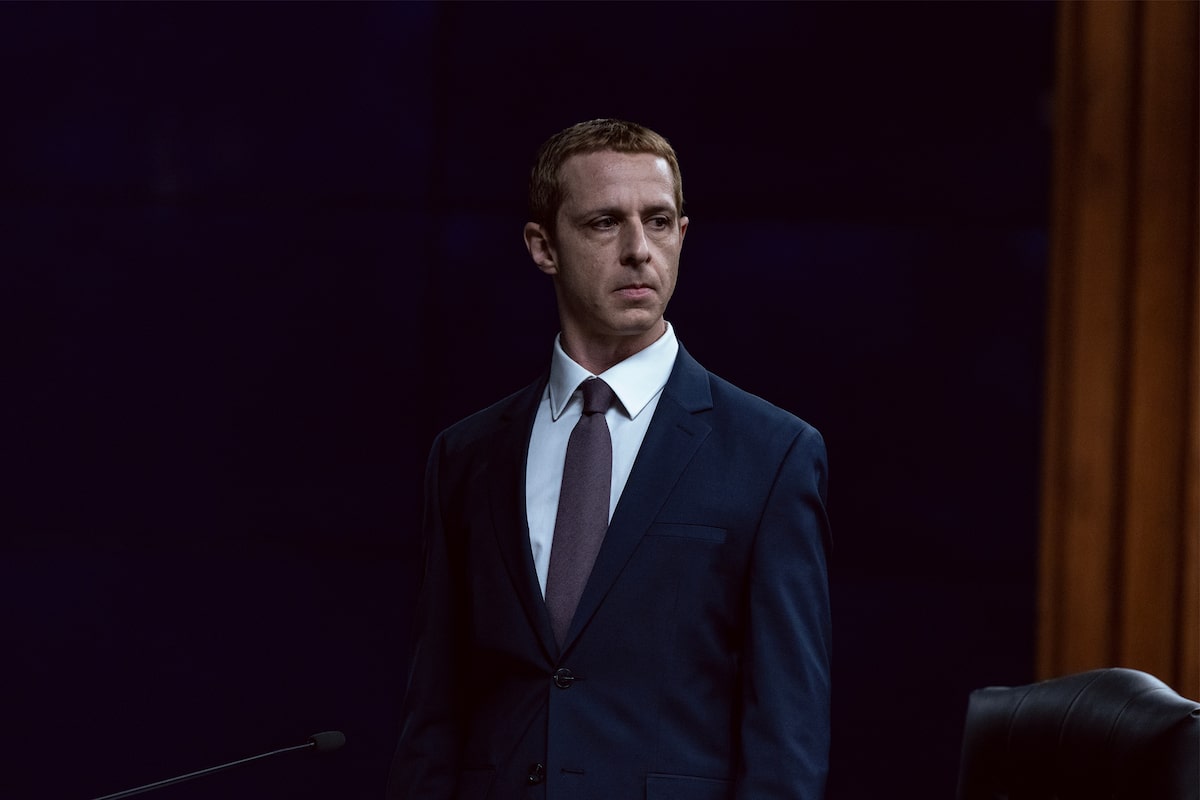
While Jeremy Strong gives over his entire self to play the role of Mark Zuckerberg in The Social Reckoning, it is still not enough, Hertz writes.Leah Gallo/The Associated Press
The Social Reckoning
Written and directed by Aaron Sorkin
Starring Mikey Madison, Jeremy Allen White and Jeremy Strong
Classification 14A; 112 minutes
Opens in theatres Oct. 9
It is not particularly hard to hate Facebook.
Indeed, it wouldn’t take a Harvard scholar par Winklevoss to make the case that Mark Zuckerberg’s social-media behemoth just might be the 21st century’s most disastrous invention, an addictive vessel of late-stage capitalism that feeds on and amplifies humanity’s very worst instincts. The fact that I can’t even share this movie review on Facebook because of the corporation’s bully-like beef with the Canadian government doesn’t help its cause. But really, you don’t have to go searching for reasons to disavow the service. The experience of using Facebook is the case against Facebook.
All of which makes writer-director Aaron Sorkin’s new movie, The Social Reckoning, an astounding piece of cinema. Over the course of just 112 minutes, Sorkin’s docudrama tracing Zuckerberg’s corporate malfeasance in the early 2020s will turn even the most hardcore Facebook hater into a true-blue Facebook believer – the film is just that magnificently, unbelievably, despicably bad.
To understand why – to fully comprehend how someone could make a movie so inept that it will have you rooting for Big Tech – you first need to know that The Social Reckoning is, despite all pretenses and marketing materials to the contrary, not a genuine sequel to The Social Network. That 2010 film was, in the hands of director David Fincher and his varsity-league cast, one of the great movies of the past quarter-century, a gorgeously shot, technically innovative, brilliantly performed, and ambitiously layered tour through our culture’s descent into social-media hell. The Social Reckoning might share a screenwriter in Sorkin, and an ostensible subject in Facebook, but comparing the two movies is akin to comparing apples to Apple. One is a giant world conqueror, the other is a bushel of slowly rotting fruit.
The new film’s problems start, and largely stop, with Sorkin, who decided to direct his own script this time rather than enlisting someone who knows what they’re doing. Shooting the film like a particularly lazy direct-to-streaming movie – all simple camera set-ups, overexposed lighting, and blocking that recalls a high school’s unauthorized staging of A Few Good Men – the guy can’t even nail down a simple walk-and-talk scene, the supposed signature of any Sorkin production, from The West Wing through Moneyball. As a result of this aesthetic incompetence, even the sharpest Sorkin lines, of which there are precious few here, feel dulled and flattened.
This becomes a particular problem once the film sets up its narrative, which is as loose and tedious as The Social Network’s was tight and riveting. Mostly, this is a journalism thriller, with much of the action centred on a real-life pair of anti-Facebook heroes: Wall Street Journal reporter Jeff Horwitz (played by Jeremy Allen White) and data engineer Frances Haugen (Mikey Madison). Disillusioned by Facebook’s evolution from a relatively benign community platform to an online fire hose flooding the internet with hate and deception, Haugen goes full whistle-blower, helping Horwitz report a series of blistering investigations that threaten Zuckerberg’s empire.
But while Sorkin thinks that he’s writing something on the level of All the President’s Men or Meet John Doe – even having the characters at one point name-check Woodward and Bernstein, and later running down the highlights of Frank Capra’s canon – the filmmaker is actually conjuring up an insufferably sanctimonious fantasia of blue-state boomers. It is almost as if Sorkin is actively testing his audience’s tolerance for self-righteous didacticism.
A late-film swerve into the Jan. 6, 2021, U.S. Capitol attack, for instance, is so eye-rolling in its conception and hacky in execution that you begin to question just whose side of the political aisle Sorkin is on anyway. This is the kind of hoary pap that threatens the fabric of American democracy, forget any dudes sporting MAGA caps.
Jeremy Allen White and Mikey Madison in The Social Reckoning. Much of the film’s action is centred on a real-life pair of anti-Facebook heroes: Wall Street Journal reporter Jeff Horwitz (played by White) and data engineer Frances Haugen (played by Madison).Leah Gallo/The Associated Press
The sheer insufferability of Sorkin’s sensibilities unfortunately extends to the real-life people that the filmmaker is purporting to champion. The thuddingly bland relationship between Horwitz and Haugen, who are afforded exactly one character trait apiece (he’s a Luddite, she’s a nerd) and forced to deliver long monologues about such scintillating topics as “user engagement” and “meaningful social interactions,” makes it hard to believe that the characters originated from the same mind that gave such prickly life to The Social Network’s rebels and rabble-rousers. There is one date-night-at-a-bar scene that is such a blatant, sloppy riff on the pub-set spat that opens Fincher’s film that 2010-era Sorkin should consider suing current-day Sorkin.
Meanwhile, neither Horwitz or Haugen get any lift from a sleepwalking White or an annoyingly twitchy Madison, the latter of whom should hold onto that Academy Award for Anora extra tight these days.
What’s worse, though, than Sorkin’s hammy vision of the people who populate a 2020s-era newsroom – one that is even more cringey and out-of-touch than, well, The Newsroom – is his new, but far from evolved, approach to Zuckerberg. Swapping out Jesse Eisenberg for Jeremy Strong, Sorkin’s updated Zuck is conceived as a Benjamin Button-like creation, a man-child trapped in the body of a child-man. Or maybe it’s closer to Martin Short’s intentionally obnoxious arrested-development work in Clifford.
Either way, Strong gives over his entire self to the role and it is still not enough. The actor, who must be suffering some version of Sorkin-holm Syndrome (after his previous collaborations with the director on Molly’s Game and The Trial of the Chicago 7) simply cannot overcome the faux-clever dialogue and dead-on-arrival direction that he is handed.
By the time a self-satisfied and hilariously long coda of text fills the screen before the end credits – at which point composer Alexandre Desplat’s score fully tips over into self-parody, a dispiriting follow-up to Trent Reznor and Atticus Ross’s piercing work on Fincher’s film – the movie unintentionally recalls and then subverts one of Sorkin’s very best lines. If Aaron Sorkin was the inventor of The Social Network, he’d have invented The Social Network.