
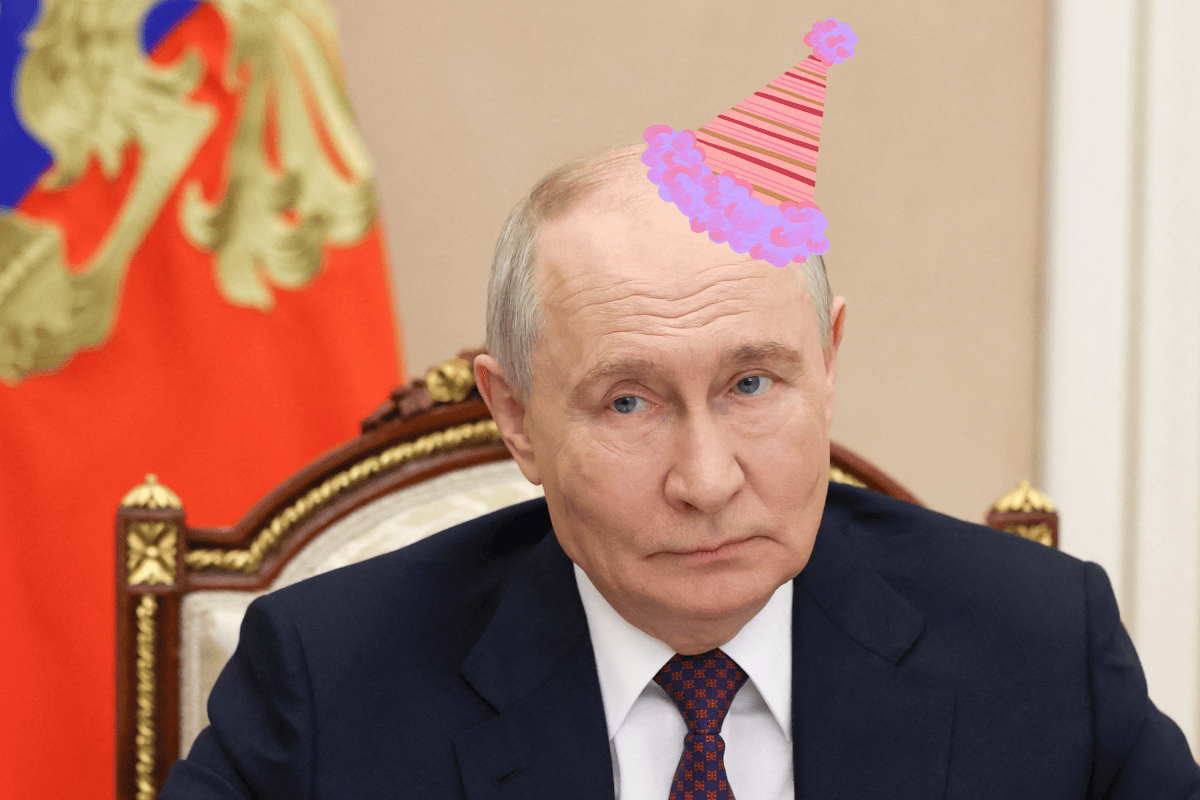
Raise your vodkas for a toast, please: Russia’s President Vladimir Putin turns 74 today.
Alexander Shuvaev, the major general Putin appointed in May to govern the front-line region of Belgorod, thanked him for support that helps locals “live and work in the most difficult conditions,” and wished him strong health.
Putin doesn’t need such wishes from his underlings, for strong health is the one thing the Russian state reliably delivers—to one man.
Read More on Analysis
A Russian boy born this year can expect to live about 68 years, according to United Nations figures, six years short of a president born more than seven decades earlier.
One born in 1952, as Putin was, could expect 53. By a rough Newsweek calculation from U.N. life tables, only about three in 10 of them made it to 74.
Then again, few have had his care plan as mid-life turned into old age. The investigative outlet Proekt tracked doctors from the presidential hospital trailing him to Sochi, a number that appears to be swelling with age. Five on average in 2016-17, nine by 2019.
The Kremlin has denied recurrent speculation that Putin is ill, as viral videos show strange hand movements and a limping gait. Proekt reported that Putin has even taken baths in deer-antler extract. Perhaps it worked; he’s not dead yet.
Last year, a hot mic caught Putin, via his interpreter, telling Chinese President Xi Jinping that organ transplants might let people “even achieve immortality.” A preoccupation, perhaps, of an aging man approaching the inevitable.
Many of his Russian subjects would settle for 60.
At 2023 death rates, a 15-year-old Russian boy has a 30 percent chance of dying before reaching it, U.N. data show. That is about the sub-Saharan African average, and worse than Afghanistan, Haiti or the Democratic Republic of Congo.
It happens in an oil-rich country the World Bank promoted to “high-income” in 2024, partly on a surge in military activity as a war economy fuels its ongoing invasion of Ukraine.
Russian women outlive their men by nearly 12 years, the world’s third-widest gap. Only Ukraine and the Palestinian territories, two war zones, one directly involving Russia, are wider.
Russia’s own official data published by Rosstat is just as unforgiving. Putin, at 74, is older than the male life expectancy at birth recorded in 82 of Russia’s 85 regions in 2023.
Nationally, male life expectancy was 68.04 years. In Chukotka it was just 58.67, while four Far Eastern regions were below 62.5. And in 64 of the 85 regions, male life expectancy in 2023 was still lower than it had been in 2019.
The war in Ukraine is, of course, the newest killer of Russian men. Mediazona and the BBC’s Russian service have identified 259,000 dead by name. Mediazona and Meduza estimate 352,000 men aged 18 to 59 were killed through 2025.
The dead skew small-town and poor, easy pickings for military recruiters. Two-thirds of those confirmed by late last year came from places of under 100,000 people, home to less than half of Russians.
Back home, veterans returning from the Ukrainian meatgrinder have killed at least 551 people, Verstka counted.
But that’s not to say all the old killers of Russians have disappeared. Drug deaths more than doubled between 2019 and 2021, topping 10,000, by Rosstat’s count. HIV kills an officially acknowledged 30,000 working-age Russians a year.
More than 60 percent of adults are overweight, says the head of the state nutrition institute, and 22 percent are obese. Bootleg methanol still kills by the batch in a society riven by alcoholism.
On that point, and in fairness to Putin, his rule got one big thing right. Alcohol controls helped cut drinking 43 percent between 2003 and 2016, the World Health Organization found.
U.N. figures show male life expectancy climbing from about 58 in 2003 to nearly 68 by 2019. Then came COVID-19 and the war in Ukraine. The UN’s latest estimate, for 2023, sits below that peak.
Putin’s answer was a decree demanding life expectancy of 78 by 2030, and a national project called “Long and Active Life.” That’s a mission made difficult when you’re sending a generation to live a highly active but very short life on the front lines of Ukraine.
U.N. projections point to about 74 as the average life expectancy for newborn Russians in the near term. At 2023 death rates, nearly two in five Russian men aged 20 would die before 65—the retirement age that Putin’s 2018 pension reform set for men.
If Russians were really living longer, Rosstat would be shouting about it. Instead, the statistics agency stopped publishing separate life expectancies for men and women for 2024, then went dark on most demographic data.
A sure sign of the internal devastation caused by Ukraine. The presidential hospital’s procurement contracts vanished from public view, too.
The Kremlin now treats the nation’s health like the president’s: as nobody’s business. And that seems to be an attitude applied to global health threats, too.
The Kremlin is under growing pressure from the U.S. to be transparent about a suspected outbreak of pneumonic plague in Irkutsk.
What exactly has happened is hazy. But without rapid antibiotic intervention, the death rate is 100 percent. Not a good omen, least of all for Russian life expectancy.
Russia’s classic toast—za zdorovye, “to health”—remains a wish for everyone, granted to one. Happy birthday, Mr. President. We hope someone got you a hazmat suit.