
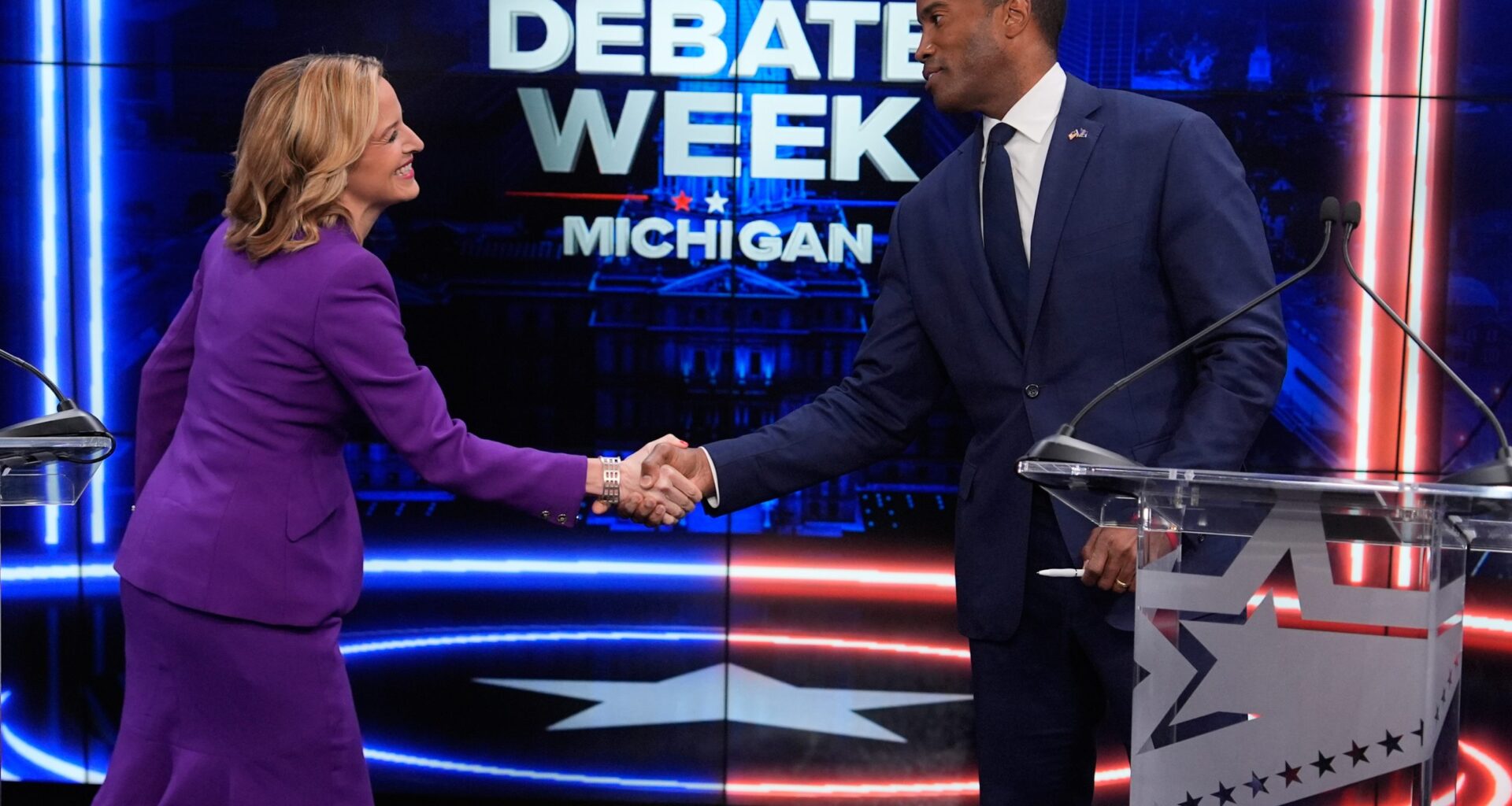
Jocelyn Benson and John James squared off in the first of two Michigan gubernatorial debates
Benson, for the first time, called for a suspension of Michigan’s gas tax to provide relief to motorists
James said he would not push for a statewide moratorium on data centers, countering his campaign’s past statements
GRAND RAPIDS — Michigan gubernatorial nominees John James and Jocelyn Benson traded barbs while making some notable policy shifts on data centers and gas taxes Tuesday night during their first televised debate.
The meeting between James, a Republican member of the US House, and Benson, the state’s Democratic secretary of state, was mostly cordial. But sparks flew during exchanges over affordability, the Iran war and more.
The debate at WOOD-TV in Grand Rapids is the first of two between James and Benson ahead of the Nov. 3 general election. The next will be held at WDIV-TV in metro Detroit Oct. 15, although absentee voting is already underway and more than 201,000 Michiganders have already cast ballots.
Read on for takeaways and fact checks from the first debate.
James waffles on moratorium
It appears a statewide moratorium on data centers is no longer on the table if James is elected governor, according to comments he made after the Tuesday debate.
“This will be led by the locals and not by Lansing,” James told reporters. “As a conservative, I don’t like bans or mandates.”
 US Rep. John James, R-Mich, Republican gubernatorial candidate talks during a debate with Democratic gubernatorial nominee and Michigan Secretary of State Jocelyn Benson, on Tuesday, Oct. 6, 2026, at WOOD-TV, in Grand Rapids, Mich. (AP Photo/Paul Sancya, Pool)
James’ stance had been somewhat opaque since August, when his campaign had told The Detroit News he was in favor of a moratorium until standards for local control, electricity use and environmental protections are put in place.
After the debate James made it clear he believes local governments should decide the fate of the facilities and he does not favor a statewide block.
“If free people decide (a data center is) what they want to do, then the government should get the heck out of their way,” James said. “The moratorium should be imposed on Lansing, not the people.”
Fact check: Did James vote against local control?
During an exchange over data centers, Benson claimed James “voted four times to block the ability of local communities to have a voice or a say in whether data centers can come to those communities.”
As a member of Congress, James didn’t vote for any standalone bills to limit local control on data centers.
But he did vote for an early version of the “Big, Beautiful Bill” that included a section called the “Artificial Intelligence and Information Technology Modernization Initiative,” which would have barred state and local jurisdictions from creating laws to regulate artificial intelligence.
A bipartisan group representing state legislatures warned the provision would also “circumvent their authority to regulate the permitting, construction and operation of data centers within their borders.” It was not included in the final law.
Benson shifts on gas tax
Benson said Tuesday night she is “open” to suspending Michigan’s 52-cent gas tax to help motorists facing high prices.
That was a shift for Benson, who had previously called for the federal government to suspend its own 18-cent tax but had argued against a state gas tax holiday, suggesting it could “potentially blow in the state budget.”
 Democratic gubernatorial nominee and Michigan Secretary of State Jocelyn Benson, talks during a televised debate with by Rep. John James, R-Mich, Republican gubernatorial candidate on Tuesday, Oct. 6, 2026, at WOOD-TV, in Grand Rapids, Mich. (AP Photo/Paul Sancya, Pool)
Republican House Speaker Matt Hall has said calls to suspend the state tax are unrealistic given its importance to a bipartisan road funding deal negotiated last year with Democratic Gov. Gretchen Whitmer.
James made a factual error on the issue during the debate, claiming Michigan could afford a gas tax holiday if Democrats hadn’t “blown” through the state’s “rainy day” savings account the past eight years.
In reality, the Budget Stabilization Fund has nearly doubled under Whitmer’s tenure. This year, Senate Democrats proposed withdrawing $350 million to plug budget holes, but House Republicans opposed it, and that plan did not pass the full Legislature.
Fact check: Did James vote for Iran war?
During the gas tax debate, Benson responded to James: “You voted six times in support of a war in Iran that has directly led to the increase in these gas prices.”
James didn’t vote to start the war, but he has voted against six resolutions to try to end it, most recently on Sept. 15, when he opposed a measure to end the conflict unless Congress explicitly authorized a declaration of war.
The resolution James voted against directed Trump “to remove United States Armed Forces from hostilities against the Islamic Republic of Iran, other than those elements of the Armed Forces that may be necessary to defend the United States or an ally or partner of the United States from imminent attack.”
James did not deny opposing the resolutions, saying in the debate that “I struggle with that vote.” But, he argued, “Iran must not have a nuke.”
Fact check: Can Benson erase Canadian tariffs?
During an exchange on President Donald Trump’s trade war with Canada, Benson claimed tariffs are costing the average Michigan household $5,600.
That figure comes from a study by the National Taxpayers Union Foundation which estimated the total cost of all Trump tariffs, not just Canadian ones.
Benson claimed she could end those costs: “On day one in office, I will call Canada and negotiate a contract between Michigan and Canada to eliminate the tariffs and the costs in Michigan,” she said.
That’s likely not possible under the US Constitution, which only gives Congress the power to levy tariffs and approve formal treaties with foreign governments. States can create subnational agreements with other governments, but they historically have not been able to overrule federally imposed tariffs.
When asked by reporters about how a subnational agreement would circumvent tariffs, Benson claimed “there’s plenty of examples” of states exempting goods from tariffs, saying “Kathy Hochul, the governor of New York, has already done this.”
The agreement Hochul struck was with the Canadian province of Ontario. It was a memorandum of understanding on nuclear energy, not trade.
Fact check: Did James vote for tariffs?
During the discussion on Canada trade, Benson claimed: “These reckless tariffs have been supported by my opponent, and that’s why we call them the John James Tax.”
James responded: “I’ve actually never voted to increase tariffs on Canada, despite what she says.”
James didn’t vote to increase tariffs, but in February he voted against a resolution that sought to terminate the national emergency Trump had declared to impose tariffs on Canada, Michigan’s largest trading partner.
The resolution passed the House 219-211 with the support of six Republicans but was considered symbolic because the Senate had no plans to take it up.
 Michigan gubernatorial candidates Jocelyn Benson and John James debated Tuesday night in Grand Rapids. (AP Photo/Paul Sancya, Pool)
Fact check: Michigan rankings, income declines
Arguing Michigan has lost ground over the past eight years under a Democratic governor, James claimed: “Michigan is 42nd in infrastructure, 43rd in economy, 45 in education, 46th overall. That means 90% of this country is doing better than us, and we all have the same president.”
The claim is largely true, at least according to US News & World Report. The publication recently gave Michigan poor rankings on a number of metrics, including those James cited. Michigan’s 46th overall ranking on the annual list was down from 33rd in 2019.
Later, James said the “median household income in the state of Michigan is $9,000 less than the median household income around the nation.”
The median income figures are accurate. Michigan ranked 40th in per capita income, 13% below the national average in 2024, according to a recent report by the Michigan Future Inc. think tank. “This is the lowest Michigan has been in per capita income compared to the nation – ever,” the group said.
Fact check: Data center stocks
“My opponent has become a multimillionaire buying stocks in data center companies that he regulates,” Benson said of James. But there’s no evidence that investments in companies tied to data centers helped grow James’ wealth.
James is worth as much as $50 million and has increased his net worth considerably since joining Congress in 2023, but personal financial disclosures show most of his gains stem from a Detroit-based logistics company his father started, not individual stock trades.
That said, James has disclosed purchasing some stocks of tech companies involved in data centers. He is a member of the House Energy and Commerce Committee, which does not directly regulate data centers but has jurisdiction over electricity used to power them.
Fact check: Family connections
James, in turn, attacked Benson for being “tied in” with data centers, alluding to claims by his supporters that Benson’s family will profit from them because her husband worked on the Saline data center as a senior vice president for Related Companies, which is helping develop the facility.
Benson denied any financial connection: “We have disclosed all our personal finances with the state, and that has reinforced the fact that my family has not profited from data centers. It’s a lie, and my opponent knows it.”
The personal financial disclosures Benson mentioned show that her husband earned $370,000 from his employer last year — at least in part for his work on the Saline project.
A spokesperson for Related Companies previously told Bridge that Benson’s husband “receives a standard salary and bonus like all members of our team,” but not a commission as some critics have claimed. He no longer works on the data center project, the spokesperson said.
James also accused Benson’s running mate, Senate Majority Leader Winnie Brinks, of signing a non-disclosure agreement “for what’s going on in Saline.”
Brinks did previously sign an NDA to learn about economic development projects, but it wasn’t specific to data centers or the Saline project.
Fact check: Medicaid cuts
During a discussion over how the “Big, Beautiful Bill” will impact Michigan’s Medicaid system, James stated: “Medicaid will not be taken away from people who are working at least 80 hours. Medicaid is not going to be taken away from caregivers and people who need it. Medicaid is vital.”
But Benson responded: “The Big, Beautiful Bill that you voted in support of is designed to make it harder for people to stay on Medicaid and get the health care coverage that they’re entitled to.”
To pay for extended tax cuts, Trump’s signature law was designed to cut future spending increases on Medicaid, including through work requirements set to begin Dec. 31, 2026. All told, estimates indicate the federal government could save more than $900 billion over the next decade.
Under the law, able-bodied adults under age 65 will need to provide proof twice a year of completing at least 80 hours a month of work, education or service to keep their coverage. The law exempts seniors, parents of children 14 and younger and people with disabilities.
This <a target=”_blank” href=”https://bridgemi.com/michigan-government/fact-check-john-james-jocelyn-benson-debate-data-centers-tariffs-more/”>article</a> first appeared on <a target=”_blank” href=”https://bridgemi.com”>Bridge Michigan</a> and is republished here under a <a target=”_blank” href=”https://creativecommons.org/licenses/by-nd/4.0/”>Creative Commons Attribution-NoDerivatives 4.0 International License</a>.<img src=”https://i0.wp.com/bridgemi.com/wp-content/uploads/2025/05/cropped-android-chrome-192×192-1.png?resize=150%2C150&ssl=1″ style=”width:1em;height:1em;margin-left:10px;”>
<img id=”republication-tracker-tool-source” src=”https://bridgemi.com/?republication-pixel=true&post=81038&ga4=G-1E2G9MSHX5″ style=”width:1px;height:1px;”><script> PARSELY = { autotrack: false, onload: function() { PARSELY.beacon.trackPageView({ url: “https://bridgemi.com/michigan-government/fact-check-john-james-jocelyn-benson-debate-data-centers-tariffs-more/”, urlref: window.location.href }); } } </script> <script id=”parsely-cfg” src=”//cdn.parsely.com/keys/bridgemi.com/p.js”></script>