
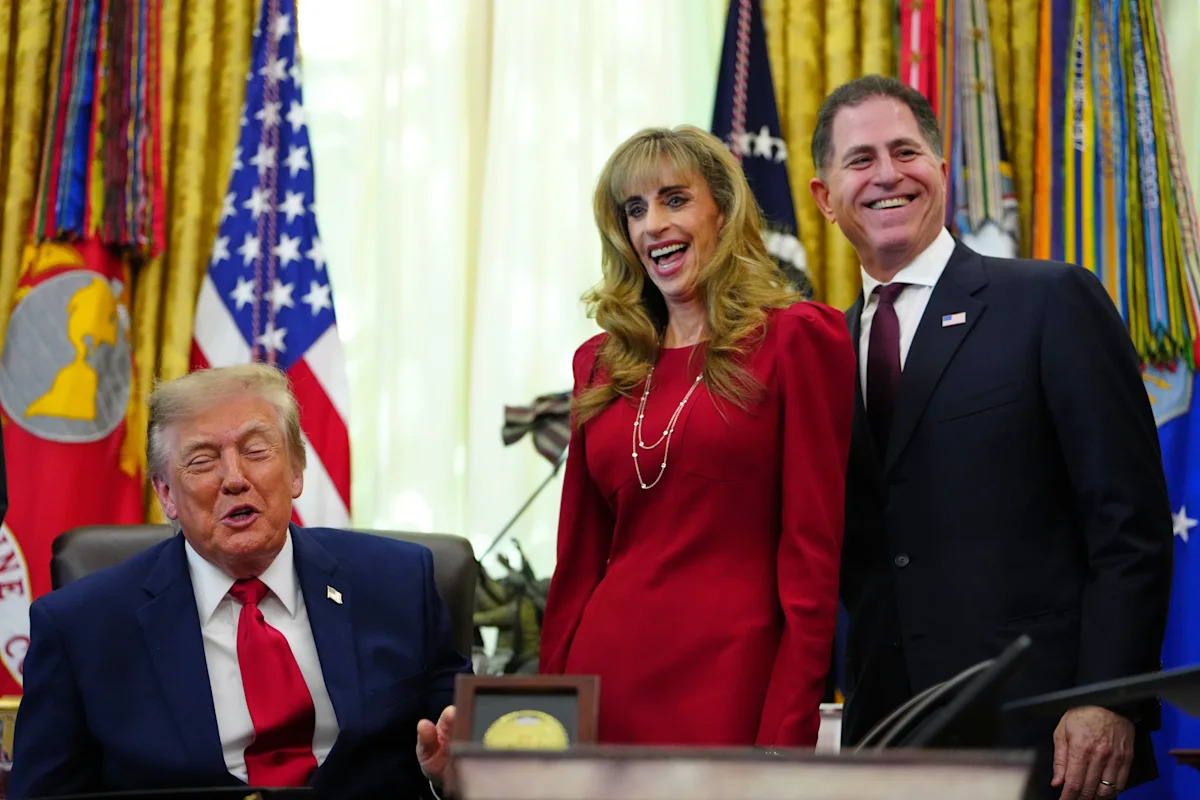
Michael Dell, philanthropist and founder of Dell Technologies, pushed back against critics who argue that allowing wealthy investors to donate individual company stocks to Trump Accounts could have a nefarious impact.
Under new rules that took effect last week, charities can put individual stocks into kids’ accounts as a donation. Trump Accounts are tax-advantaged investment vehicles that can be used for education expenses, starting a business, or saving for retirement. They were authorized in last year’s One Big Beautiful Tax bill. Previously, the money was required to be invested in low-cost index funds.
Read more: Trump Accounts expand to stock donations. What are the benefits and risks?
So far, SpaceX President Gwynne Shotwell is the only donor to announce a major stock contribution, pledging more than 2 million shares to benefit lower-income children ages 11 to 17 living in lower-income areas.
“It’s kind of hard for me to believe that’s a bad thing, right?” Dell said Wednesday in an interview with Yahoo Finance. “That these children are going to somehow be negatively influenced because they now have one share of SpaceX, but they didn’t have before, right? The alternative is they didn’t have it, right?”
He continued, “It seems unlikely that that is some kind of devious plot to somehow influence these 2 million children. If anything, they’re going to be interested in space and capitalism and how capital markets work, compounding and investing, and it will spark an interest in them that hopefully helps them as they become adults.”
Critics say the rule change could tie a child’s long-term financial security to a single company rather than the broader economy, and they’ve raised ethical concerns that billionaire donors could use multibillion-dollar stock dumps into kids’ portfolios to manipulate asset prices or secure tax write-offs.
Dell and his wife, Susan, have pledged to donate $6.25 billion to invest $250 in the Trump Accounts of 25 million children across America. More than 10 million children have now received the contribution, representing $2.6 billion invested. By Friday, the full $6.25 billion is expected to be invested.
“I believe there will be a number of additional philanthropists that join us,” said Dell. “We have now many employers that are joining in the fund here and either matching the government’s contribution or going much larger and contributing to the accounts of the children that work inside their companies or even children in the communities where they operate their businesses.”
Story Continues
As of Oct. 1, the Treasury Department shifted Trump Accounts from a voluntary index-fund investment to automatic enrollment to ensure broader access to the child savings accounts.
Nearly 70 million children under 18 with a valid Social Security number now have a Trump Account established in their names. It’s now up to parents and guardians to claim their child’s account.
Parents can claim an account — and the $1,000 seed contribution for eligible children — by downloading the official Trump Accounts app, verifying their identity and relationship to the child, reviewing the child’s information, and accepting the account terms. Any child born during President Trump’s second term is eligible for the $1,000 seed money, though that payment won’t happen in auto-enrolled accounts until parents or guardians claim them.
Parents can contribute up to $5,000 a year. Employers can also contribute and let workers fund accounts.
Dell said the tangible ownership of these accounts will serve as a powerful tool for nationwide financial literacy, sparking an interest in children and their parents to learn more about how to invest.
“Financial education is critical, and I think the [Trump Accounts] will spark that interest,” said Dell.
“There’s really no reason to learn about capitalism or capital if you don’t have any, right? We’re starting to see that interest — ‘hey, I’ve got a little piece of all these companies, what is that all about? How does that work?'”
“It starts [kids] on the path of saving and investing and learning about compounding,” he said. “Hopefully, we’re not just giving them $250, we’re giving them the beginning of an education and learning.”
Jennifer Schonberger is a veteran financial journalist covering markets, the economy, and investing. At Yahoo Finance, she covers the Federal Reserve, Congress, the White House, the Treasury, the SEC, the economy, cryptocurrencies, and the intersection of Washington policy with finance. Follow her on X @Jenniferisms and on Instagram.
Sign up for the Mind Your Money newsletter
Read the latest financial and business news from Yahoo Finance