
 DAVENPORT, Iowa —
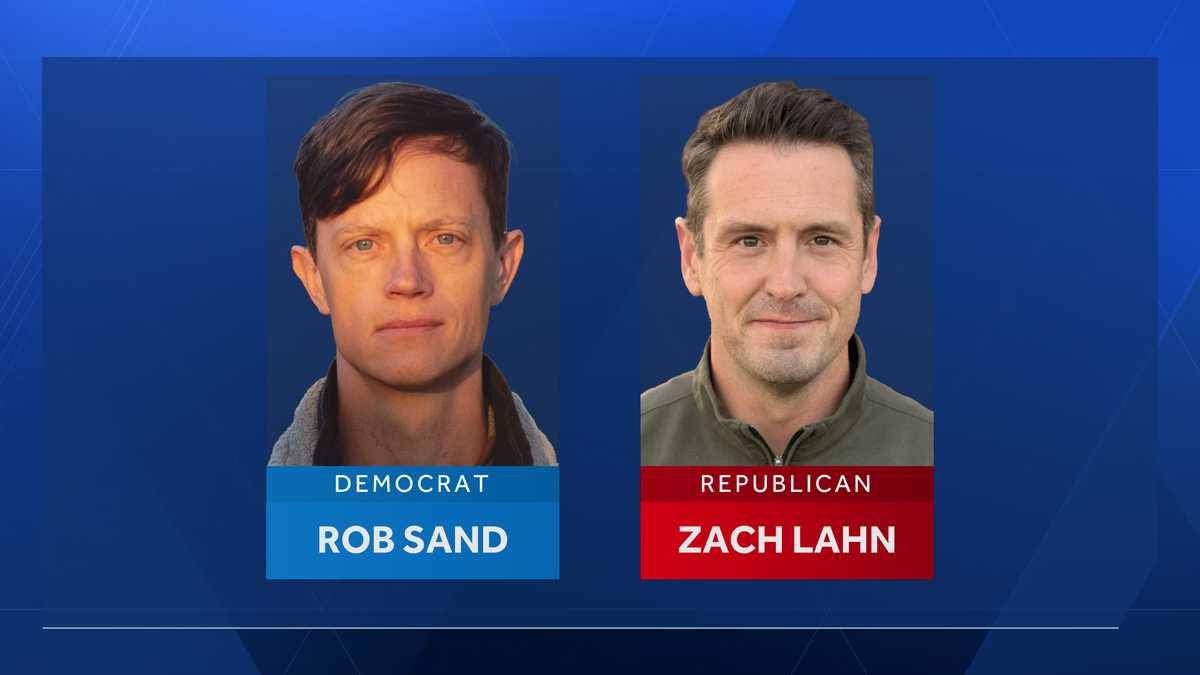
Democratic Iowa Auditor Rob Sand and Republican businessman Zach Lahn met for their first debate in the competitive campaign for Iowa governor on Oct. 6, clashing over their loyalty to the state and campaign funding sources.
Sand criticized Lahn for time spent in Kansas, drawing attention to Lahn’s voting record in that state and saying he wouldn’t be a “full-time” governor if elected in Iowa.
Lahn accused Sand of being funded by wealthy family members and said his moderate campaign message was misleading Iowans about his more left-wing beliefs.
The candidates also debated possible solutions to Iowa’s high cancer rates.
KWQC-TV hosted the debate at St. Ambrose University in Davenport.
PolitiFact fact-checked some moments and statements from the debate.
Sand: “This is not about why you’re in Kansas. This is about the fact that you’re not in Iowa.”
Lahn: “It is just not true. You have no evidence of that.”
Sand has repeatedly criticized Lahn for being a “part-time Iowan,” referring to Lahn’s frequent travel from Iowa to Wichita, Kansas.
Lahn cites his blended family and a custody agreement as the reason for the travel to and from Wichita. Lahn and his wife both have children from previous marriages who live in Kansas.
Lahn owns a family farm in Belle Plaine, Iowa, which he purchased in 2014, and a home in Kechi, Kansas.
From Oct. 1, 2025, to May 14, 2026, Lahn’s company plane took 37 flights to Wichita, Kansas, the Des Moines Register reported. The newspaper also said of the 37 flights, Lahn’s plane was documented as landing overnight in Wichita for 75 nights and in Belle Plaine for 51 nights.
Lahn says he moved to Iowa full-time in 2023.
Sand: Lahn “voted in Kansas in 2018 and in ’20 and in ’22.”
This is accurate.
According to the Kansas Secretary of State, Lahn voted in Kansas in the August 2022 primary. He also voted in Kansas in the 2018 and 2020 general elections. His last recorded vote in Kansas was in August 2022.
Lahn voted in Iowa in the 2024 general election and in a Belle Plaine city election in November 2025. Before his 2024 votes, his last Iowa vote was in the 2016 general election.
Lahn: Sand is “being funded with a tremendous amount of money from his family, largest donation in the history of Iowa.”
This is largely accurate.
During this campaign, Sand has received more than $10 million in donations from members of his wife’s family, who own an Ankeny-based holding company. Iowa law, unlike federal law, sets no limit on how much a person can donate to a campaign.
Sand’s wife, Christine Lauridsen Sand, is CEO and part owner of the Lauridsen Group, which has companies in health, agriculture and nutrition products.
Members of the Lauridsen family have donated $13 million to his campaigns since he first ran for auditor in 2018, with about $11.5 million coming during this campaign cycle, according to Iowa campaign finance data. Since 2023, Christine Sand has donated $4.5 million, and her father, Nixon Lauridsen, has given $4 million to Sand’s campaign.
Sand has raised $37.8 million overall so far this cycle, a record for an Iowa state office campaign.
Lahn’s largest donor this cycle is the Republican Governors Association, which has given $15.5 million, according to a campaign finance filing. Most of that has come since his latest campaign fundraising report, which reported about $10 million since the campaign’s start, including a $2.5 million loan to himself.
Nitrate fertilizer and cancer
Answering a question about what actions he would take to address Iowa’s high cancer rates, Lahn said he’d work to lower high levels of nitrate, a chemical compound used for fertilizer, in Iowa’s water. He tied that problem to Sand’s family’s company.
Lahn: “My opponent’s family has given him $13 million dollars, and that money, in part, came from selling high nitrate fertilizer.”
Sand: “No, my family, my in-laws’ business doesn’t sell nitrate fertilizer.”
Lahn: “It’s on the website, it’s literally on the website.”
This needs context.
Lahn was referring to donations from the Lauridsen Group, a holding company operated by Sand’s wife and her family.
One of its businesses, Boyer Valley Co., makes “high-nitrogen organic fertilizer” using chicken byproducts, according to its website. Organic fertilizers have lower nutrient content than synthetic fertilizer and release nutrients more slowly.
They are still broken down into nitrate by microorganisms in soil and can pollute waterways when used incorrectly.
Boyer Valley’s products are marketed for gardens, while concerns about pollution from nitrogen fertilizer are focused mainly on large-scale farm operations.
Sand: Iowa’s public education system “is now in the bottom half.”
This statement is largely accurate.
Many institutions have ranked Iowa education, but the two most prominent ranked it in the bottom half.
In the past, Iowa has been ranked highly among states for K-12 education, and it has dropped over the last 30 years.
U.S. News and World Report ranked Iowa sixth in the nation in K-12 education in 2017. In 2026, that ranking dropped to 26th nationally.
According to a 2026 report from the Annie E. Casey Foundation, a private philanthropy, Iowa ranks 27th in the nation for education. The report said fewer Iowa preschoolers are enrolled in school, and the state has a lower reading proficiency rate compared with 2019.
Lahn: “The average family of four on the tax increases that he has criticized would save an average of $7,500 per year.”
Sand criticized tax cuts at the state and federal levels, but the savings don’t add up to $7,500.
Sand took aim at Iowa’s 2024 income tax cuts, which set a flat 3.8% tax rate starting in 2025. That change was projected to save the typical Iowa household about $410 in 2025, on top of savings from earlier tax reforms.
Sand also opposed the One Big Beautiful Bill Act, pointing to its negative effects on Medicaid and rural hospitals. The law made President Donald Trump’s 2017 tax cuts permanent and added new tax cuts. The extension and other tax cuts in the bill saved Iowans about $3,100 on average in 2026, according to a Tax Foundation analysis.
The tax savings from the bills Sand criticized would amount to about $3,500 on average, not $7,500.