

“The time of containment in the face of hostile [acts] against the State of Israel is over,” Foreign Minister Gideon Sa’ar said Thursday, warning that Britain’s Labour government risks losing its influence in the region as Jerusalem responds to a series of sanctions and diplomatic measures.
Speaking in an interview with The Jerusalem Post at the newspaper’s Diplomatic Conference in Jerusalem, Sa’ar defended his decision to shut down the British Consulate in Jerusalem on Thursday, saying “Every state that works and acts against the State of Israel must understand that we will take our revenge.”
The decision to close the consulate is the latest in a series of retaliatory measures following the British government’s imposition of sanctions on Israel on September 8.
In addition to ordering the closure of the British Consulate in Jerusalem, Israel has removed British representatives from the International Gaza Support Center in Kiryat Gat, terminated British training activities for Palestinian Authority security forces in the West Bank, and barred 12 British elected officials and other British citizens accused by Israel of antisemitic or anti-Israel activity from entering the country.
The closure also means the departure of approximately 20 British diplomats, including the consul general, from the Jerusalem mission.
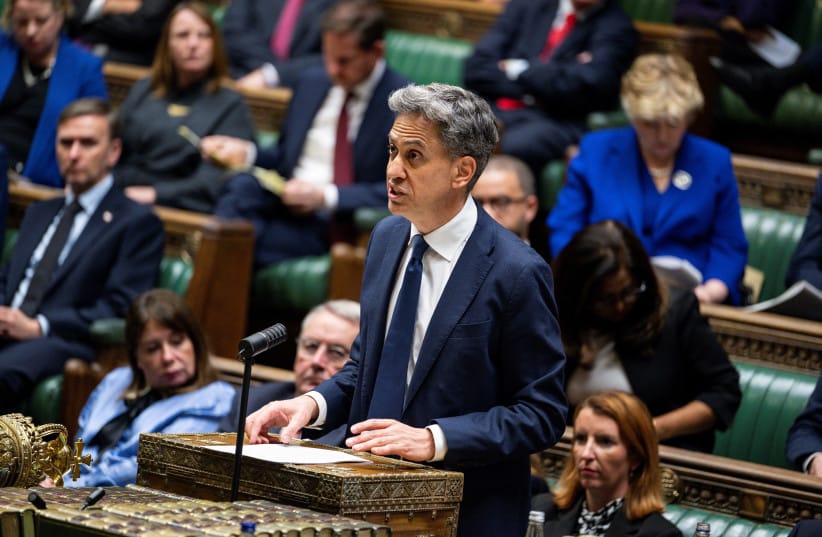 Britain’s Foreign Secretary Ed Miliband speaks at the House of Commons in London, Britain, September 8, 2026. (credit: House of Commons/Handout via REUTERS)British consulate in east Jerusalem downgraded to limited diplomatic mission
Sa’ar authorized the British government to operate a task force of only seven diplomats in the mission building with a limited scope of activity.
Sa’ar told the Post that Israel deliberately targeted areas in which Britain previously maintained a diplomatic or security presence, including Jerusalem, the West Bank, and Gaza.
“Any country that pursues a one-sided and unbalanced policy against Israel will lose its influence and relevance in our region, including in Gaza and Jerusalem.”
“We didn’t choose this path. It was the Labour government that chose that. But we had to react,” he said.
Sa’ar accuses UK Labour government of increasingly hostile policies toward Israel
Sa’ar accused the Labour government, which came to power in July 2024, of pursuing an increasingly “hostile” policy toward Israel, pointing to measures targeting Israeli officials, organizations, trade negotiations, and military cooperation.
Despite the deterioration in relations, Sa’ar insisted that diplomatic dialogue between Jerusalem and London would continue.
“I’m always for dialogue,” he said, although he expressed little optimism about a significant change in British policy under the current government.
Asked whether he believed relations could recover while Labour remained in power, Sa’ar pointed to the party’s recent conference, claiming that government ministers had avoided an event organized by Labour Friends of Israel while attending one hosted by Labour Friends of Palestine.
“I believe this tells you the direction, and therefore I want to be realistic,” he said. “It doesn’t mean we don’t give a chance. We always give a chance for a different path.”
Sa’ar says Britain risks undermining valuable intelligence and security cooperation with Israel
The foreign minister also stressed that Israel continued to provide Britain with valuable assistance in intelligence and security cooperation, suggesting that London was undermining a relationship from which it benefited.
“We help the Brits: security, intelligence, a lot of issues. They know it,” he said. “I think they are making a mistake in their approach.”
Sa’ar drew a distinction between legitimate criticism of Israeli government policy and what he described as punitive action against the Jewish state.
“There’s one thing to criticize, and there’s a different thing to act against you,” he said.
Colombia to open embassy in Jerusalem next week
Turning to Israel’s wider diplomatic relations, Sa’ar announced that Colombia would inaugurate an embassy in Jerusalem next Wednesday, October 14, becoming the tenth country to establish an embassy in the Israeli capital.
“Next Wednesday, we are going to inaugurate the 10th foreign embassy in Jerusalem, which will be the Colombian embassy,” he told the conference.
“When I entered my ministry, it was less than two years ago, there were five [embassies in Jerusalem]. Next week, we’re going to have 10.”
Sa’ar also revealed that Israel had already reached an agreement with the Democratic Republic of the Congo to open an embassy in Jerusalem, which would become the eleventh foreign diplomatic mission in the city.
“We already agreed about the 11th embassy with DRC. And that will be very soon,” he said.
Sa’ar hopes more countries, including Brazil, will open embassies in Jerusalem
The foreign minister expressed hope that additional countries, including Brazil, could eventually follow, linking the expansion of Jerusalem’s diplomatic presence to Israel’s efforts to strengthen its international standing.
“This is a diplomatic battle over the truth,” Sa’ar said, arguing that Jerusalem’s historical connection to the Jewish people remained central to Israel’s diplomatic efforts.
“Jerusalem was always the capital of one nation, and it’s the Jewish people, from the times of King David more than 3,000 years ago until this very day,” he said.
Returning to Britain in his closing remarks, Sa’ar suggested that London’s refusal to recognize Jerusalem as Israel’s capital did nothing to diminish that historical connection.
“Everyone knows Jerusalem,” he said, “even if it is not recognized by the foreign secretary of the United Kingdom.”