
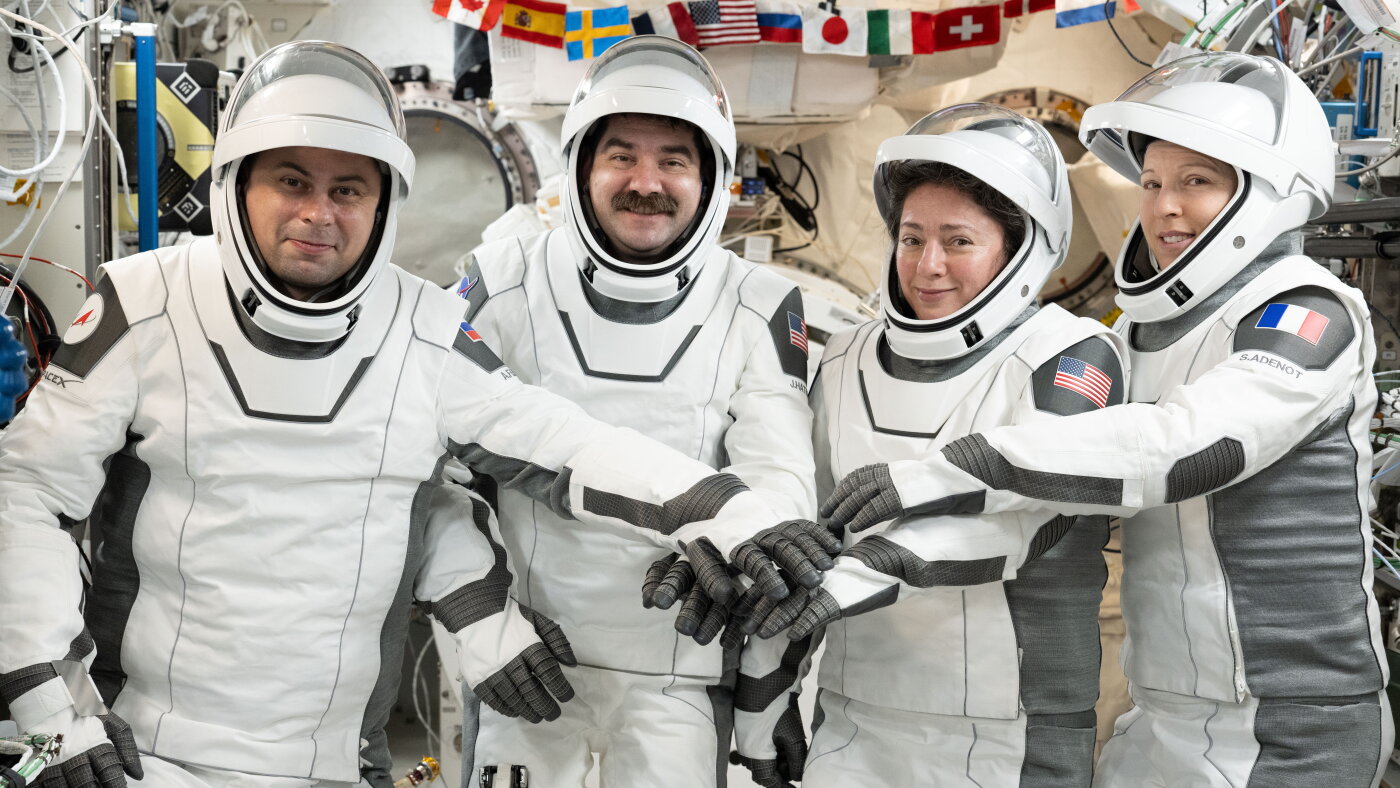
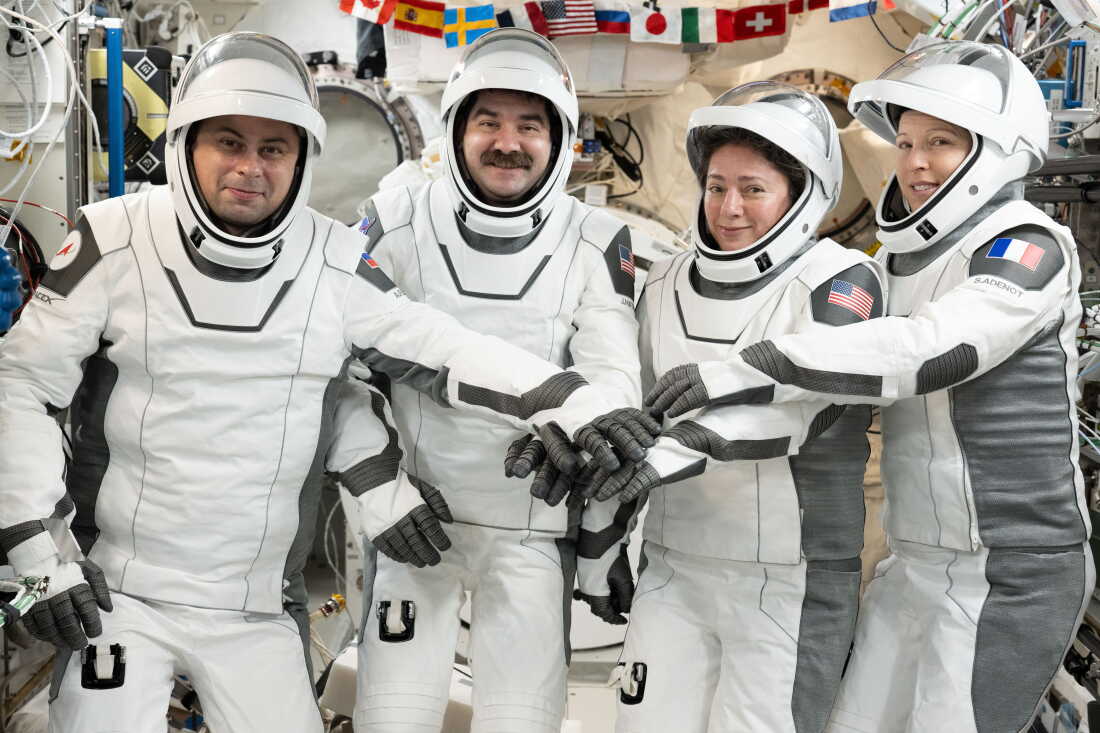
NASA’s Crew-12 members gather for a portrait in the pressure suits they wore while departing the International Space Station inside the SpaceX Dragon spacecraft. From left, Roscosmos cosmonaut Andrey Fedyaev, NASA astronauts Jack Hathaway and Jessica Meir, and European Space Agency astronaut Sophie Adenot.
NASA via Anil Menon
hide caption
toggle caption
i
NASA via Anil Menon
Three astronauts and a cosmonaut of NASA’s Crew-12 mission have safely returned to Earth after an almost eight-month trip to the International Space Station.
The crew, commanded by NASA’s Jessica Meir and pilot Jack Hathaway with mission specialists Sophie Adenot of the European Space Agency and Andrey Fedyaev of Russia’s Roscosmos, splashed down into the Pacific Ocean off the coast of Los Angeles, Calif., on Thursday, aboard a SpaceX Crew Dragon capsule.
Their trip home started about 45 minutes before, at an orbital speed of 17,500 mph.
The spacecraft lit its thrusters to nudge it out of orbit, causing the capsule to plunge into the atmosphere, its ablative heat shield battling extreme temperatures (up to 3,500 degrees Fahrenheit) during the fiery reentry. Over the course of about half an hour, the capsule slowed to a few hundred miles per hour, and then four orange-and-white parachutes took over, easing the spacecraft to just 16 mph above the cool, blue ocean and a gentle plop into the water.
The Crew-12 mission was the 20th time SpaceX had sent humans into orbit, lifting off in February on a Falcon 9 rocket from Cape Canaveral in Florida. It docked with the space station the next day. During the eight months in space, NASA said the crew completed dozens of science experiments and research, including studies of stem cells, how crystals grow in space and bone loss in microgravity.
Not all of their work happened inside the space station. Meir conducted four spacewalks totaling just over 27 hours to perform maintenance and upgrade the aging orbital outpost. Adenot performed three spacewalks.
Before departing, members of the Crew-12 mission were relieved by the three astronauts and cosmonaut of Crew-13, who arrived at the space station last week to start a six-month rotation.
During a pre-departure news conference on the station last month, Meir said she couldn’t wait to be reunited with her 3 1/2-year-old daughter.
But there was something else she missed after all this time in orbit. “So looking forward to seeing nature again, feeling the breeze on my face, the wind rustling through the leaves. Experiencing all those things that we don’t have up here,” she said.
The two-time space veteran said there were two things she’d miss about space: weightlessness and the wonderful views of Earth.