
‘Jews!” called Emanuel Ringelblum to his brethren, “write it down!”
A historian trapped in the Warsaw Ghetto, Ringelblum understood the value of documenting what he was witnessing, and so secretly recorded, with other scholars he assembled, everything they learned and saw about the unfolding Holocaust.
Ringelblum was murdered along with his family after managing an escape and getting caught, but much of what he documented was found stuffed in tin containers after the war, and became a priceless contribution to the Holocaust’s documentation.
He was but one link in a long chain of reporters who chronicled the Jewish people’s calamities, harking back to the Book of Lamentations’ description of Jerusalem’s sack in 586 BCE, and to Deuteronomy’s command “Remember what Amalek did to you” more than five centuries earlier.
It was a clarion call that the Jewish people repeatedly fulfilled.
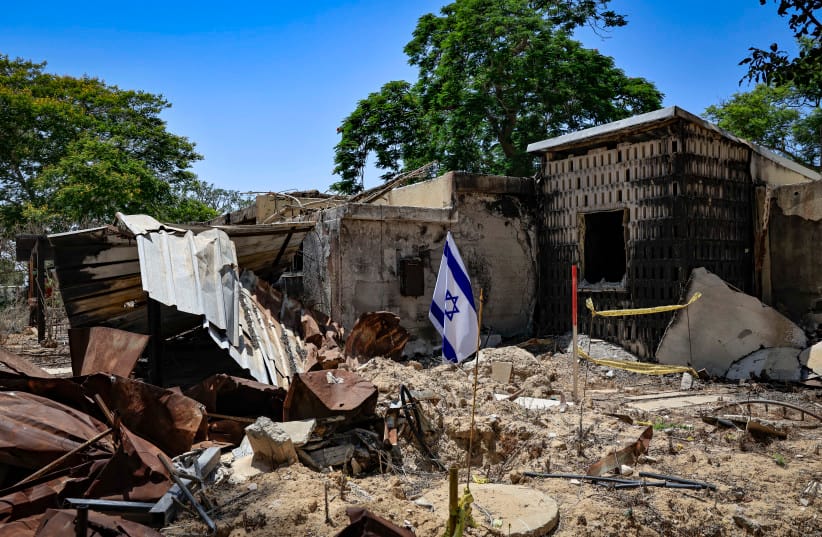 A view of homes destroyed and burned in the Hamas October 7, 2023 massacre at Kibbutz Nir Oz, near the Gaza border, August 5, 2026 (credit: Tsafrir Abayov/Flash90)
“Father of Mercy,” a call for divine revenge written after the Crusader massacres of 1096, is said in synagogues throughout the world every Shabbat morning, to this day. After the 1648-49 massacre in Ukraine, for centuries millions of Jews fasted on the anniversary of its largest pogrom. Following the Holocaust, the Jews established more than 700 museums, monuments, and research institutions worldwide.
October 7 massacre raises new challenges for Israel’s tradition of remembrance
Expectedly, Hamas’s massacre in the western Negev three years ago this week triggered this time-honored Jewish instinct. However, this trauma’s commemoration has raised dilemmas that previous disasters did not evoke.
Commemoration initiatives began days after the massacre. Makeshift monuments, laughing youngsters’ photos nailed onto fence poles above flower pots and little Israeli flags sprouted in multiple locations along Route 232. In the Re’im Forest, where the Nova music festival’s partygoers were mowed down, a whole forest of such photos became a makeshift pilgrimage site.
Then came commemoration projects.
Kinneret Gat, who was murdered in Kibbutz Be’eri, and her daughter Carmel, who died as a hostage in Gaza, are memorialized by a social start-up launched by their husband and father, Eshel, who collects unsold fruit and vegetables and distributes them to the needy. There are countless such initiatives countrywide: parks, stools, scholarships, concerts, and whatnot.
National commemoration, however, has been trickier. The dilemma began with the designation of the catastrophe’s memorial date. The Hebrew date was impossible because it falls out on Simchat Torah. The Gregorian date was also impossible, because Israeli remembrance days are all defined by Hebrew dates, and rightly so.
Ultimately, the government decided on the day after Simchat Torah, which will now be etched in Jewish memory alongside the dates that commemorate the Babylonian destruction, the Roman destruction, and the Holocaust.
Israel establishes national October 7 memorial day following public debate
Legislated as a National Memorial Day for the Massacre and Heroism of 22 Tishrei – October 7, the government initially tried to avoid including the word “slaughter” in its name. Public wrath, inspired by Jewish memory, changed that, and the bill passed along with instructions that flags be lowered to half-mast, ceremonies be held in schools, and a central memorial monument be built in the western Negev.
Though there were scandals en route to this formula (see “Miri Regev’s Ministry of Truth,” August 30, 2024), this part of the commemoration effort has been resolved. Not so the communal dilemma.
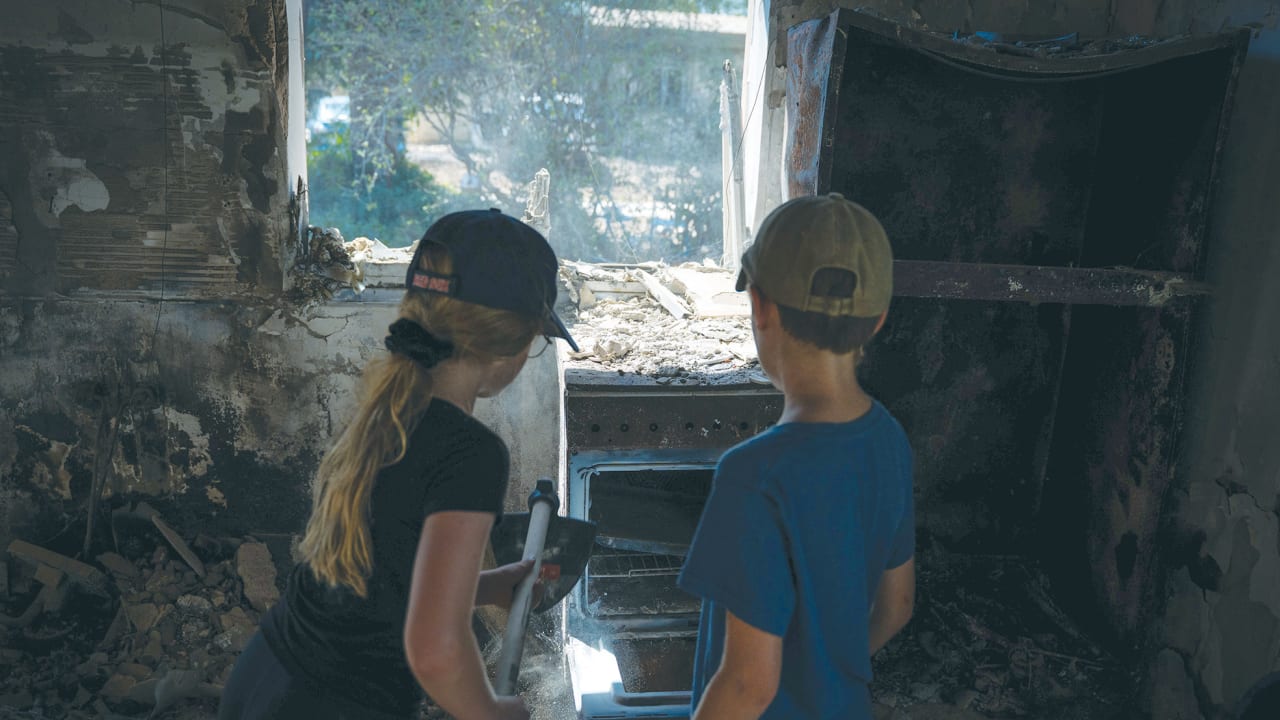
The big problem was what to do about the houses that Hamas disfigured and torched. There were three alternatives: repair and rebuild; destroy and build from scratch; turn the ruins into monuments, and rebuild elsewhere.
Kibbutz Nir Oz decided to destroy all its 400 damaged buildings and build from scratch, preserving only sporadic reminders of the carnage, to be integrated in a memorial complex. Kibbutz Be’eri took a similar decision, but decided to preserve one of the destroyed houses as part of a new memorial site.
In Kibbutz Kfar Aza, however, the dilemma caused a big debate between the “destroy” and “preserve” camps. The former won the vote, but a group of bereaved parents appealed last spring to the Supreme Court to block the demolition. A ruling has yet to be issued.
Commemorating October 7 in the western Negev is a shared national responsibility
It’s a heartbreaking communal debate in which outsiders are unable to participate. That cannot be said of the areas between, around, and beyond these kibbutzim. There, in the western Negev, the commemoration is every Israeli’s concern, obligation, and opportunity.
Some 50 KM. long and 20 kms. deep, the region abutting the Gaza Strip was part of a massive settlement project launched in the 1950s, becoming a great success, with 30 moshavim, 24 kibbutzim, and three cities.
In this part of the country there never were Palestinians, or, in fact, any human settlements until Israel turned it into a lush breadbasket. The virginity of its soil is what made it ideal for the organic agriculture in which some of its farms specialize, exporting more than 100,000 tons of highest-quality potatoes annually to Germany, Holland, Britain, and France.
Like its immaculate soil, the region’s inhabitants defied Israel’s political divisions, with secular and religious farmers regularly cooperating and living peacefully alongside the proletarian populations of Netivot, Ofakim, and Sderot.
In all, this region’s 57 communities were home to 60,000 Israelis when Hamas invaded and killed 278 in its rural communities, and 96 in its urban towns. Three years on, the population is 66,000, and growing.
This improbable momentum should be accelerated. The western Negev should inhabit 250,000 Israelis, connected by a spinal hikers’ path extending from Yad Mordecai in the North to Kissufim in the South.
Stretching along this trail on the massacre’s annual anniversary, the colorful march of thousands, winding between blossoming fields, handsome houses, and bustling towns, will say better than any prayer, monument, poem, or book: We remember. We remember that they came to kill, and we came to live; that they came to destroy, and we came to build; that they came from hatred’s bowels, and we came back from the dead.
The writer, a Hartman Institute fellow, is the author of the bestseller, The Jewish March of Folly (Yedioth Books 2026), now available in English on Amazon.