
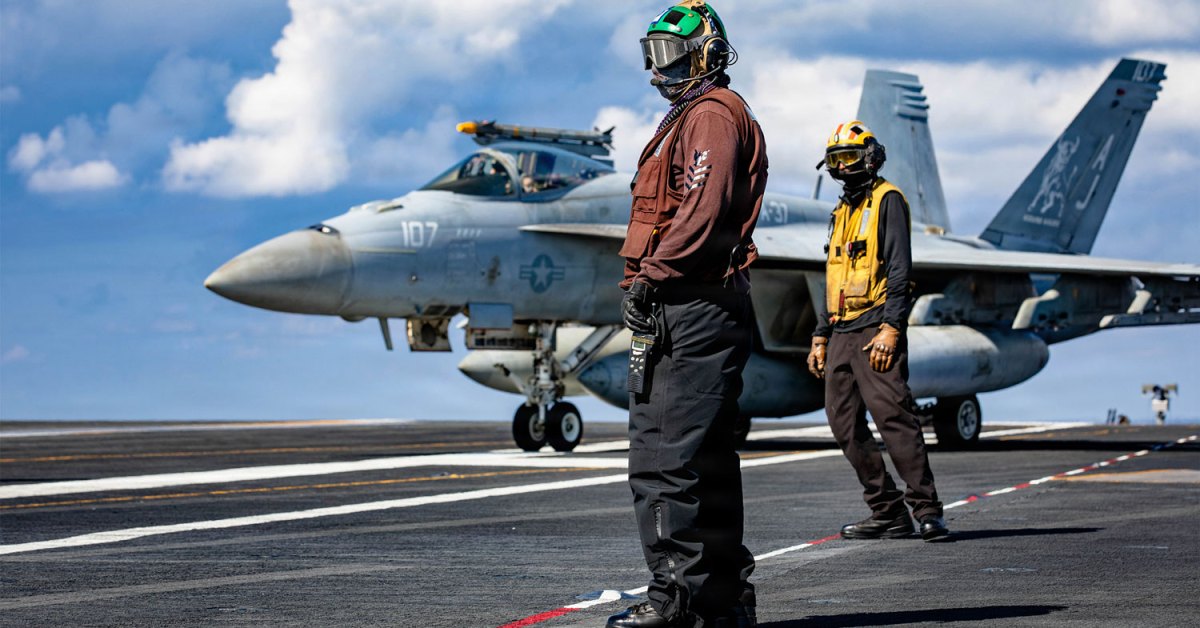
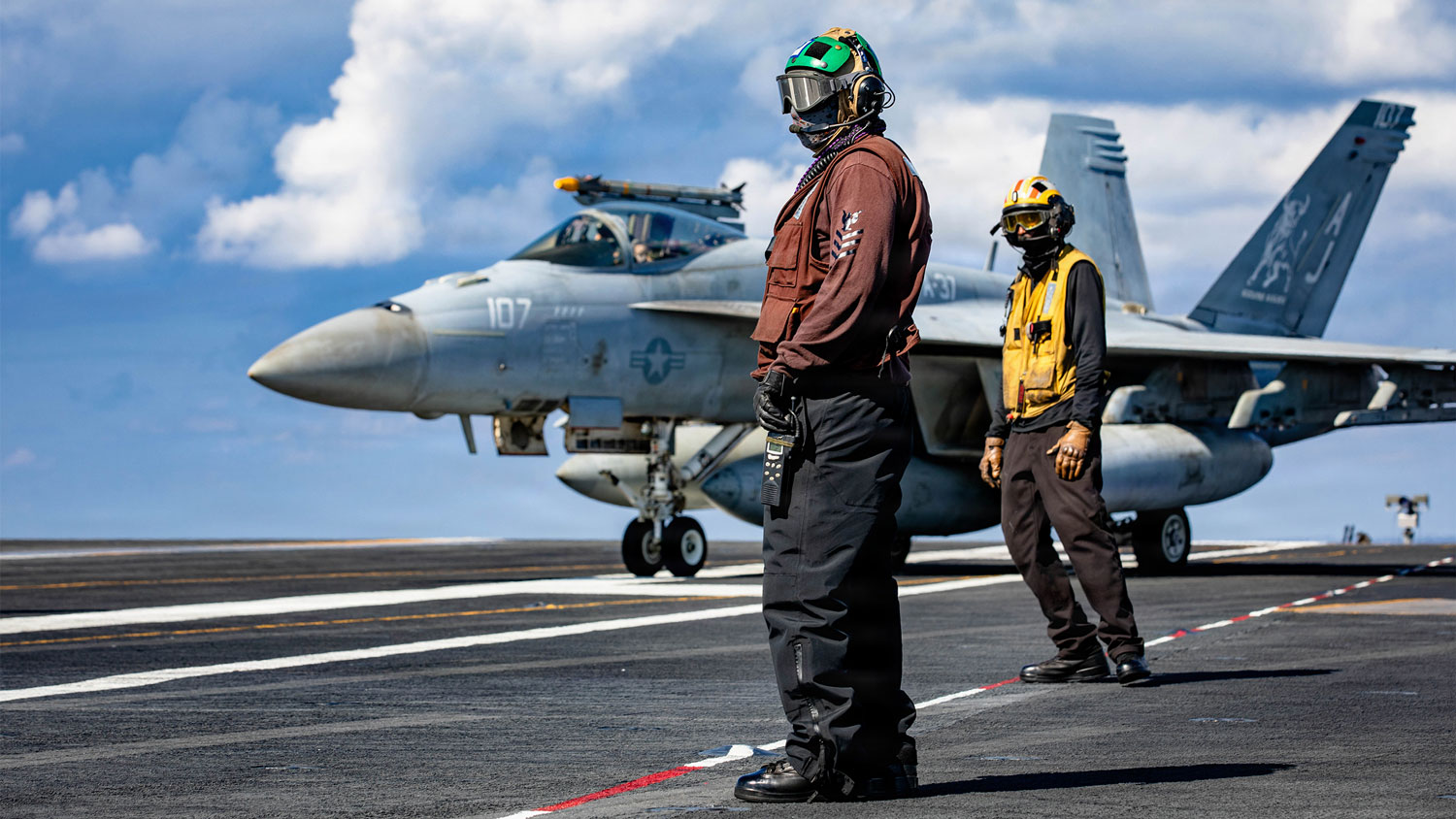
 Flight deck operations on board the aircraft carrier USS Gerald R. Ford on March 2, 2026, in the Mediterranean Sea. (U.S. Navy photo via Getty Images)
Around two-thirds of Americans (65%) disapprove of the way President Donald Trump is handling the U.S. military action in Iran, while a third (33%) approve, according to a new Pew Research Center survey.
Americans largely disapprove of Trump’s handling of the Iran conflict and expect it to continue for months
% who say they __ of how Donald Trump is handling the U.S. military action against Iran
% who say they are __ confident the Trump administration will achieve its goals in the conflict with Iran
How much longer do you think the U.S. military action against Iran will last? (%)
Note: No answer responses are not shown.
Source: Survey of U.S. adults conducted Sept. 28-Oct. 4, 2026.
PEW RESEARCH CENTER
Share on X
Share on Facebook
Americans largely disapprove of Trump’s handling of the Iran conflict and expect it to continue for months
% who __ of how Donald Trump is handling the U.S. military action against IranNET DisapproveStrongly disapproveSomewhat disapproveSomewhat approveStrongly approveNET Approve654420201433% who are __ confident the Trump administration will achieve its goals in the conflict with IranNot too/Not at allSomewhatExtremely/VeryNot sure521616815% who say the U.S. military action against Iran will last another …Less than 1 month1 to 6 months6 to 12 monthsMore than a year2183047
Note: No answer responses are not shown.
Source: Survey of U.S. adults conducted Sept. 28-Oct. 4, 2026.
PEW RESEARCH CENTER
ChartData
Download ImageShare
The conflict has been unpopular with the American public from the start. But it has grown more so over time: In March, shortly after it began, 61% disapproved of Trump’s handling of the conflict while 37% approved.
Evaluations of the initial decision to use force are similar: 34% now view this as the right decision – down 4 percentage points from March.
On both measures, Republicans and Republican-leaning independents have grown more negative about the conflict. Democrats and Democratic leaners have remained overwhelmingly negative in their views.
Meanwhile, most Americans expect the conflict to continue for at least another six months, according to the new survey, conducted Sept. 28-Oct. 4, 2026, among 5,062 adults:
About this research
We conducted this survey to understand how Americans currently view the U.S. conflict with Iran. We began asking many of these questions in March 2026 and asked them again in the fall to understand changes in public perceptions about the conflict.
Why did we do this?
Pew Research Center does research to help the public, media and decision-makers understand important topics. We have studied Americans’ views of politics and major policy issues for decades. This includes topics related to foreign conflicts, including presidential administrations’ handling of each.
Learn more about Pew Research Center and our politics research.
How did we do this?
We surveyed 5,062 U.S. adults from Sept. 28 to Oct. 4, 2026. Everyone who took part in this survey is a member of the Center’s American Trends Panel. The survey represents the views of the full U.S. adult population.
Here are the survey questions used for this analysis, the detailed responses and the survey methodology.
How Republicans and Democrats view Trump’s handling of the Iran conflict
Republicans and Democrats continue to differ widely in their views of military action in Iran. But the partisan gap has narrowed somewhat, as Republican support for Trump’s handling of the conflict – as well as the initial decision to use military force – have declined over the last several months.
Slightly smaller share of Republicans approve of Trump’s handling of Iran now than did in March
% who say they approve of how Donald Trump is handling the U.S. military action against Iran

Source: Survey of U.S. adults conducted Sept. 28-Oct. 4, 2026.
PEW RESEARCH CENTER
Share on X
Share on Facebook
Slightly smaller share of Republicans approve of Trump’s handling of Iran now than did in March
% who say they approve of how Donald Trump is handling the U.S. military action against Iran
DateMarchOctoberTotal3733Rep/Lean Rep6963Dem/Lean Dem99
Source: Survey of U.S. adults conducted Sept. 28-Oct. 4, 2026.
PEW RESEARCH CENTER
ChartData
Download ImageShare
Today, 33% of adults say they approve of how Trump is handling the U.S. military action against Iran – down from 37% in March.
This decline has come entirely from Republicans: At the start of the conflict, 69% approved of his handling of the conflict. Today, 63% do. Democrats’ views are unchanged.
There is a similar pattern in views of the initial decision to use for in Iran.
Today, 65% of Republicans say the decision to use force in Iran was the right one – down from 71% in March. One-in-ten Democrats now say the initial decision was the right one – essentially unchanged.
What are Americans’ top concerns about the Iran conflict?
When asked about specific concerns related to the conflict with Iran, large majorities of adults say they are extremely or very concerned about higher gas and fuel prices (73%) and American troops being wounded or killed (71%).
Higher gas prices, U.S. casualties are top public concerns in Iran conflict
% who say, thinking about the current U.S. military action against Iran, they are __ concerned about each of the following

Source: Survey of U.S. adults conducted Sept. 28–Oct. 4, 2026.
PEW RESEARCH CENTER
Share on X
Share on Facebook
Higher gas prices, U.S. casualties are top public concerns in Iran conflict
% who say, thinking about the current U.S. military action against Iran, they are __ concerned about each of the following
TopicExtremely concernedVery concernedNET concernedHigher gas and fuel prices502373American troops being wounded or killed413071U.S. sending ground troops into Iran312758Terrorist attacks in the U.S.262349A shortage of weapons for the U.S. military201938
Source: Survey of U.S. adults conducted Sept. 28–Oct. 4, 2026.
PEW RESEARCH CENTER
ChartData
Download ImageShare
Democrats are more likely than Republicans to be concerned about higher gas prices and U.S. troops being wounded or killed. But majorities in both parties express these concerns.
A narrower majority of adults (58%) say they are extremely or very concerned about the U.S. sending ground troops into Iran. Democrats are far more likely than Republicans to say this (72% vs. 43%).
Americans express lower levels of concern about terrorist attacks in the U.S. (49% are extremely or very concerned) or a shortage of weapons for the U.S. military (38%).
Note: The survey was conducted prior to comments by Trump this week about Iran possibly striking U.S. cities.
How have Americans’ concerns about the Iran conflict changed?
Gas and fuel prices
Since March, there has been an increase in the share of Americans who say they are concerned about higher gas and fuel prices as a result of the conflict in Iran.
Much of this shift has come among Democrats: 85% say they are extremely or very concerned about this, up from 79% in March.
Democrats have become more concerned about gas prices, weapons shortages due to Iran conflict
% who say, thinking about the current U.S. military action against Iran, they are extremely or very concerned about each of the following

Source: Survey of U.S. adults conducted Sept. 28–Oct. 4, 2026.
PEW RESEARCH CENTER
Share on X
Share on Facebook
Democrats have become more concerned about gas prices, weapons shortages due to Iran conflict
% who say, thinking about the current U.S. military action against Iran, they are extremely or very concerned about each of the following
DateStatementTotalRep/Lean RepDem/Lean Dem10-2026Higher gas and fuel prices73618503-2026Higher gas and fuel prices69597910-2026A shortage of weapons for the U.S. military38314503-2026A shortage of weapons for the U.S. military31303410-2026Terrorist attacks in the U.S.49475203-2026Terrorist attacks in the U.S.56546010-2026The U.S. sending ground troops into Iran58437203-2026The U.S. sending ground troops into Iran614876
Source: Survey of U.S. adults conducted Sept. 28–Oct. 4, 2026.
PEW RESEARCH CENTER
ChartData
Download ImageShare
Among Republicans, 61% express this concern – largely consistent with the 59% who said this in March.
Weapons stockpiles
Democrats also now express higher levels of concern about a shortage of weapons for the U.S. military: 45% say they are extremely or very concerned about this, up from 34% in March.
Republicans’ concerns about weapons shortages are much lower and largely unchanged from the spring.
Terrorist attacks and ground troops
Since the start of the conflict, Americans in both partisan coalitions have grown less concerned about terrorist attacks at home and the possibility of the U.S. sending ground troops into Iran.
There continues to be a wide partisan gap, however, in views of the prospect of ground troops in Iran: 72% of Democrats are extremely or very concerned about this, while 43% of Republicans say the same.
Note: Here are the survey questions used for this analysis, the detailed responses and the survey methodology.