
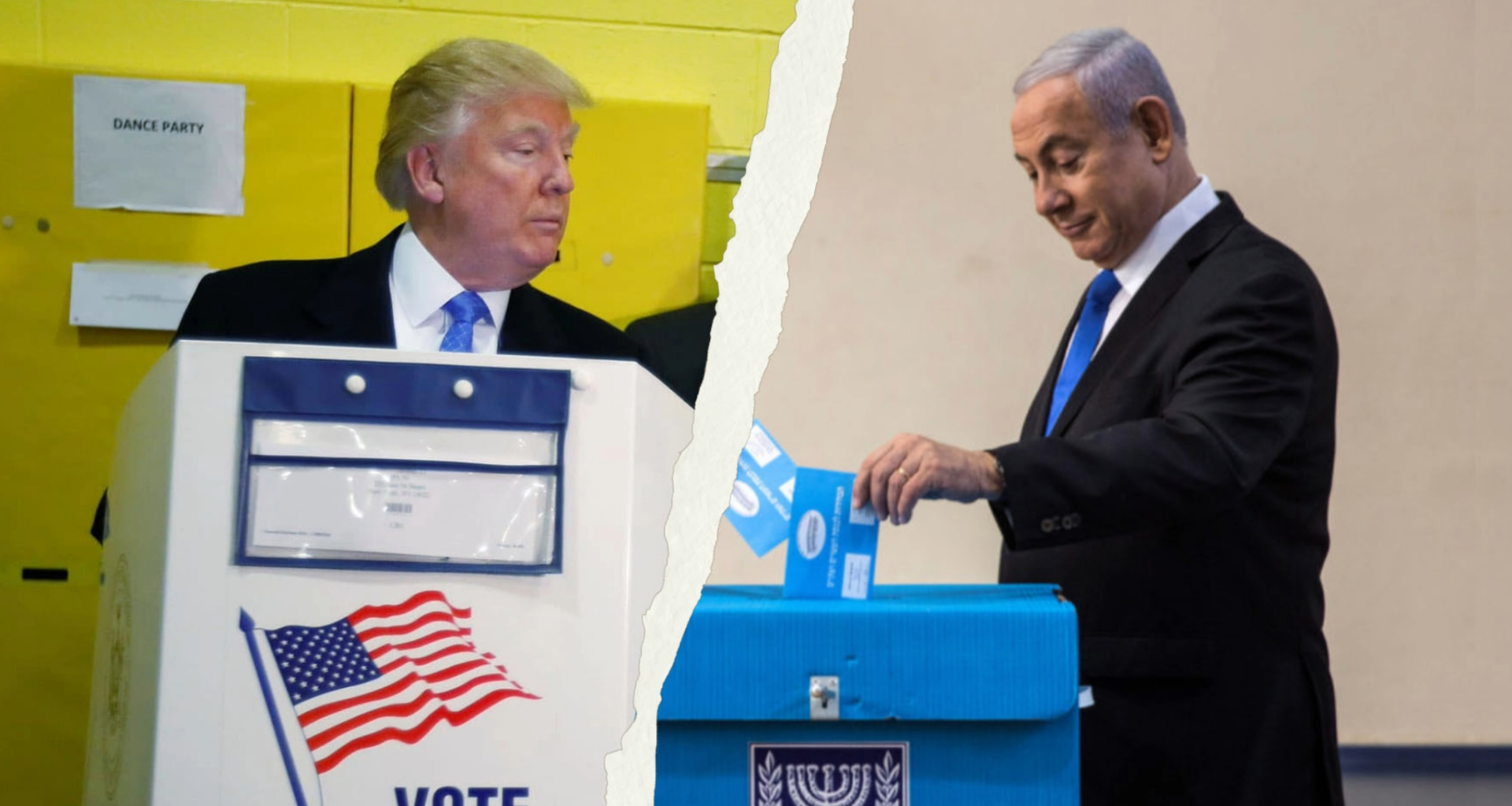
For those who have not been following the Israeli election, which is coming up on October 27, a few updates may be in order. The stakes in this political horserace seem high, with all 120 seats in the Knesset up for grabs; depending on what party or parties gain a majority, Benjamin Netanyahu may be replaced as Israel’s Prime Minister. But it may not surprise readers to learn that, when it comes to any issues of substance, the Israeli elections are a disaster. In the last few weeks, we have seen an attempt to ban all Arab parties, only recently overturned by Israel’s Supreme Court, and multiple parties have argued, explicitly or implicitly, that Arabs should have no say in the Israeli apartheid state. In public opinion polls, a strong majority of Israelis support expelling the Palestinian population from Gaza, otherwise known as ethnic cleansing. Meanwhile, there is a complete absence of any serious discussion of withdrawal from the West Bank.
These are the headlines. But beneath them is a nauseating dynamic. While the entire media coverage and political debates are taken up by masturbatory conversations about what settlers, colonists, and imperialists want, the peoples who are occupied, invaded, and oppressed are systematically denied a vote or a voice.
Why can’t Palestinians in the West Bank, Gaza, and diaspora vote in Israeli elections? Why can’t Iraqis vote in American elections? Why can’t the Senegalese vote in French elections? Do these questions sound silly? Perhaps they do, but they help explain why speaking about our own American elections is often just as nauseating, because this same dynamic is equally present. So, let’s look at the Israeli elections, then bring it home to the United States. Then, hopefully, we can move from cyclical “pragmatic” responses of “well, this is your choice” to the more productive question of “what is to be done?”

The Game, the Players, and the Issues
So first, what’s happening in Israel in October? Well, in essence, the Israeli settlers are holding what they would call an election, where they choose their favorite settlers to carry out the apartheid settlement project.
An unfamiliar onlooker might assume that the loud, fierce debate leading up to October 27 would be about the illegal settlements in the West Bank, responding to sanctions regimes placed on them by Europe, or reconciliation with Palestinians. But if you thought these issues were central, or that Israelis were even seriously pretending they were, well, silly onlooker: you underestimate the absurdity of the situation.
Israel has a parliamentary system, meaning that there are many parties that will likely have to come together to form a ruling coalition. The largest coalitions expected are headed by Likud (Netanyahu’s party) and Yashar (Gadi Eisenkot’s party). I trust we know who Netanyahu is, but Eisenkot is a newer face who became popular because of his “military” accolades.
Western commentators consistently frame the entire election around Eisenkot’s chances of replacing Netanyahu, implying that if only the Prime Minister could be ousted, the problem of Israel’s mass slaughter of Palestinians would go away. As the ever-ridiculous Thomas Friedman puts it in the New York Times:
I have no doubt that if the opposition to Netanyahu — now most prominently led by the former chief of staff of the Israel Defense Forces Gadi Eisenkot, a very decent man with much in common with Yitzhak Rabin — is able to triumph on Oct. 27, at least the shameful pogrom that Netanyahu has enabled Jewish settlers to perpetrate in the West Bank will be halted and Trump will have an Israeli partner ready to make a good faith effort to implement his peace plan for Gaza.
There’s a high degree of willful ignorance here, because Eisenkot has made his stances perfectly clear, and they differ from Netanyahu’s only slightly. Far from “halting the pogrom,” his Yashar party “supports strengthening the settlement blocs and establishing new communities [in the West Bank],” according to its own statements. True, Eisenkot opposes annexing the West Bank altogether—but only because it would “endanger the Jewish majority in Israel,” i.e., too many Arabs would have to be made citizens. The Yashar party also says that “the establishment of a Palestinian state is not on the agenda,” making any gesture at decolonization a non-starter.
(Rabin, meanwhile, was a well-known war criminal, personally responsible for the ethnic cleansing of Lydda and Ramle in 1948, along with the indiscriminate bombing of southern Lebanon during 1993’s “Operation Accountability,” to name only two incidents. He, too, opposed a Palestinian state. So it’s unclear how Eisenkot’s apparent similarity to him is supposed to be a glowing endorsement.)
The other major party is “Together” or Beyachad, which is a coalition formed by former Israeli prime ministers Naftali Bennett and Yair Lapid. They generally agree with Eisenkot on the West Bank and Palestinian statehood, again with slight variations. The two smaller, but loud and important groups are the far-right hardliners (who represent a good portion of Israeli society) and the Arab parties (who are systematically denied power, such that even the mention of working with them is a criticism thrown at Eisenkot). The far-right hardliners are represented by parties like Itamar Ben-Gvir’s Otzma Yehudit (literally “Jewish Power”) and United Torah Judaism, an Ashkenazi ultra-Orthodox party for the Haredi. The Arab parties are those of the Joint List and Ra’am, which may represent some real opposition, but whose influence is limited by the electoral base, the composition of which Israel has manipulated by keeping Arabs out of “Israel proper,” most obviously by carrying out the Nakba and spending the subsequent 78 years denying Arabs the right to return to their family homes.
This outline is needed mostly to notice who isn’t really there: the left, with the major contenders all being right-wing. The only self-described left-wing parties, like “The Democrats,” are currently polling equal to or even lower than the Haredi parties. The Joint List is actively being limited and has no chance of heading a coalition. For all that Israel is frequently touted as a beacon of democracy in the Middle East, there is no effective disagreement about the most critical issues: no suggestion of ending the illegal presence in the West Bank or Gaza, no reconciliation with Lebanon or Iran, and certainly no accountability for genocide.
This election, then, is clearly not a referendum on whether Israel should change anything fundamental, but on precisely how Israel continues its apartheid and genocide. Which leads to the headline issue: the draft question. This represents the quintessential example of the absurd intra-colony nature of this election, with the central idea being: “who, exactly, must serve in the terrorist army?”
The Draft: “So We All Agree We Should Commit the Genocide, But Who Are We Gonna Make Do It?”
The draft issue is primarily the question of whether Haredi Jews and Arabs should be forcibly drafted into the IDF. As it stands, 25 to 30 percent of the eligible population for the IDF draft, a two-year course of indoctrination through the action of murdering Palestinians and convincing oneself it is needed, are exempt. This is significant to Israelis, as the IDF is their most important organization, and in a society so militarized, service is seen as core to Israeli identity.
The major argument, especially from Haredi Jews, is that they serve their country effectively through Yeshiva Torah study. This is an explicitly religious understanding of Israel and Israeli national identity. It also places a major limit on recruitment into the IDF that, at least according to Israelis, leaves it understaffed and having to pull many people from the reserves multiple times.
The two primary contenders for the leader of the Knesset have polarized views on this exact issue: Netanyahu wants to maintain and strengthen the separation and has hardliners in his coalition who are vocal about strong protections for the exclusions, like Ben-Gvir and Smotrich. Eisenkot wants to remove the exceptions for the Haredi and Arab populations, with Naftali Bennett and the Yesh Atid party agreeing with the removal of exceptions generally. None of them want to solve the problem by reducing the size of the IDF, the scale of its terrorist actions, or the aggression that necessitates its existence. After all, Eisenkot has gained mass appeal by criticizing Netanyahu for his treatment of the soldiers, something that can only be laughed at since the primary job of those soldiers is to mistreat the Palestinians.
In a country under so much scrutiny, upheaval, and controversy, the natural question arises: of all things, why is the draft such a major issue? This comes down to one very simple point: if you only ask soldiers about their problems, their answer will never be something that would put them out of a job. If you ask a West Bank settler about their problems, their answer will never be that they are a settler. Instead, it’s that they either are paying too high a price for doing so (too much blowback from the Iranians or Palestinians) or are being limited too much in doing so (why isn’t the IDF protecting the expansion of settlements more?)
The question of ending the expansion of Israeli settlement is explicitly excluded from any such discussion, because this is only a discussion between members of such a project. That project will expel or disenfranchise anyone who wants to challenge it, as Israel has already proven extremely capable of doing. Once the questions have been confined to only those about how to maintain the project, it should be clear why a militant society built on the expulsion of Arabs is debating who should be forced to do the dirty work, and how essential that is to their identity on an individual level.
This is not to say that there are not real issues, especially with how Israel deals with “internal” problems like the extreme internal racism in Israel; it is to say that fights over those issues will always take place in the context of actively ignored colonial issues. That is because the borders that determine the electorate are explicitly engineered by those in the colonial project. In Israel you can see this on the map: the lines in the West Bank that determine who gets to vote and who doesn’t in this election will even decide who gets to vote on those internal issues. And if a population ever does pose a threat to internal policies that enable this colonial aim, the Israeli state will simply change those lines, as with the slow conversion of the West Bank into a series of Bantustans, and the restrictive right of return.
One very famous example comes to mind with Gaza. In 2005, the pullout from Gaza by Israeli settlers was lauded by Zionists as an act of charity to the Palestinians. But even publicly, politicians admitted that this was a cynical tool to deny Palestinians any chance of ever having a vote or role in Israeli elections. Shlomo Brom, a former Deputy National Security Advisor for Strategic Affairs and head of Strategic Planning for the IDF, described the move as “the most salient development in Israeli national security thinking[…] the growing role of demography at the expense of geography.” We see this on a wide scale with Palestinians, but we are seeing the particularly sensitive fascist regime currently in power expand this exclusion even to Jewish activists, with the proposed denaturalization of the directors of NAZA, a documentary exposing Israeli war crimes. Anyone perceived as a threat to the colonial project will be ejected from Israel’s body politic.
This is why it is unsurprising that no one is discussing the right of return for Palestinians, no one is discussing the return of the West Bank to Palestine, no one is discussing reparations—god forbid—to Palestinians, and certainly no one is discussing the abolition of the Israeli state as it currently exists, even though that is where even many Westerners are in this discussion. Instead, the discussion is about how to maintain those systems and what the internal consequences will be, making it so that the only real debate will be within those bounds: Who conducts the violence? Who pays the price? Who is exempted?
Bringing the Criticism Home: What is an Election in the American Empire?
But let us bring some of these observations home, especially in light of the upcoming congressional midterms in the United States. One may point to real differences in these contexts, since much of American imperial violence in this century has been happening further from home, and the profits from it tend to be less well-distributed. That is to say, in this century we steal oil from Iraq and Venezuela rather than land from the Palestinians. We give that profit to multibillionaires at a higher rate, while Israel has universal healthcare. This leads to a visual difference between modern-day American imperialism and Israeli expansionism, but, on a fundamental level, with America having stolen land from the Native Americans and constructed its own version of social democracy with westward expansion on the back of slavery, even these differences have limits. And the same tendency to both moralize and singularly focus on the benefits for the imperial electorate, while blinding oneself to the needs and benefits of anyone else and justifying that blinding, exists strongly within the American electoral political system.
The United States does the same thing as Israel: exert power abroad (and over oppressed peoples at “home”), benefit from this extractive enterprise, and deny those it extracts from a democratic say in how the empire is run. All the while, it uses the democratic merits of domestic elections to justify itself as free. I want to highlight how the debate in the U.S. is also about how to run the empire, not whether to, in three major areas: foreign policy, immigration, and social democracy.
The War on Iran: “Why Aren’t You Winning It?,” “It’s Costing US Too Much,” “OUR People Are Dying.”
A vivid example of the tendency to implicitly confine U.S. politics only to the “national interest” occurred when Democrats came out with strong moralizing about the illegal invasion of Iran. Even after Donald Trump threatened to commit genocide, writing that “a whole civilization will die tonight,” the primary criticism was not that we shouldn’t have been meddling in other countries, or the extraordinary human cost of this intervention. Rather, it was that it cost American citizens too much. The image that’s constantly invoked in the U.S. media is the “pain at the pump” that American drivers experience buying gas, rather than the pain of Iranian parents who return, night after night, to sleep by their children’s graves in Minab. The primary criticism of the United States’ aggression that Democrats have is that it is destroying the U.S.’s image on the world stage—as if there really were anything left to destroy in the eyes of the millions that America has bombed, invaded, or ruled.
This mirrors the Israeli debates: Who pays the cost of this violence (inside the empire)? How does this violence profit us (inside the empire)? And how far are we willing to take this supremacist ideology we made up to justify bombing other countries when it was profitable (in barrels of oil) versus when it stops being profitable (invading another country that can actually strike a blow back)?
Immigration: “We Can Invade Their Countries, But How Dare They Be Here?”
Immigration brings the question of “who gets to decide” even closer to home, with the explicit gerrymandering of who is allowed within this country to maintain our “culture,” “society,” and “values.” Israel explicitly gerrymanders its borders to maintain a Jewish majority, and as noted above, this consistently limits Arab parties in their political project. The American right is becoming more open about that being the aim of their current immigration policy: maintaining a white majority. This aim is clear when the not-so-alt right, like the president, uses phrases like “import the third world, become the third world.” What exactly do you think they mean? And if we want to stretch it as far as possible, current right-wingers are pushing for an effective Aliyah to America for white South Africans while denying asylum to almost everyone else.
And what is the liberal response to this? It used to be something along the lines of America being a “melting pot” or America being “welcoming to everyone,” though with the caveat of holding “our” (implicitly white) values and culture, and still maintaining the primacy of Americanism. But even that facade of inclusion has clearly fallen for most Democrats. Instead, they have made a rightward shift, with even Kamala Harris and Bernie Sanders calling for us to “have a secure border” in what is already one of the most militarized non-war borders in the world. Their criticism is that ICE is too violent, but they agree that ultimately we do need to use force to police the border and expel unauthorized immigrants. They are not only co-signing the supremacist ideology that a settler colony has any right to kick people out of the country that it stole, but they are explicitly positioning their criticisms as a better way to enforce that right.
There are no major parties levying criticism against the settler-colonial borders, only against the “violent settlers” wearing ICE masks and Border Patrol vests that the state funds to enforce them. There is no critical reflection on why this violence is only committed against racialized minorities, or the role these “patriotic” liberals had in producing those forms of oppression. There’s only some moral hand-wringing when a particularly violent fascist takes their racist undertones, and very often overtones, seriously.
Social Democracy: “Hey Now, Why Don’t We Get Some of the Blood Money?”
Finally, let’s think about social democracy, which is one issue in which the problem is more obscured. To simplify, we can first look at social democracy in Israel. That is, the unpopular social democratic parties that are failing in the polls, like A Place for Us All (Makom Lekulanu / Maku Kulanu), which is related to the Standing Together movement. That movement does laudable work, keeping a protective presence in the West Bank and Jerusalem during Jerusalem Day. They are in support of reconciliation, as they say their aim is “building a shared home for all of us” on the basis of the alleged “shared interests” between the occupier and the occupied.
Significantly, though, even they must appeal to the alleged mutual suffering of settlers and Palestinians; even they must talk about the pain the IDF goes through in its terrorism. They don’t call for the abolition of the state or the state’s terrorists in the IDF, because a significant portion of their electorate consists of current or former IDF soldiers. (Due to Israel’s mandatory draft, this is true of almost all major parties, barring the Orthodox and some Arab ones.) Even those Arab parties must make concessions to this electorate for fear of what they are seeing right now, where they will either be made illegal or made toothless because their primary electorate is expelled, impoverished, or bought off.
I do not doubt the good intentions, and even the delusions of progress, many of the politicians, organizers and activists involved have. The issue is that the game they are playing is one in which the fascists draw the lines determining citizenship, and thus whose vote matters. As we’ve seen, participation in Israeli politics is confined to questions of how to maintain the violence, and that participation will be revoked if those confines are ever crossed.
Taking this dynamic directly to America, the strategy of contracting or expanding the franchise is one way we can understand the growth of fascist politics in the Trump era. We can see it play out in numerous cases, such as the widening of who is a “terrorist”—a term explicitly leveraged to connote the foreign “them” opposed to the American “us”—to include political dissent, or the public calls from many Republicans to deport New York City mayor Zohran Mamdani and other supposed dissidents. This is bigotry, and importantly it serves a purpose, as the implicit violence maintaining the political discussion within particular confines.
In the past few weeks especially, we have seen a massive and consistent walking back of any form of anti-imperial policy by our social democrats. Plenty of examples come to mind: from Mamdani’s NYPD arresting people for protesting Netanyahu, rather than arresting Netanyahu himself for war crimes, to Abdul El-Sayed shaking hands with genocide accomplice Kamala Harris—or god forbid someone say the dirty words “armed resistance.” (Which the occupied have a right to under international law.) The blindspot is imperialism, and it always has been.
None of this is surprising. In fact, it’s not even really the social democrats’ fault (though this does not obviate their complicity). These politicians are accountable primarily to voters, and the voters are the American working class, just as the voters of Israeli politicians are the Israeli working class. Both are majority-settler classes (barring the oppressed nations within them, such as Native Americans and racial minorities in America and Palestinian citizens of Israel, whose positions are deserving of more attention, but who have also faced consistent disenfranchisement). The people on the receiving end of the empire’s violence don’t get a vote. If all Palestinians could vote in the Michigan senate race, it would not take moral fortitude for El-Sayed to outright condemn Harris for her role in the Biden administration’s crimes. It would be, as liberals are obsessed with saying, the “pragmatic” thing to do. And this simple fact is why the fundamental fear of fascists is that something analogous to this might ever happen. This is at least one reason why they fearmonger so much about Haitians or Somalis being able to vote: because one day, god forbid, the victims of American imperialism might have a say in that empire.
What, Then, is To Be Done?
Put simply, we have a choice: we can either continue bickering among ourselves over who exactly gets to profit off of imperialism, or we can ally ourselves with those projects actually oppositional to it. There are a lot of ways you could do this, but here are two starting points: Complicity in resistance, and de-escalating imperial violence.
To the first point: aiding and abetting real, effective resistance movements against American imperialism at home or abroad, and thus increasing the cost of imperialism and the consequences to the imperial system for its violence, can bring these questions closer together. Every time a colonial act of violence is met with resistance, be that physical, political, social, or economic, the interests of the colonizer and colonized come closer together.
For an example, consider the U.S. invasion of Vietnam. When the Viet Cong increased the human, economic, and political cost of America’s illegal war in their home, and the political left in the United States ramped up disruptive protest efforts against the war, the combined effect was enormous. Over time, the interests of the Vietnamese in Yanks going home, and those very Yanks in pulling their troops out and cutting their losses, aligned more closely, until it was in the overwhelming interest of everyone from ordinary soldiers to Richard Nixon himself to end the war.
Anything Israelis can do to create and enable internal dissent literally shifts the interests of Israelis as a whole closer to their oppressed class, and anything Americans can do to make sure America pays the cost of its imperialism has the same effect. Extrapolating this principle to resistance organizing and international solidarity gives us a roadmap for breaking the cycle.

The question of what constitutes a “good” Israeli has been circulating recently, especially with the release of NAZA, and whether anyone complicit in that genocide is redeemable is ultimately up to the Palestinians. For those attempting such a redemption, however, I have some practical suggestions: maintaining a protective presence in the West Bank to de-escalate colonial violence there, refraining from vocally condemning Palestinian resistance, and even reducing the settler population by moving out of Israel. Your presence is used to justify settler-colonial violence, and thus, if you are not actively undermining it, you are complicit and engaged in it. The bare minimum is not joining the IDF where one is able to avoid it. Historically this has meant activism like organizing draft dodgers, or putting together protective presence groups, though specific strategies change as violence escalates. A rule of thumb is that even the Zionist state properly recognizes your work as a threat, as we saw recently when it revoked two prospective settlers’ Aliyah applications due to their work in protective presence—yet another example of how one’s inclusion in this system is predicated upon one’s complicity in the violence necessary to maintain it.
Further, building solidarity with Palestinians in occupied territories and effectively supporting the limited Arab representation within Israel is at least one good starting place for those who feel they must stay within institutional politics. Building a rallying cry around Israeli identity will only lead to the same dynamic of offering reforms that reinforce the colonial project. The aim is to be a traitor to the system of extraction and supremacy, not to change that system to execute supremacy differently.
Support for Oppressed Nations At Home and Abroad
In the United States, the situation is slightly different, as many of those harmed by America live far outside its borders, making a trip to Iraq, Vietnam, or Korea difficult. (The notable exceptions being Cuba, where Americans can bring humanitarian aid from Florida relatively easily, and the internally occupied and oppressed peoples.) This physical separation acts as both a physical and ideological justification for breaking solidarity with those peoples. There are still actions we can take, however, to build solidarity with them and de-escalate violence against them.
To start, just as Israelis have Palestinians upon whom their society was built, America has its own occupied peoples, with many revolutionary and sovereignty movements advocating for Black sovereignty, Indigenous sovereignty, and Chicano sovereignty in all their various ideological forms. As a starting point, educating oneself on those struggles and the methods by which they call for solidarity and support is essential. The primary domestic call for white Americans, though this deserves a much longer treatment, is to shift from an “ally” to the oppressed nations, to an accomplice in their fight for liberation.
This is deeply interconnected with the foreign front, which is the primary focus of this article, as I’d argue it is necessary for the liberation of any occupied peoples within the American Empire for those imperial profits to cease flowing, as they directly fund systems of oppression domestically from prisons to ICE to the police.
This front is where we really shine; there are ways that we, and only we, can attack the empire from within that are not available to those outside the core. For example, U.S. troops are the only ones who can be deployed by the United States to oppress and kill people overseas, which also means they can refuse to do so. Only we can staff the CIA and FBI. This holds generally true for the military infrastructure as a whole, as well as ICE, police, contractors, and managers. By virtue of being in the imperial core, physically near those committing and funding this violence, we are given certain privileges and permissions that can, and, in my view, must be used to undermine the system. It is often said that capitalists will sell you the rope you hang them with; imperialists will give you the education, food, and privilege you use to sabotage them.
Once you recognize the real class position of many Americans as the managerial class of a global empire, our power to disrupt that empire’s recruitment and management becomes clearer. We can disrupt the social acceptance of joining the military, the intelligence agencies, or any of these imperial arms, provide systems for those already complicit to exit these flagrantly criminal bodies, and increase the social, political, and economic costs of joining them. Specific actions that come to mind include disrupting military recruitment in high schools, and providing mutual aid networks to disrupt the school-to-prison pipeline.
This can also take the form of direct actions, such as those against the weapons company Elbit Systems, where activists successfully shut down at least one plant that was sending weapons to Israel in 2025. These, paired with actions and organization by oppressed nations, provides a starting point: taking a hammer to the empire’s systems to align our interests with its victims as effectively as possible, as opposed to merely debating how the empire should operate by casting a vote in November.
I began with the righteous disgust that many of us feel when we hear pragmatic talk about appealing to allegedly “moderate” or “liberal” parties within Israel to mildly slow down their country’s violence. But for Americans, what I hope to do is take the disgust at the gross indulgence and self-obsession in the Israeli election, and turn this observation inward, and shift away from attempting to appeal to American interests in de-escalating American imperialism.
Rather, we must be oppositional rather than indulgently engaged in the ideology that centers the preferences and rhetoric of settlers and imperialists, whether in Israel or America. We should not spend our lives, time, and energy trying to shift support from one essentially imperial party to another one, confusing an election for an answer to a question it never asked. The task is not to moderate the system of imperial power, but to end it.
Will McCaffery is a leftist content creator focusing on anti-imperialism, anti-Zionism, and anti-capitalism, specifically responding to and deconstructing propaganda. He goes by willz.talks on YouTube, Instagram, and Substack.