
This is a rush transcript. Copy may not be in its final form.
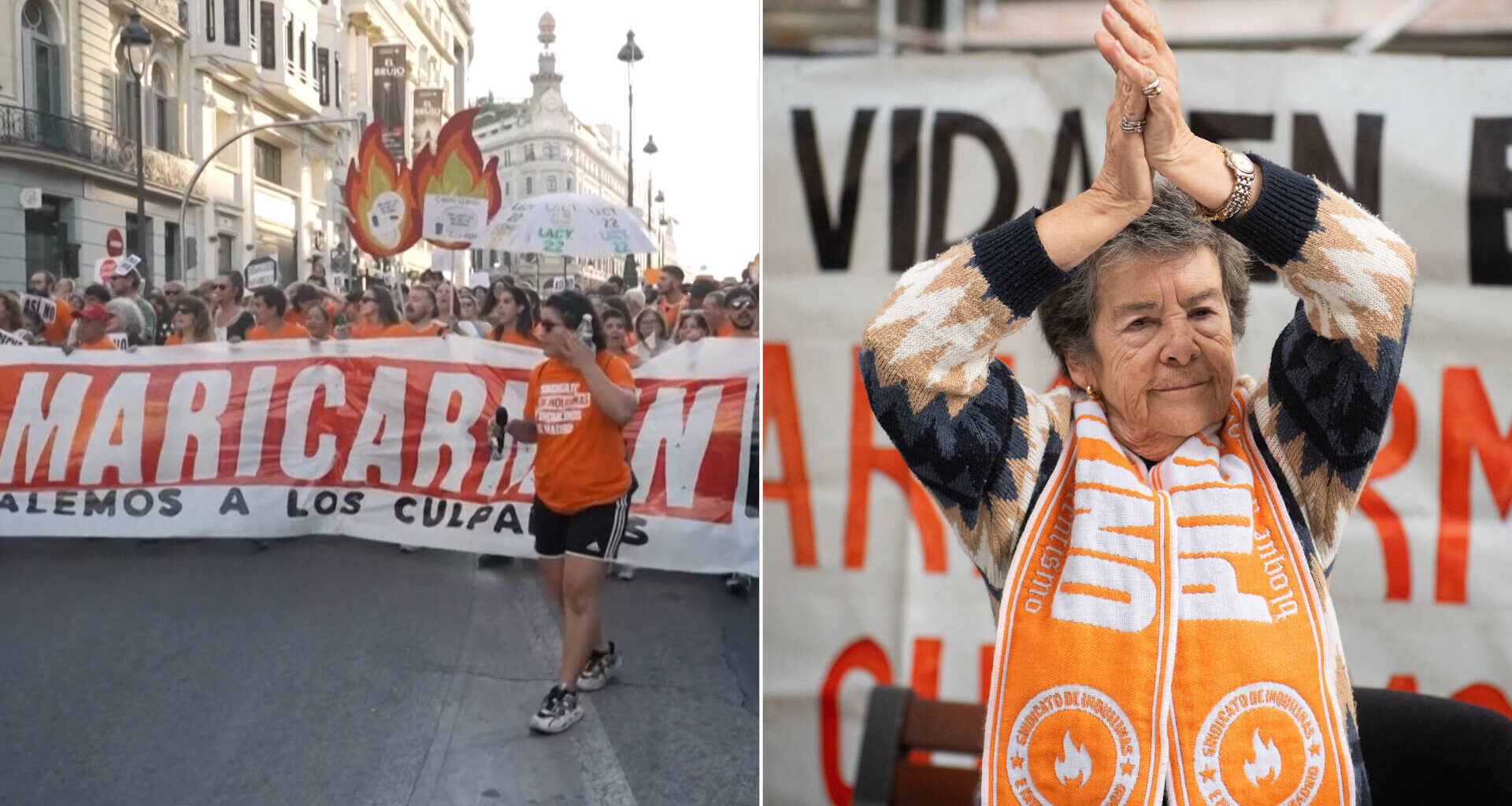
NERMEEN SHAIKH: We begin today’s show in Spain. Maricarmen has died. She’s the 87-year-old woman whose eviction from her home of 70 years in Madrid sparked mass protests across Spain. In September, she was forcibly removed from her apartment on a stretcher after the private investment company which owns the building hiked her rent. After massive public outcry, the landlord had agreed to allow her back into her apartment. María Carmen Abascal died on Wednesday just hours before she was set to sign a new rental agreement.
On Wednesday, protesters in Madrid gathered to shout “murderers” outside the Madrid parliament.
PROTESTERS: ¡Asesinos! ¡Asesinos! ¡Asesinos! ¡Asesinos!
AMY GOODMAN: Protesters in Madrid, Spain, responded with sadness and anger over the death of 87-year-old Maricarmen.
DIANA: [translated] She’s a woman who died of heartbreak. They killed her through heartbreak. Taking an 87-year-old woman out of her home after she had lived in the same house for 70 years, that’s killing someone. A year ago, she had such strength, such life, such enthusiasm. It was a joy to see her. And the moment she left that apartment, or, rather, the moment they took her out of that apartment, she had to be hospitalized. And today, she is gone.
So, breaking the news has been horrific, because most people here weren’t following the news. They were preparing food, helping people on the streets. It has been very hard. There have been many people crying, so many people trying to stay strong. But you can’t, not at a moment like this. …
Amid all this grief, I think it serves perfectly to show why we’re here, because we’re trying to fight so that no one has to feel that grief and that emptiness of feeling alone, and above all, so that people remember her, so that they remember that she died alone out of her home.
NERMEEN SHAIKH: Protesters also rallied in Barcelona on Wednesday to decry the death of Maricarmen.
PROTESTER: [translated] Maricarmen has died. But she didn’t just die. She was killed. The state killed her. The companies killed her. And she has been our inspiration. She’s pushed us even more to mobilize, to organize, to fight against those in power.
AMY GOODMAN: Spanish Prime Minister Pedro Sánchez expressed his condolences, writing, quote, “All my love to Maricarmen’s family and loved ones. A hug also to all those who today feel this loss as our own. Rest in peace,” the prime minister wrote.
After public outcry, Sánchez dissolved the Spanish parliament Monday after lawmakers refused to pass a broad emergency housing law including an eviction moratorium. Sánchez called a snap election for November 29th.
In a moment, we’ll go to Spain for the latest. But first, let’s hear Maricarmen in her own words, speaking on September 27th, after she was evicted, from her hospital bed.
MARÍA DEL CARMEN ABASCAL MARTÍN: [translated] I want what happened to me to help ensure that it doesn’t happen to other people. I wanted to lead people to fight so the unfair laws that allowed for my eviction can be changed. That is why on Tuesday Maricarmen’s Law must be approved, so they can take a first step to end with this. …
I would like to be there with you, to be camping with you, fighting with you, but I don’t have that chance. That is why, from here, I’m asking you all to be brave. Fight to defend what is yours. Please be careful. Keep camping as long as your bodies allow and as long as you want to.
AMY GOODMAN: That was María del Carmen Abascal, known by the world now as Maricarmen, speaking from her hospital bed.
We go now to Spain, where we’re joined by the independent Spanish journalist and former Democracy Now! producer María Carrión.
María, if you can talk about the significance of the death of MariCarmen, the response in the streets, and now what could lead to the fall of the Spanish government?
MARÍA CARRIÓN: Hi, Amy, Nermeen. Thank you so much for having me on.
Yes, Maricarmen has become a symbol, and it’s hard to believe that so much has happened in the last two weeks, since she was evicted on the 23rd of September after living in her home for over 70 years, and after activists had blocked the entrance to her building and her apartment with their own bodies, and resulting in massive police brutality, and then the images that have gone around the world of Maricarmen being taken out on a stretcher and into an ambulance and going into a hospital, where she’s been able to survive only for two weeks.
And this shows that what happens to vulnerable people and young people and people of every walk of life here in Spain when the interest of speculators is more important to those who govern than the well-being of ordinary citizens like Maricarmen. She literally put her body on the line for seven years, which is how long she fought this eviction for. And we’ve seen how she’s deteriorated over time, especially the last couple of weeks, but, really, since she began fighting for her home.
And so, she’s become a symbol, through her own loss of life, of the most extreme example of what happens to families and to individuals here whose homes are bought maybe by, you know, vulture funds or investment funds, and, like what happened to her, rent gets hiked by as much as five times what you can pay. This actual investment fund bought the apartment for very low cost because Maricarmen was living in it. It was a rent-controlled home, and they knew it very well, and that’s why the price was fixed so low. And then they proceeded to look for the way that they could legally expel her from her home.
And this is happening all over Spain. The same day that Maricarmen was evicted from her apartment, a family with two little kids was also evicted in Madrid. It’s a daily occurrence. And the encampments that have been born out of this outcry for what happened to Maricarmen, the people who are living on the streets now in small tents and putting their own bodies on the line, under, you know, rain and inclement weather, are saying this is enough.
And this is what has led to the protests. This is what led, finally, the Spanish government, which is considered quite progressive, to approve these housing decrees that got voted down in parliament. This is what resulted in last weekend’s massive protests all over Spain, which led Pedro Sánchez, the prime minister, on Monday to dissolve parliament and call for snap elections, and then proceed to approve these two decrees by a different system that happens once we don’t have a working parliament. And who knows what will happen from here to the 29th of November?
NERMEEN SHAIKH: So, María, before we conclude, if you could tell us who in Spain, what — is it a regional government, the state government — that is, the national government — or a municipal government that’s responsible for housing legislation and implementation?
MARÍA CARRIÓN: All of the above. So, we have national housing laws, which have to be approved by parliament. And in this case, these emergency decrees were not. But also, regional governments have to implement what the national governmental laws are. And in the case of conservative regional governments, including Madrid’s, which is extremely right-wing, they have refused to implement a lot of these housing laws.
But anyone, as the activists say, could have stepped in to prevent Maricarmen and so many other people from being evicted. So it’s a collective responsibility, which is why the street has said, “Enough. Everyone needs to be held responsible.” And all of these housing decrees are not even enough, because none of them basically are structural and go to the heart of the matter, which is that rents have gone up 80% in the last 10 years, while salaries have not kept up. Young people cannot leave their homes. They cannot become independent or start families. And this is what people are trying to change from the street.
AMY GOODMAN: I want to end with Maricarmen in her own words, speaking in May.
MARÍA DEL CARMEN ABASCAL MARTÍN: [translated] I’m 87 years old. I live on my own. I don’t have a family. And I have been living for 70 years in that house. A vulture fund bought it at the same price I would have been able to buy it. And in 2021, they took me to court because I have an old, lifelong rental contract. They tried to evict me in October 2025, and they stopped it. Now they will try to evict me on June 3rd. …
This government must understand people have the right to have a home, and they cannot evict people so vulture funds become rich without working.
AMY GOODMAN: That was Maricarmen speaking in May. She died on Wednesday. We thank María Carrión, independent journalist, joining us from Spain. And we will continue to cover this issue tomorrow on Democracy Now! Today, later tonight, there is a major march planned from the main plaza, where the encampments have been set up, to the apartment building where Maricarmen lived for over 70 years and was taken out by stretcher in her eviction, dying in the hospital on Wednesday.
Coming up, The AI Doc: Or How I Became an Apocaloptimist. Stay with us.
[break]
AMY GOODMAN: Patti Smith and Michael Stipe singing Patti’s iconic “People Have the Power” at Democracy Now!’s anniversary.