
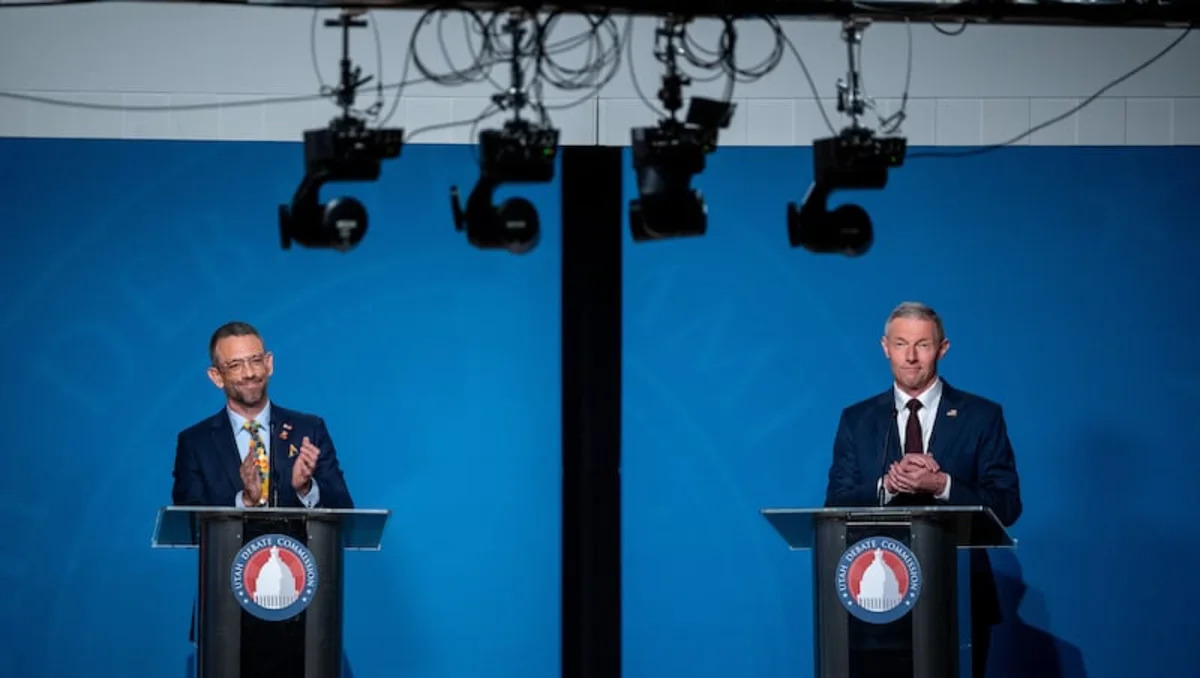
Two of the candidates for Utah’s new 4th Congressional District disagreed over policy solutions on issues like the cost of healthcare, housing affordability, data centers and gas prices at a debate Thursday night.
Rep. Mike Kennedy, the Republican candidate, and Jonny Larsen, the Democratic candidate, participated in a debate held at the Eccles Performing Arts Center on Snow College’s Campus in Ephraim, Utah.

Candidate for Utah’s 4th Congressional District Republican Mike Kennedy participates in a debate with Democrat Jonny Larsen at Snow College in Ephraim on Thursday, Oct. 8, 2026. | Trent Nelson
Ahead of the Nov. 3 election, the debate gave voters a preview of how the candidates would address issues the district is facing. The 4th District now includes Tooele, Millard, Sanpete, Juab and Sevier counties and parts of Salt Lake and Utah counties.
Throughout the debate Kennedy emphasized that he is for “making Washington smaller and Utah stronger.”
Larsen called himself a “blue dog Democrat,” and said lawmakers should be working on the “90% of issues that we all agree on instead of fighting over the 10% that we don’t.”
Larsen grew up in the district and is a Marine Corps veteran and has a background in IT.
Kennedy currently represents Utah’s 3rd District in Congress. He has practiced family medicine in Utah County for over 20 years and is an attorney. He began his first term in Congress in 2025 and previously served in the Utah Legislature.
The debate was hosted by the Utah Debate Commission and the moderator was Deseret News Executive Editor Doug Wilks.
The high price at the gas pump and the war in Iran
Candidates for Utah’s 4th Congressional District Democrat Jonny Larsen, left, and Republican Mike Kennedy participate in a debate at Snow College in Ephraim on Thursday, Oct. 8, 2026. | Trent Nelson
When asked about the high cost of living, specifically high gas prices and what they would do to bring those down, both candidates quickly turned to expressing their different views on the war in Iran.
Kennedy said that he understands families are struggling and he also feels the burden of filling up the tank. He then turned to the Iran war saying that the Iranian regime chants “death to America” and something has to be done about it.
“If this despotic regime were to get nuclear weapons, that it would not only be a threat to the United States of America but to the whole world,” he said, adding that he supports President Donald Trump in this war effort to bring safety to the world.
Kennedy also said that he recently sponsored the License to Drill act which is awaiting the president’s signature. Kennedy said that the bill — which would help energy permits be processed more efficiently — will help reduce the cost of gas.
Larsen jumped straight to the war saying “The immediate thing that we can do right now is end this illegal war.” He said ending the war will help bring down the price at the pump.
He said that his opponent has voted against war power resolutions multiple times. As a veteran, Larsen said that he understands the cost of going to war and the price that the military and their families pay.
When asked what role Congress should play in the war in Iran, Larsen said the Constitution gives Congress the power to declare war. He said that Kennedy gave up his constitutional duty by allowing Trump to continue this “illegal war.”
Housing affordability and the accessibility of the American dream
Candidate for Utah’s 4th Congressional District Republican Mike Kennedy participates in a debate with Democrat Jonny Larsen at Snow College in Ephraim on Thursday, Oct. 8, 2026. | Trent Nelson
A student at Snow College asked the candidates about what they will do to make homeownership more affordable, especially for the younger generation.
Kennedy shared that Congress recently passed the 21st Century ROAD to Housing Act. The legislation will stop institutional investors from buying up large tracts of single-family homes and help more individuals and families to buy their own home.
He also said that the tax cuts passed by Congress, including on tips and overtime, will help Americans keep more money in their pockets, allowing them to build or buy homes.
“We are working hard to get the federal bureaucracy out of the way,” the congressman said.
Larsen said that the federal government needs to stop the “egregious tariffs” that have been placed on goods coming in from other countries in order to make homes more affordable. He said this will make building supplies more affordable and accessible.
The Democratic candidate added that the government also needs to work with unions to see what can be cut to make homes more affordable.

Candidate for Utah’s 4th Congressional District Democrat Jonny Larsen participates in a debate with Republican Mike Kennedy at Snow College in Ephraim on Thursday, Oct. 8, 2026. | Trent Nelson
He also mentioned logging and said it’s important to work on a local level to have what is needed to build homes and create more jobs.
When asked if they believe the American dream is still alive, both candidates said it is.
Kennedy said he fully believes in the American dream and shared that he is the son of an immigrant and divorced parents, adding that through hard work and determination he was able to go to college, medical school and law school.
Larsen said that we need to make sure we keep the American dream in reach for all Americans because currently it is out of reach for many.
Data centers, energy production and environmental concerns in Utah
Candidates for Utah’s 4th Congressional District Democrat Jonny Larsen, middle, and Republican Mike Kennedy, right, participate in a debate moderated by Deseret News Executive Editor Doug Wilks, left, at Snow College in Ephraim on Thursday, Oct. 8, 2026. | Trent Nelson
This year, data centers have been a hot topic across Utah and the nation. The two candidates were asked whether data centers belong in the state.
Larsen said that many people in the district and the state as a whole are upset because they feel their voices aren’t being heard when it comes to this topic. He added that he is definitely not against innovation.
He said that the district’s constituents want a moratorium on the building of data centers “until we can actually come up with solutions to make them work better for everyone.”
Kennedy said that individual communities should be able to decide whether to build a data center or not. He said local communities don’t need the federal government to decide one way or the other, and that they should be trusted to make the right decision. He added that if people feel blindsided by the issue there will be a political price to pay.
“I believe in my local communities, that they will work with mayors, city councils, county commissions,” Kennedy said. “They’ll work with the citizens.”
The development of energy sources like oil, gas, nuclear and renewable energies is important to the economy of the district. The candidates spoke about how they will balance the production of energy with concerns over water, wildlife and recreation areas.
Larsen said that lawmakers should focus on making permits affordable and accessible while keeping things safe. He also said he believes the district should focus on solar energy.
Kennedy said there needs to be permit reform, adding: “We are an energy-rich society, but we act like we’re energy poor because of permits.”

Candidates for Utah’s 4th Congressional District Democrat Jonny Larsen, left, and Republican Mike Kennedy participate in a debate at Snow College in Ephraim on Thursday, Oct. 8, 2026. | Trent Nelson
He added that he is a big fan of geothermal, solar, wind, coal, oil, natural gas, and nuclear, and wants all of those options on the table.
The candidates also spoke about the water issues facing the state, specifically concerning the Great Salt Lake and the Colorado River Compact.
Larsen said that the Colorado River Compact needs to be revisited so that it reflects the current water flow. He also pointed out that much of the district’s water comes from underground, so caution needs to be taken with mining and drilling so that water isn’t contaminated.
He said he supports Utah’s agricultural industries and the government can help create a more efficient watering method so water can be conserved to help refill the Great Salt Lake.
Kennedy said that the federal government should not be brought into issues around the Colorado River and it should be worked out by the seven states involved.
He also added that he will work with the rest of Utah’s congressional delegation to make sure the state will receive the $1 billion the president promised to help the Great Salt Lake. He said that money will go toward leasing water rights and getting rid of invasive species that are harming the lake.