

Want to bookmark your favourite articles and stories to read or reference later? Start your Independent Membership today.
Already a member?
Log in
Is there a threat which requires a massive investment in air defence? Well, there were a raft of unexplained drone incursions in Poland, Germany, Denmark, the Netherlands, Belgium and Sweden in 2025. Anything “explosive”? No, but a lot of military air bases were targeted in what looked like reconnaissance.
One would be a fool to pretend there are no exposed UK targets for Russia – and Iran – to attack if they should choose to. Not just military airbases, either, but power stations, internet routing centres, even warehouses. There are two windowless buildings visible on Google Maps/Earth where a drone strike on either or both would take out mobile phone and internet activity in the south of the UK for days – all of it.
This week’s Conservative Party announcement of a plan to implement a “Britannia Shield” to provide protection against drone and missile attack does differentiate the party from Labour. The Tories now have a specific plan for this, while Labour’s existing programme is much more limited. It is little known or understood how badly defended the UK is against the whole range of air attacks, from $200 drones to hypersonic ballistic missiles. The truth is that the UK has critical gaps in its air and missile defences, and we are running out of time to fix them.
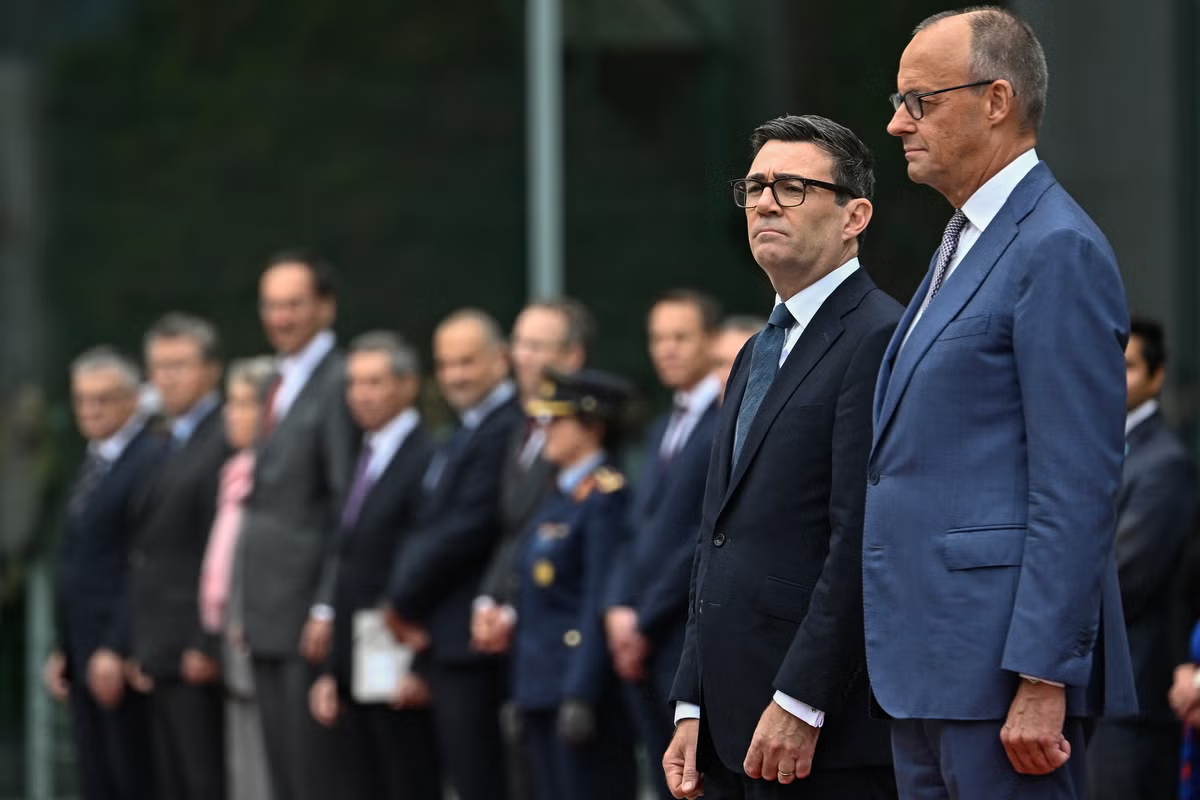
 German chancellor Friedrich Merz and prime minister Andy Burnham meet in Berlin (Getty)
Is £10bn enough to provide “protection [for] Britain from missile and drone attack”, as the Conservatives’ press release says? Put simply, no. As a comparison, Qatar, with a land area about the size of Greater London, has invested heavily in integrated air and missile defence. It bought Patriot systems in a deal worth almost $10bn, and there has been a proposed purchase of two of the US’s expensive ($6.5bn) THAAD anti-ballistic interceptor SAMs (surface-to-air missiles). And still this wasn’t enough to guarantee that nothing in Qatar was hit – with the country experiencing significant attacks on its liquefied natural gas production facilities.
As Mr Burnham heads to Germany to establish a joint UK-Germany security framework aimed at countering cyber attacks, sabotage and other hybrid threats from hostile foreign actors, particularly Russia, it is also worth also considering the position from Berlin.
Germany is spending billions on a major expansion of its air defences. It is buying more than 600 Skyranger systems in a programme worth more than €9bn, on top of the €3.8bn Arrow 3 ballistic-missile defence system. This is a start, not an end. France and Italy have both placed initial orders for SAMs of over €15bn. Denmark, Belgium, Sweden and the Baltic states are all investing many billions in air defence. So, let’s be clear, the UK is an outlier in not investing in ground-based air defence, not a leader.
To be really effective, the UK would need to ensure that it had ready stocks of radars and weapons (missiles, guns, jammers and laser weapons) that could cover not just London, but also the regional capitals (Edinburgh and Cardiff), as well as critical facilities, both military (Faslane nuclear submarine base) and civilian (Milford Haven for natural gas deliveries from the USA). To be clear, the £10bn pledge by the Tories wouldn’t cover even a basic list of critical national infrastructure targets.
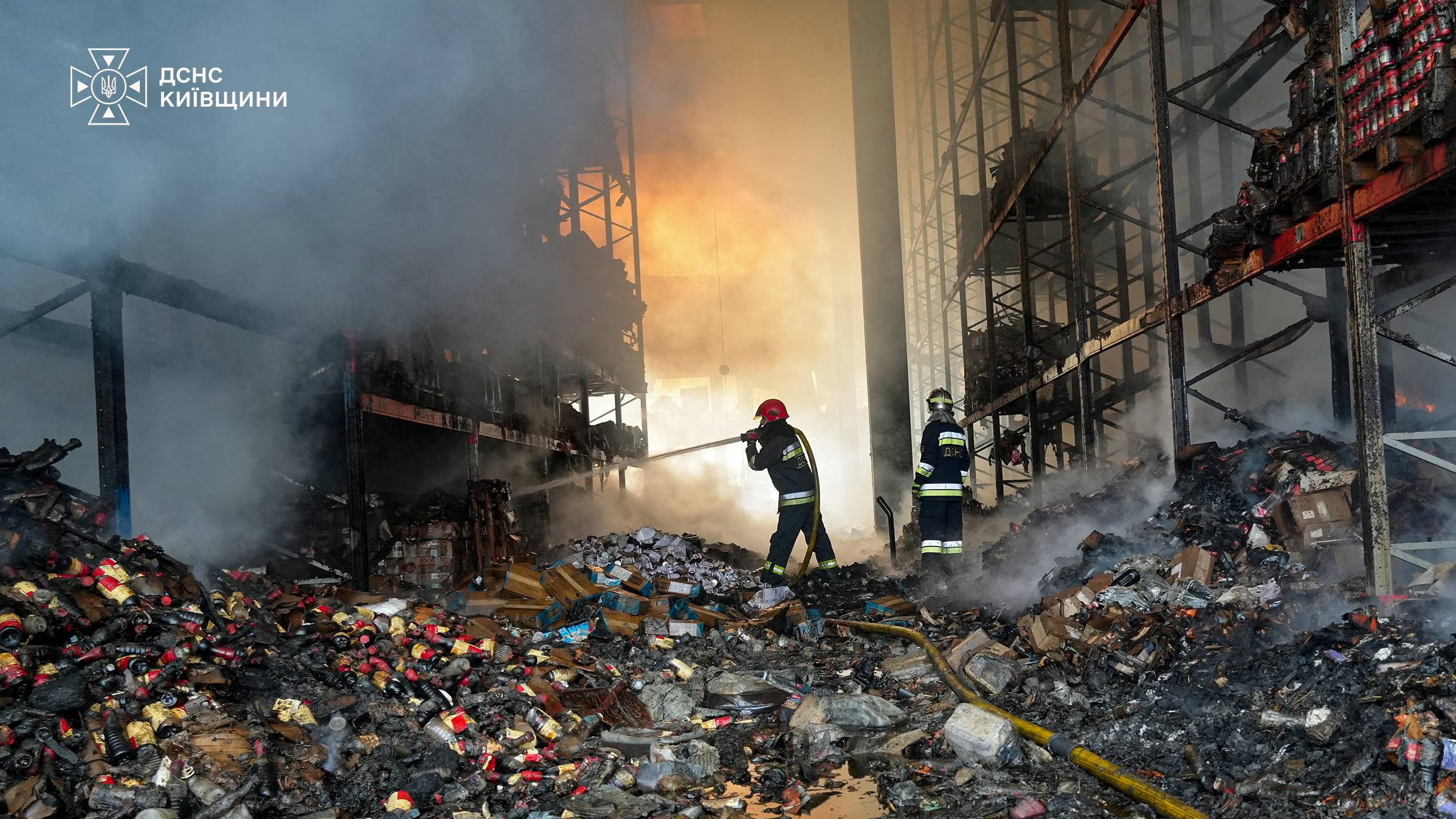 The aftermath of a drone attack in Kyiv (Emergency Service of Ukraine)
One advantage of a drone attack is that it is as close to risk-free military action as you can get. If the drone has Iranian markings, Russian and Chinese parts, and also parts from the West, can you ever prove that it was launched as a deliberate attack by Moscow? And even if the evidence starts to point the finger at Moscow (or Tehran…), are you going to war over this? Almost certainly not.
And Russia, Iran or whoever else doesn’t necessarily have to launch drones from their own territory. Could they be launched from “shadow fleet” ships – vessels with murky ownership and registration? This has happened before, including drones reportedly being used to monitor RAF Lakenheath, a US Air Force base in Suffolk, and when the French aircraft carrier Charles de Gaulle was in Malmö, Sweden, in February this year.
And the problem for the UK is that there are significant gaps in our ability to detect, track and respond to certain threats, particularly at low level and against mass drone attacks. The “old threat” might be from Russian bombers coming from the north, but the new threat could come from merchant ships in the Channel and Irish Sea. As things stand, the UK has critical gaps in its ability to see where threats might come from.
So, what would the UK have to buy for us to be properly protected? For the low-level drone threat, there are Thales’ Starstreak and Martlet short(er)-range SAMs. Built in Belfast, these are combat-proven in Ukraine and have also been used against Iranian drone threats in the Middle East – there’s no need to look anywhere else. But there needs to be an order, and this is lacking.
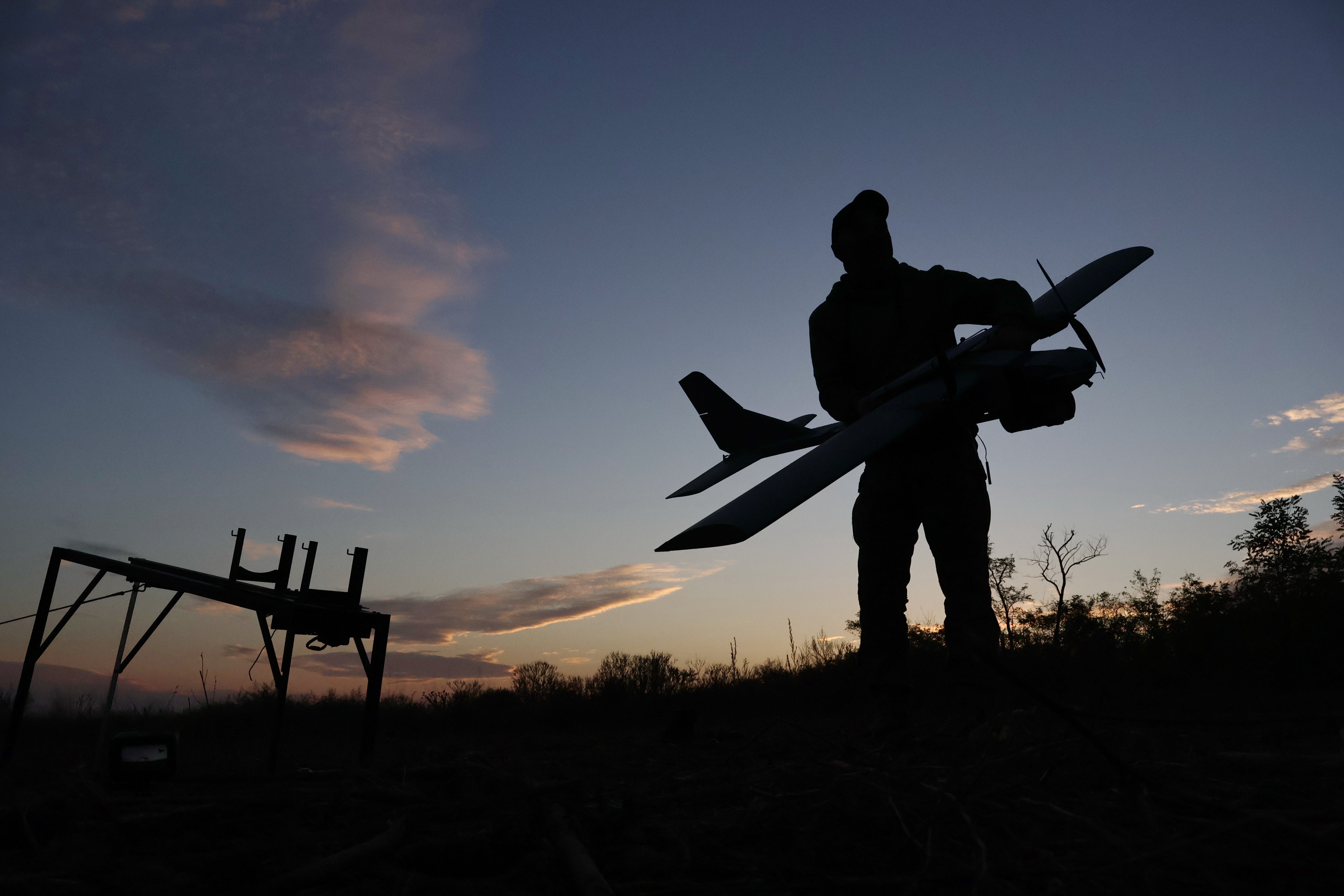 A Ukrainian serviceman launches a drone towards Russian positions at the front line in the Zaporizhzhia region, Ukraine, on Wednesday, 7 October 2026 (AP)
An order has been placed for counter-drone drones from Cambridge Aerospace. But the overall cost, millions of pounds, won’t provide the numbers of systems that would be required to deal with a Ukraine-style attack on the UK’s critical national infrastructure. It’s performative, not risk-based. The MoD boasts of a spend of £200m on counter-UAV systems, but many of these get sent – correctly – to Ukraine. The UK needs these systems, deployed around the country, and this is not happening.
Above that, we need an anti-ballistic missile system. The US supplies very expensive – some missile costs can be $12m-plus each round. Each. Missile. But, deliveries of these are now on hold while America re-stocks its magazines and supplies those of high-paying Gulf customers. Buying American will mean paying up-front and waiting for more than five years for delivery.
Could the UK buy the US-Israeli anti-ballistic missile system that has been bought and deployed by Germany? In theory, yes. But the current political smell suggests that the government wouldn’t buy an Israeli missile. Further, Tel Aviv, like the US, is building its own stocks so deliveries for export customers cannot be guaranteed.
So, is the UK “safe” from drone or missile attack? Absolutely not. Is there a threat? Yes – as has been demonstrated over the past few years. Do we need a home defence system? Yes. Are there any credible plans for this? No. Did the Defence Investment Plan put up enough money to fund this? No.
-80e7c735.jpeg) Lord Kim Darroch and General Sir Richard Barrons in Sky’s ‘Wargame’, which simulated an attack by Russia on UK soil (Sky)
Lord Kim Darroch and General Sir Richard Barrons in Sky’s ‘Wargame’, which simulated an attack by Russia on UK soil (Sky)
In July 2026, General Sir Richard Barrons, the former commander of UK Joint Forces Command, gave evidence to the Commons Defence Committee and made the important point that the UK does not own the clock on when we need to be ready.
“I think that is set by Russia, likely on the back of an outcome in Ukraine, which is why people talk credibly about 2030 or even sooner,” he said, adding: “That is an uncomfortable view in Whitehall; you may have to make different spending choices faster than you are comfortable with because your opponents have decided that is how the game will be played. That removes the leisure from the 10-year programme.”
A comprehensive “Iron Dome” is extraordinarily expensive – Barrons stated that an IAMD of his “dreams is probably £120bn over 10 years”. Prof Steven Barrett, the CEO of Cambridge Aerospace that has been developing interceptor missiles, told the BBC £10bn was a “significant commitment” but the exact cost of the project would depend on the details of the Conservatives’ proposal.
He said that it would not be practical for the system to defend “every square inch” of UK territory and a more plausible set up would cover “significant parts of the population in key high density areas”. He also said there needed to be a focus on protecting critical national infrastructure, adding that a “huge amount of damage” could be done if data centres used by transport and health systems came under attack.
With a stagnant economy in a very large public sector, the Treasury has some big decisions to make. But can they really afford to ignore the nightmare scenarios that are being pulled into sharp focus every day? The kind of nightmare that was on full display in Sky’s recent four-part series The Wargame, in which Barrons appeared and which simulated an attack by Russia?
Performative defence policies are not going to be enough to protect us. So, if there is the chance of a conflict with Russia before 2030, you’d better stock up on tinned goods and water – because the effect of a Russian (or Iranian) attack on the UK will be empty shelves and no communications. Unless the warnings are heeded and orders for air defence systems are placed today.