
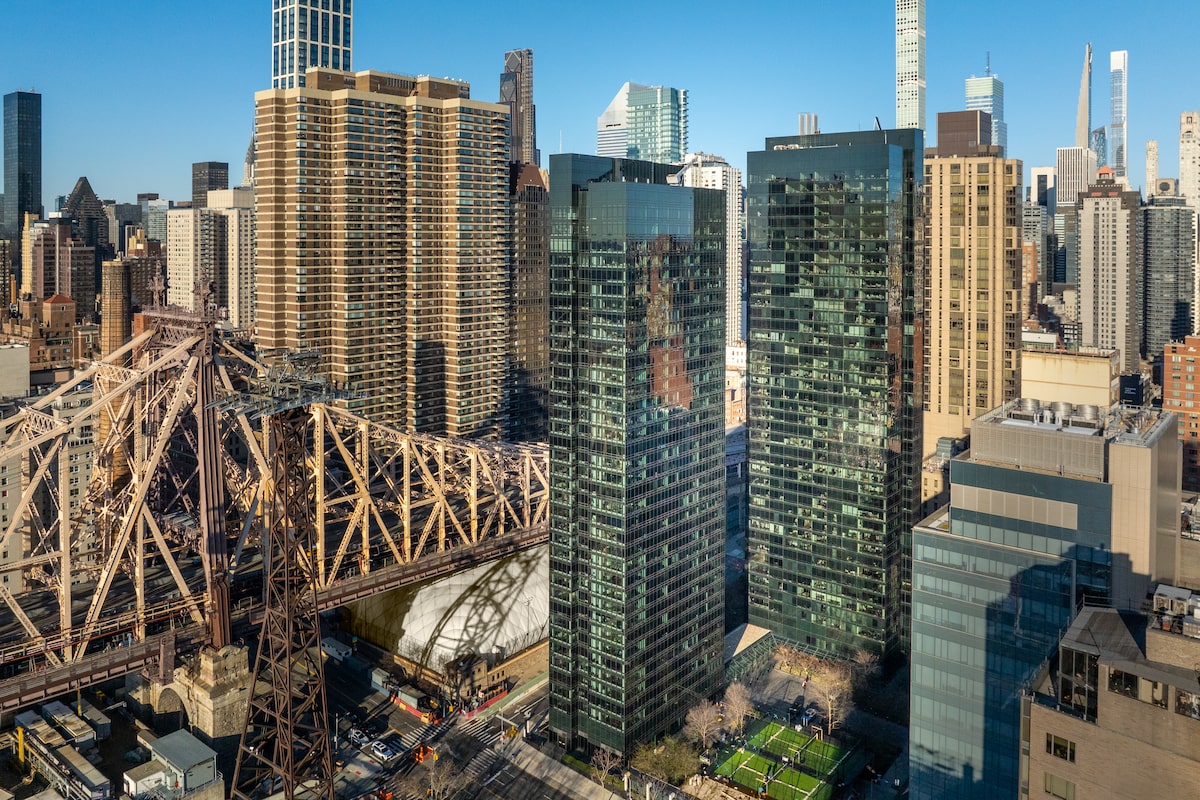
GO Residential REIT’s One Sutton Place North and Two Sutton Place North in Manhattan, New York. Major unitholders of H&R REIT have come out against its proposed takeover by GO.Evan Joseph/Supplied
RBC Global Asset Management, one of H&R Real Estate Investment Trust’s HR-UN-T largest unitholders, will vote against H&R’s proposed takeover by another REIT, adding a prominent voice to a growing campaign against the deal.
The bank, which currently owns 9.3 million H&R units, said Thursday it will vote against the takeover by GO Residential Real Estate Investment Trust GO-U-T. It declined to elaborate on its reasoning.
A day earlier, Boston-based Mill Pond Capital also came out against the deal. Mill Pond beneficially owns 2.2 million H&R units.
H&R agreed to a complex deal in August that is ultimately a takeover by GO Residential. But it also involves a consortium of other buyers that includes Blackstone Real Estate, Crestpoint Real Estate Investments Ltd., and CRAL, a company controlled by relatives of H&R founder Tom Hofstedter.
Both H&R’s units and GO’s units have lost value on the Toronto Stock Exchange since the deal was announced in mid-August, with H&R down 12 per cent and GO down 20 per cent. The S&P/TSX Capped REIT Index is down 7 per cent over the same period.
Mill Pond raised several investor concerns about the deal in a letter to Stephen Gross, H&R’s lead independent board trustee, on Wednesday. They included confusion around a partial sale of assets to Mr. Hofstedter, as well as fears about preferential treatment for his deal.
The takeover involves GO acquiring H&R’s residential properties across three U.S. Sunbelt states and the New York metropolitan area, among other assets; Blackstone, Crestpoint and PSP Investments each acquiring some of H&R’s Canadian industrial properties; and CRAL acquiring H&R’s remaining “non-core assets.”
H&R unitholders will receive a mix of cash and GO units if the transaction is approved. However, Mr. Hofstedter, who is one of H&R’s largest unitholders, has a different form of payment and his units will be cancelled, which means he isn’t rolling his equity into GO.
“No other unitholder was offered consideration in that form,” Mill Pond wrote in its letter.
Canadian takeover deals down sharply in third quarter, while corporate fundraising soars
GO’s involvement has also caused frustration. Because of its financial limitations around new debt, GO can only pay so much in cash, and therefore must issue some GO units as a form of payment.
Some existing GO unitholders who disliked the deal responded by selling units, because it amounts to a reverse takeover of sorts. If the acquisition goes through, H&R unitholders will own roughly two-thirds of the combined company. The deal also adds exposure to the U.S. Sunbelt; currently, GO predominately owns luxury multifamily properties in New York.
GO Residential went public at US$15 a unit on the TSX in 2025 – its IPO was priced in U.S. dollars – and its units currently trade for US$7.78 apiece.
In a takeover circular filed with regulators on Thursday, H&R’s independent board trustees justified the deal by saying that over two years, they tested available alternatives – including a stand-alone repositioning, an industrial sale, a residential spin-out, and a formal market check involving approximately 18 potential counterparties.
“Ultimately, no other unconditional, en bloc offer emerged,” they wrote, referring to the consortium deal that found buyers for all of H&R’s assets. “In the view of the independent trustees, the transaction is the best available outcome: H&R REIT unitholders receive immediate cash, a tax-efficient rollover into a scaled multi-residential focused real estate investment trust in which H&R REIT unitholders will receive a majority of the outstanding GO REIT Units upon closing of the transaction, and the potential to participate in value discovery that may be meaningful as the combined platform re-rates toward its peers.”
H&R REIT has traded on the TSX for decades and made its name as a diversified real estate company that owned retail, office, industrial and multifamily properties.
The REIT has repositioned itself over the past five years because investors fell out of love with its asset mix. Its asset sales have included spinning out 27 enclosed malls into the newly created Primaris REIT and selling some major office assets, such as the Bow Tower in Calgary and a Bell Canada office campus in Mississauga.
In 2025, the company received multiple permutations of partial takeover offers, but the board of trustees decided against a deal. Takeover talks resumed in March, 2026, and concluded in August with the multiparty transaction.