
(Bloomberg) — It’s one of the least understood signals in the fixed-income world, but lately, everyone on Wall Street is abuzz about what it means as it reasserts itself in the market.
Most Read from Bloomberg
It’s known as the term premium, or the extra payout that investors demand in return for the risks of owning 10-year Treasuries instead of just rolling over short-dated securities for the same amount of time. How exactly to measure it varies. So do the explanations for its moves.
What’s not in question is that during the past few weeks it spiked to levels not seen in over a decade and drove the latest leg of the bond selloff that’s sent US Treasury yields to a 24-year high. And that, in turn, is fanning fears of a potential shift that will heap pressure on an already battered market and keep borrowing costs elevated across the economy.
That term premium is essentially protection against unpredictable turns, ranging from geopolitical shocks to government fiscal crises, that could hit the market before long-term bonds come due.
It’s distinct from the current outlook for inflation and the direction of monetary policy, both of which are also reflected in yields. Because the premium isn’t directly observable and must be inferred, Neel Kashkari, the president of the Federal Reserve Bank of Minneapolis, once likened it to dark matter, the invisible substance physicists say explains some cosmic mysteries.
“There’s multiple ways to calculate it, but they’re all going higher,” said Frank Rybinski, head of macro strategy at Aegon Asset Management. “And what that tells me is that this move has staying power.”
What Bloomberg’s Strategists Say…
“The sharp repricing of term premium embedded in Treasuries — with 10-year term premium breaking out to a 12-year high — suggests investors are demanding greater compensation for holding duration amid mounting fiscal and geopolitical uncertainty.”
— Frank Monkam, Macro Markets Strategist
Click here for more
There was no clear-cut catalyst. Barclays researchers led by Demi Hu said macroeconomic uncertainty, breakdowns in the usual correlations between stock and bond moves, the rising supply of debt and worries about fiscal policy are all things that figure into the term premium and could be playing a role.
Story Continues
Neil Shearing, the group chief economist at Capital Economics, said the recent move could reflect technical factors, like portfolio adjustments at the end of last month, or the side effects of mounting concern in Europe about France’s debt load. Stephen Douglass, chief economist at NISA Investment Advisors, pointed to some indications of stress in credit markets, as well as broader doubts among investors over the benefits of holding fixed-income assets when inflationary shocks are becoming more frequent.
“It’s not a simple story,” said Douglass, who warned against reading too much into short-term moves. “But I would say that I think we are in a rising term-premium environment.”
That’s a worry for bond bulls. A structurally higher term premium could keep long-term interest rates elevated, preventing the market from rebounding from its slump.
The metric came down steadily in the 1990s, when increasing globalization was exerting a deflationary force, and fell further still during the 2010s as central banks’ quantitative-easing programs distorted global bond markets by flooding them with cash. It dropped as low as negative 1.7% in March 2020, when investors were rushing for the safety of bonds, before rising consistently into positive territory after late 2024, according to a model created by economists working for the New York Fed.
It had remained relatively steady during most of the selloff that started after the US launched its war against Iran in late February.
Then, in mid-September, it started surging. The New York Fed model shows it climbed around 40 basis points to about 0.98%, the highest since 2014 and more than enough to account for the nearly 30 basis-point rise in 10-year Treasury yields over that time. Bloomberg Economics’ estimate shows a similar increase. Another, which incorporates economists’ forecasts for Fed policy into the calculation, has climbed to 1.08%, the most since 2010.
That break higher came as other drivers of prices were little changed. Inflation expectations have been stable. The Fed’s unanimous decision to raise rates last month quelled some concerns about its commitment to reining in consumer prices. And oil, while elevated at over $100 a barrel, has been holding in a narrow range.
A sustained term-premium increase would add to the pressure on the market from elevated inflation, robust economic growth, plus a flood of borrowing from companies investing in artificial intelligence and from deficit-running governments around the globe. Fed Bank of Dallas President Lorie Logan last week said a rising term premium, by pushing up borrowing costs, may slow the economy and reduce the need for the central bank to hike rates.
“The bond market is no longer waiting for the Fed to tighten financial conditions,” said Florian Ielpo, head of macro at Lombard Odier Investment Managers. “High term premia, inflation uncertainty and government borrowing needs can keep longer-dated yields restrictive even when the expected path of short rates becomes less aggressive.”
One reason behind the latest moves may be spillover effects from the disorderly selloff in French bonds. Some also point to hedging activity by holders of mortgage-backed securities that can temporarily exaggerate market moves.
Yet behind it may be lurking longer-term risks that have been building up in the global economy. One is that shocks to the supply of energy and other commodities — like those that followed Russia’s invasion of Ukraine and the US war on Iran — may become more frequent as geopolitical divisions widen.
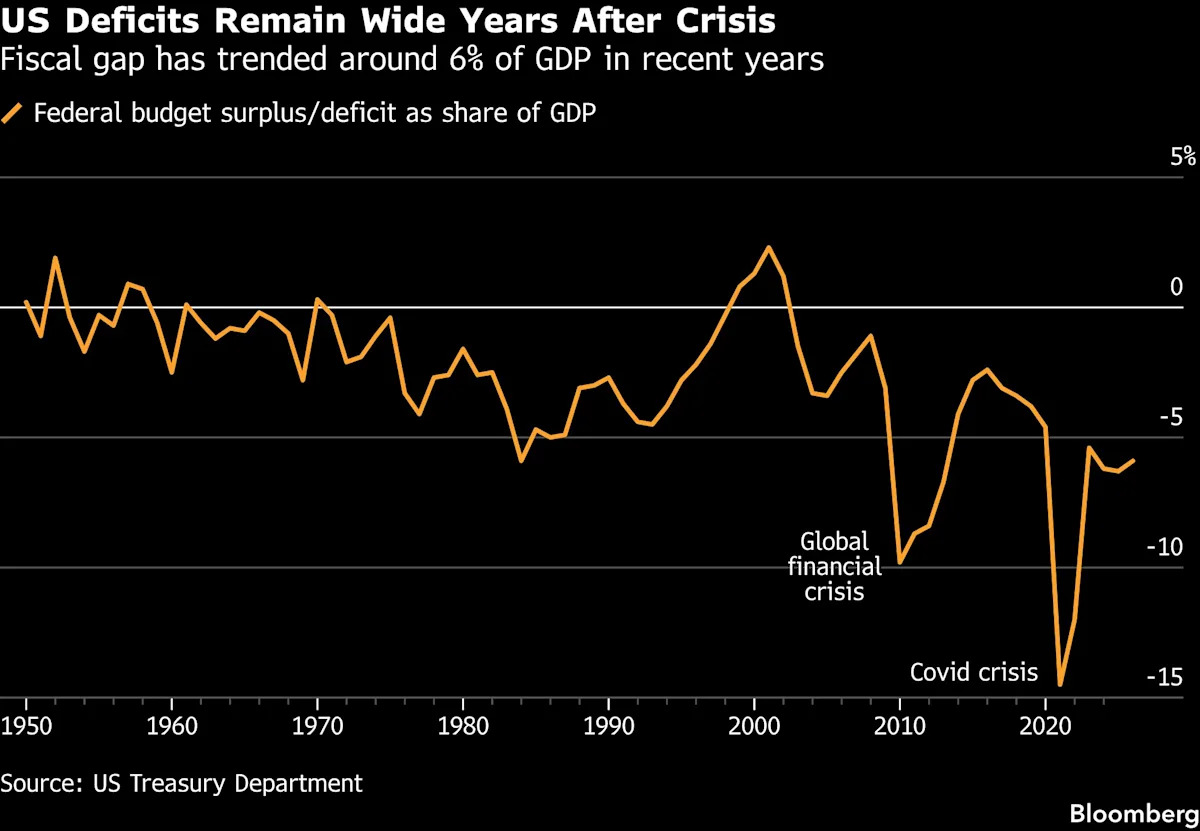
Then there’s the federal government’s $2 trillion budget deficit — the equivalent of about 6% of the nation’s gross domestic product, an historically high level of stimulus at a time of low unemployment and solid economic growth. While the Trump administration has repeatedly vowed to rein in spending, there’s little expectation that will happen anytime soon.
“The macro picture is full of risk which should translate into a healthy term premium,” said Mark Malek, the chief investment officer at Siebert Financial. “Any time we have a headline flair up, investors are reminded of that risk.”
–With assistance from Christopher Anstey.
Most Read from Bloomberg Businessweek
©2026 Bloomberg L.P.