
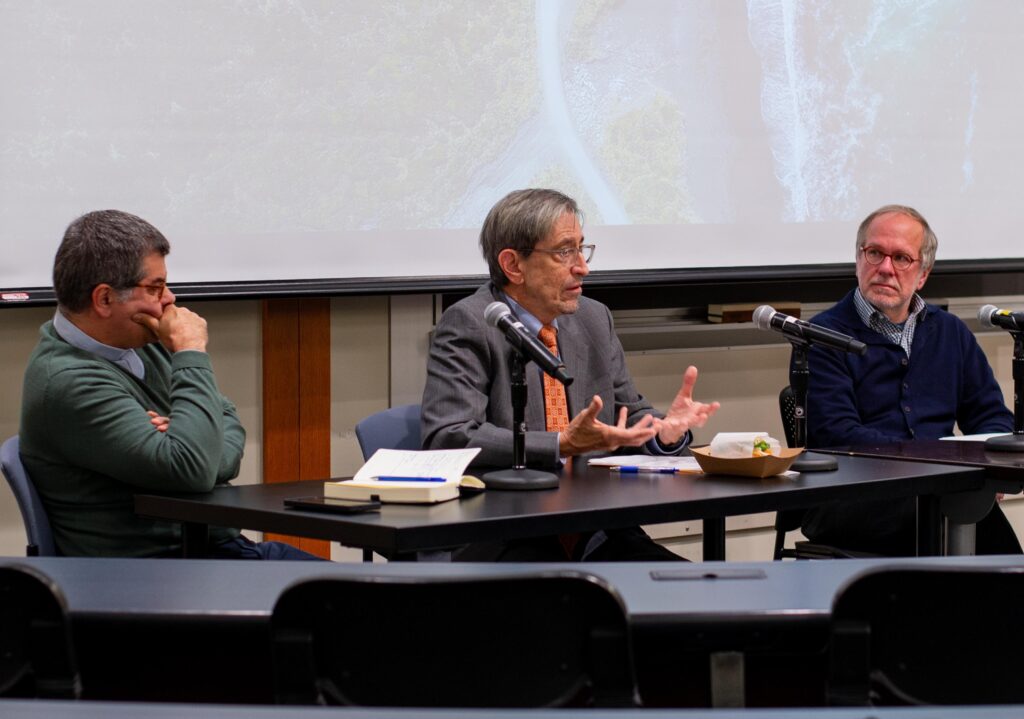
As tensions surrounding the United States’ conflict with Iran continue to raise questions about the limits of government authority and the role of international law, three Boston College Law School professors gathered for a discussion, hosted by the International Law Society and the National Security Law Society, examining the conflict through constitutional, economic, and humanitarian perspectives.
The event, titled “A Primer on the Iran Conflict: The Current Legal Issues,” featured professors Thomas Crocker, Frank Garcia, and Afonso Seixas-Nunes, SJ, each bringing expertise in a distinct area of law. Together, they explored the legal frameworks governing military intervention, the growing use of economic sanctions as instruments of warfare, and the challenges emerging technologies pose for accountability on the battlefield.
The Constitutional Question: Who Has the Power to Wage War?
Professor Thomas Crocker opened the discussion by examining the separation of powers issues raised by the conflict. At the center of his analysis was a fundamental constitutional question: What constitutes war, and who has the authority to authorize it?
Under Article I of the Constitution, Congress possesses the power to declare war and control federal spending. Article II, meanwhile, grants the president executive authority, which has historically been interpreted to permit certain limited military interventions without congressional approval.
Crocker explained that the distinction between a limited military engagement and a full-scale war is central to determining whether presidential action requires congressional authorization. Historically, presidents have relied on executive authority to conduct limited military operations in pursuit of national security interests, including interventions in Libya and Syria.
However, determining whether an engagement qualifies as war requires an assessment of its duration, scope, objectives, and potential for escalation.
Applying this framework to Iran, Crocker considered arguments that the conflict falls within the president’s unilateral authority because of its limited objectives, anticipated duration, and absence of American ground troops. Yet he also questioned whether the conflict’s broader implications and potential for escalation challenge that characterization.
Crocker further examined this under the War Powers Resolution, which places statutory limits on the president’s ability to engage in hostilities without congressional authorization. He raised concerns about the administration’s apparent interpretation that interruptions in hostilities could effectively restart the statutory timeline governing military engagement.
“As long as there is a pause in hostilities, you can restart the clock, and this could go on indefinitely,” said Crocker. “This seems to be the Trump administration’s position here.”
Ultimately, Crocker’s analysis returned to a broader concern about the balance of power between the executive and legislative branches: If presidents can repeatedly engage in military operations without congressional authorization, what meaningful role remains for Congress?
Economic Sanctions: When Trade Becomes a Weapon
Professor Frank Garcia shifted the conversation from military authority to the economic consequences of the conflict. He examined how international trade and financial systems, traditionally viewed as mechanisms for cooperation and peace, have increasingly become instruments of geopolitical coercion.
Economic sanctions are not new, Garcia explained. What distinguishes the present moment is their growing reach and intensity, particularly as the United States uses its influence over the global financial system to pressure not only Iran but also foreign businesses and governments that maintain economic relationships with it.
He distinguished between primary sanctions, which restrict direct economic dealings with Iran, and secondary sanctions, which extend pressure to entities outside the United States. By threatening access to American financial markets and dollar-based transactions, these measures can influence economic activity far beyond US borders.
“So what we really see is a growing effort to use the leverage the US financial system gives to the United States to essentially coerce any country that might consider doing business,” said Garcia.
Garcia situated these developments within what he described as a broader rupture in the post-World War II international economic order. The United States, once a leading architect of institutions designed to encourage economic interdependence, is increasingly using that same interdependence as a source of leverage.
The conflict also demonstrates that economic coercion is not exclusively available to powerful nations. Garcia pointed to Iran’s strategic position along the Strait of Hormuz, a critical passage for global energy shipments, as an example of how geographic advantages can provide leverage even amid substantial differences in military and economic power. Disruptions to energy supplies can drive up prices, increase economic instability, and encourage protectionist trade policies, potentially creating a cycle of escalating economic and geopolitical tensions.
For Garcia, these developments raise a deeper question about the relationship between trade and peace. Although economic interdependence has long been understood as a means of reducing conflict, the Iran conflict illustrates how those same connections can be exploited during periods of hostility. “What we see now is that trade is no longer an alternative to warfare, but a tool, where essentially that trade is part of the modern value,” he said.
Nevertheless, Garcia suggested that economic relationships may still offer opportunities for negotiation and conflict resolution, particularly if international institutions can foster a more equitable and mutually beneficial system of cooperation.
International Humanitarian Law and the Challenges of Artificial Intelligence
Professor Afonso Seixas-Nunes, SJ, who joined the BC Law faculty this academic year, brought the discussion to the international legal rules governing the use of force and the conduct of warfare.
Seixas-Nunes began by distinguishing between two fundamental questions: whether a state is legally justified in using military force and whether its conduct during an armed conflict complies with international humanitarian law.
Under the international legal framework established after World War II by the United Nations, a state’s ability to use force is constrained by rules governing self-defense and international security.
Seixas-Nunes emphasized the importance of distinguishing between a serious national security threat and an imminent threat that might justify military action. The existence of a potential danger, he explained, does not automatically establish a legal basis for the use of force.
He then turned to the increasingly complex relationship between artificial intelligence and military targeting decisions.
Using the Feb. 28 attack on a school in Iran as a case study, Seixas-Nunes examined how international humanitarian law distinguishes civilian objects from legitimate military targets. A building ordinarily protected as a civilian facility may lose that protection if its use transforms it into a military objective.
“So this school, from the moment that Iran used this school to keep military facilities, it becomes a military target and a legitimate target,” said Seixs-Nunes.
However, determining whether a target retains that status becomes particularly challenging when military operations rely on intelligence databases or automated targeting systems that may contain outdated information.
Seixas-Nunes explored the possibility that an artificial intelligence system could identify a target based on information that no longer accurately reflects its civilian or military status. Such circumstances raise difficult questions about whether a targeting error constitutes a violation of international humanitarian law and who, if anyone, should bear legal responsibility.
The Continuing Role of Law in International Conflict: During the question-and-answer portion of the event, the professors revisited the relationship between national security, legal authority, and accountability. Although the professors approached the conflict from different legal disciplines, their analyses converged on a common concern: the ability of existing legal institutions to constrain the exercise of power.
Photograph by Kasra Raffi ’28